
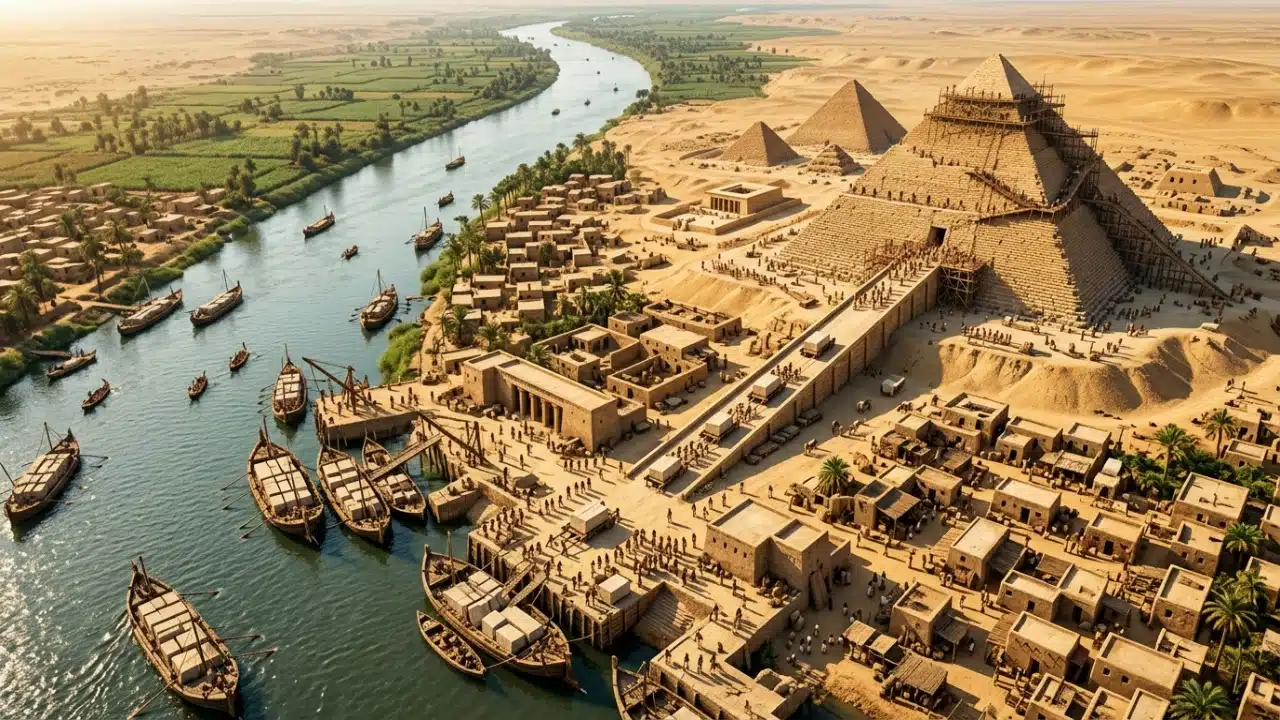
How Were the Pyramids Built? What Modern Science Just Proved
The Question That Never Goes Away
It is the most asked question in all of archaeology. It has been asked by ancient Greeks, by medieval Arab scholars, by Renaissance engineers, by Enlightenment scientists, and by every generation of curious minds since. How were the pyramids built?
The Great Pyramid of Giza contains approximately 2.3 million stone blocks. The average block weighs 2.5 to 15 tonnes. The heaviest blocks, used in the internal chambers, weigh up to 80 tonnes. The entire structure rises 138 meters and covers 53,000 square meters of base. It was built roughly 4,500 years ago by a civilization that had no steel, no diesel engines, no cranes, and no wheels capable of bearing serious weight on sand.
For over a century, the standard answer to how were the pyramids built was the ramp theory: workers dragged blocks up massive earthen ramps to each successive level. It was a plausible answer. It was also deeply problematic. An external ramp long enough and shallow enough to haul 80-tonne blocks to the pyramid’s upper levels would itself have required more material than the pyramid it was serving. Archaeologists have found no physical evidence of such a structure anywhere at Giza.
Between 2024 and 2025, that old answer has been systematically replaced by something more sophisticated, more evidence-based, and considerably more impressive. The new science of how were the pyramids built involves a lost river, a hydraulic elevator, an internal spiral ramp, and a counterweight network that could place a stone block every sixty seconds.
AEO Quick Answer: How Were the Pyramids Built
How were the pyramids built according to modern science?
Modern research suggests how were the pyramids built involved multiple complementary engineering systems rather than one single method. A May 2024 study in Nature’s Communications Earth and Environment identified the Ahramat Branch, a 64-kilometer lost branch of the Nile that ran directly alongside 31 pyramid sites, explaining stone transport by water. A 2024 PLOS One study proposed a hydraulic elevator system at the Step Pyramid of Djoser. Computational modeling published in npj Heritage Science identified an internal spiral ramp system as the most viable construction method for raising blocks to upper levels. And researcher Dr. Simon Scheuring of Weill Cornell Medicine proposed a counterweight network capable of placing a block every 60 seconds.
Who built the pyramids?
The pyramids were built by ancient Egyptian workers, not slaves. Archaeological excavations at Giza by Mark Lehner and Zahi Hawass from the 1990s onward revealed an entire worker village with bakeries, breweries, hospitals, and burial sites. The Diary of Merer, a papyrus dated to 2560 BCE discovered in 2013 at Wadi al-Jarf and considered the oldest logbook ever found, records a team of 200 elite workers transporting fine white limestone by boat from Tura quarries to Giza. The workers were skilled, organized, fed by the state, and received medical care. An estimated 20,000 to 30,000 workers were involved at peak construction.
What is the Ahramat Branch and how does it explain how were the pyramids built?
The Ahramat Branch, named from the Arabic word for pyramids, was a 64-kilometer-long active branch of the Nile River that ran along the western desert plateau where Egypt’s major pyramids stand. It was identified in May 2024 by Eman Ghoneim of the University of North Carolina at Wilmington and published in Nature’s Communications Earth and Environment. The study found that 31 pyramids had causeways running perpendicular to the branch and terminating at its banks, suggesting valley temples functioned as river harbors. The Nile today is four miles from Giza. In pyramid-building times, the Ahramat Branch brought water directly to the construction sites.
How did Egyptians lift heavy blocks to the top of the pyramids?
The exact method remains debated, but the leading current theories in the question of how were the pyramids built are the internal spiral ramp proposed by researcher Vicente Luis Rosell Roig in npj Heritage Science, supported by a notch found in the unfinished pyramid at Abu Roash that matches a ramp position, and the counterweight network proposed by Dr. Simon Scheuring of Weill Cornell Medicine, who calculated that workers could position a 2.5-tonne block every 60 seconds using organized pulley and counterweight systems built into the pyramid’s own structure as it rose.
The River That Was Hidden for Four Thousand Years
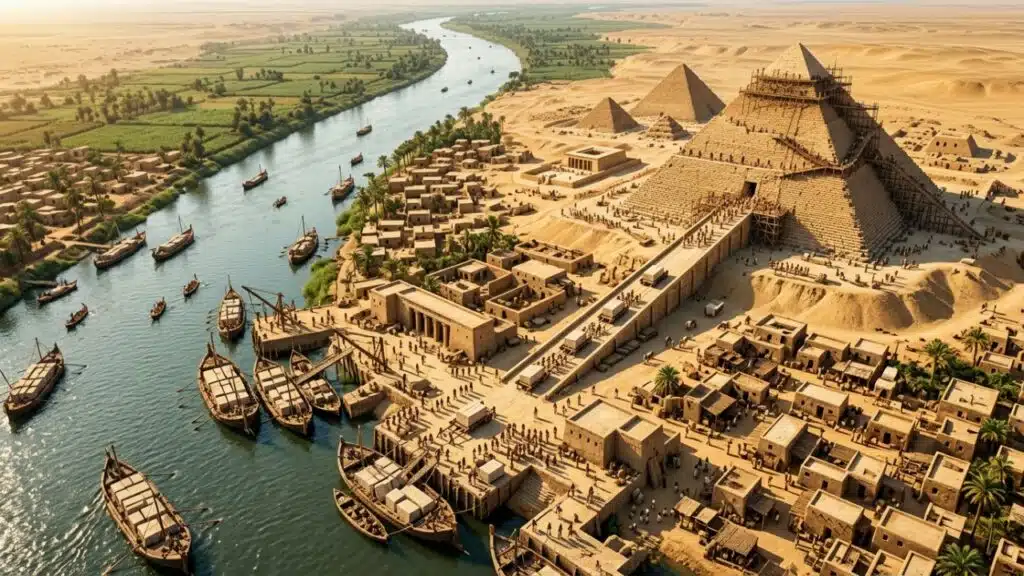
The single most important recent discovery in understanding how were the pyramids built is not inside the pyramids. It is underground.
Today, the Nile River runs approximately four miles east of the Giza plateau. That distance has always been the central logistical puzzle of how were the pyramids built. Moving millions of stone blocks across four miles of desert, using sledges pulled by human teams over sand that shifts and resists, would have consumed an almost inconceivable quantity of labor and time. The mathematics never fully worked.
In May 2024, Eman Ghoneim of the University of North Carolina at Wilmington published a study in Nature’s Communications Earth and Environment that changed the entire framework. Using radar satellite imagery, geophysical surveys, and deep sediment core sampling, Ghoneim and her team identified the buried remains of a major ancient river channel running along the western desert plateau where Egypt’s pyramid chain is concentrated.
They named it the Ahramat Branch, from the Arabic word for pyramids. The channel was 64 kilometers long and between 200 and 700 meters wide, comparable in scale to the contemporary Nile itself. Its banks, confirmed through sedimentary evidence, were active and operational during the construction period of the Old and Middle Kingdom pyramids. And when the researchers overlaid the channel’s path against the locations of 31 pyramids, they found something that settled the question immediately.
Causeways running from the pyramids toward the river. Valley temples positioned directly on the ancient banks. The raised stone approaches that archaeologists had always identified as ceremonial processional routes were, in origin, functional harbor access roads. Each pyramid’s causeway ran perpendicular to the Ahramat Branch and terminated at what would have been a riverbank. The valley temples, long interpreted as ritual spaces at the base of each pyramid complex, were river harbors where stone-laden barges could dock and unload directly at the construction site.
The answer to how were the pyramids built begins on water, not sand. The Egyptians did not drag millions of tonnes of stone across miles of desert. They floated them to the site on a river that has been buried under farmland and desert for thousands of years, invisible to every generation of researchers who stood on top of it and wondered how the work had been done.
The Workers Were Not Slaves
Before addressing the engineering systems, one persistent misconception about how were the pyramids built needs to be put to rest permanently.
The pyramids were not built by enslaved people. This idea, which entered popular culture through ancient Greek accounts and was amplified by certain later traditions, has been comprehensively disproved by the physical archaeology of the site itself.
Beginning in the 1990s, Mark Lehner of the Oriental Institute and Zahi Hawass of the Egyptian Supreme Council of Antiquities excavated the worker village at Giza, a settlement of considerable scale located south of the pyramid complex. What they found was not a barracks or a labor camp. It was a functioning community with bakeries capable of producing enough bread for thousands of workers daily, breweries producing the grain-based beer that was a staple of the ancient Egyptian diet, fish-processing facilities, medical facilities where the bones of workers show evidence of healed injuries and surgical interventions, and a cemetery where workers were buried with offerings and grave goods, indicating they were considered valued members of society rather than expendable labor.
The Diary of Merer, a papyrus discovered in 2013 at Wadi al-Jarf on the Red Sea coast and dated to 2560 BCE, the reign of Pharaoh Khufu himself, is the oldest known logbook in human history. It records, in administrative detail, the daily activities of a team of roughly 200 elite workers called the Escort of the Apet-Khufu. Inspector Merer’s team transported fine white Tura limestone by boat to Giza, describing loading procedures, travel routes, the canal system connecting the Nile to the plateau, and overnight stops with precise dates. This document is direct contemporary evidence answering how were the pyramids built, from someone who was doing it at the time it happened.
The workers who built the pyramids were fed by the state, housed by the state, and buried with dignity. They were organized into named teams with supervisors and inspectors. They were skilled craftsmen engaged in the most ambitious construction project their civilization had ever attempted.
The Hidden Ramp Inside the Pyramid
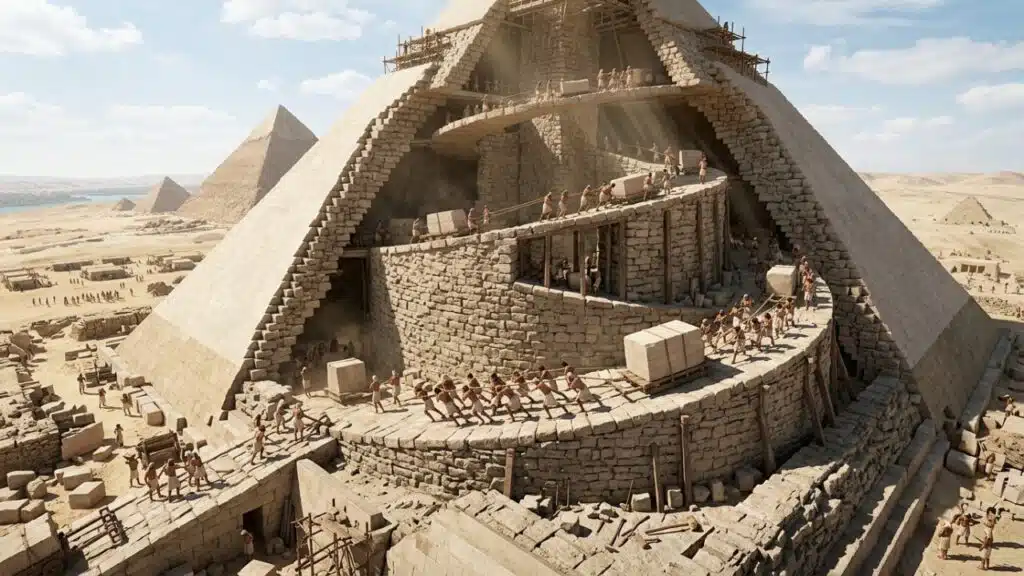
The most technically convincing answer to how were the pyramids built for the upper levels of construction comes from computational modeling published in npj Heritage Science by researcher Vicente Luis Rosell Roig.
The external ramp theory has always had a fundamental geometric problem. A ramp long enough to give workers a manageable slope for hauling multi-tonne blocks to the pyramid’s upper levels would need to extend for hundreds of meters beyond the pyramid’s base. Building and then dismantling such a ramp would require a quantity of material comparable to the pyramid itself, yet no evidence of it exists anywhere in the archaeological record around Giza.
Rosell Roig’s model proposes an internal solution. Rather than external ramps that approached the pyramid from outside, workers used an integrated edge ramp system: ramps built into the pyramid’s own faces and corners as it rose, spiraling upward with the structure. The outer surface of the pyramid would have had gaps, essentially open channels in the outer casing where the ramp traveled, which were filled in at the end of construction as the workers descended and completed the facing work on their way down.
This explains both the absence of external ramp evidence and something else that archaeologists have found puzzling: at the unfinished pyramid of Abu Roash, a notch cut into the monument at exactly the position where an integrated corner ramp would have been positioned provides direct physical evidence for the system. The pyramid was abandoned before completion, and the notch was never filled in. It is the engineering equivalent of a blueprint left exposed.
Rosell Roig’s code is open-source and testable, which has made his model one of the most seriously evaluated answers to how were the pyramids built in recent years.
The Step Pyramid’s Water-Powered Elevator
For the earliest pyramid in Egyptian history, the Step Pyramid of Djoser at Saqqara built around 2680 BCE, a 2024 study published in PLOS One by Xavier Landreau and colleagues proposed something even more remarkable: a hydraulic elevator powered by water.
The Step Pyramid contains a central vertical shaft approximately 28 meters deep, along with a series of chambers and passages whose architectural configuration Landreau’s team argued matches the components of a hydraulic lifting system. The shaft would have been connected to a water source, filled and drained in cycles, raising a float carrying stone blocks on each filling cycle to the level where workers needed them.
In a recorded interview with NPR about the study, Landreau described the mechanism clearly: the water would have been guided to a central shaft beneath the pyramid, and through filling and draining cycles, the shaft would have raised the float carrying stones. The water did the work.
The nearby Gisr el-Mudir enclosure, a massive stone structure that Egyptologists have struggled to explain as either a precursor to the Step Pyramid or a separate monument, was proposed by the team as a check dam: an upstream water control structure that managed the flow feeding the hydraulic system.
If this interpretation is correct, the answer to how were the pyramids built includes the earliest known use of hydraulic engineering in monumental architecture, predating every other known application of the principle by centuries.
Wet Sand, Sledges, and the Friction Reduction Secret
While the major engineering debates about how were the pyramids built focus on lifting, a separate question concerns horizontal transport: once blocks arrived by boat on the Ahramat Branch, how were they moved from the riverbank to their position in the pyramid?
A relief carving on the tomb of Djehutihotep, an ancient Egyptian official, shows workers pulling a massive statue on a sledge while a figure at the front of the sledge pours liquid onto the surface ahead of it. For a long time, this was interpreted as a ritual act. Modern tribological analysis concluded it was engineering.
Pouring water onto desert sand reduces the coefficient of friction by approximately 50 percent. A wet sand surface creates a compact, semi-rigid surface that allows a wooden sledge carrying tonnes of stone to slide with significantly less force than would be required on dry sand. Experimental archaeology has confirmed this: teams pulling sledges on moistened sand require roughly half the workforce needed for the same load on dry ground.
The Egyptians had understood tribology, the science of friction between surfaces, millennia before the word existed. The figure pouring water at the front of the sledge in the Djehutihotep relief was not performing a ceremony. He was doing physics.
The Counterweight Network That Could Place a Block Every Minute
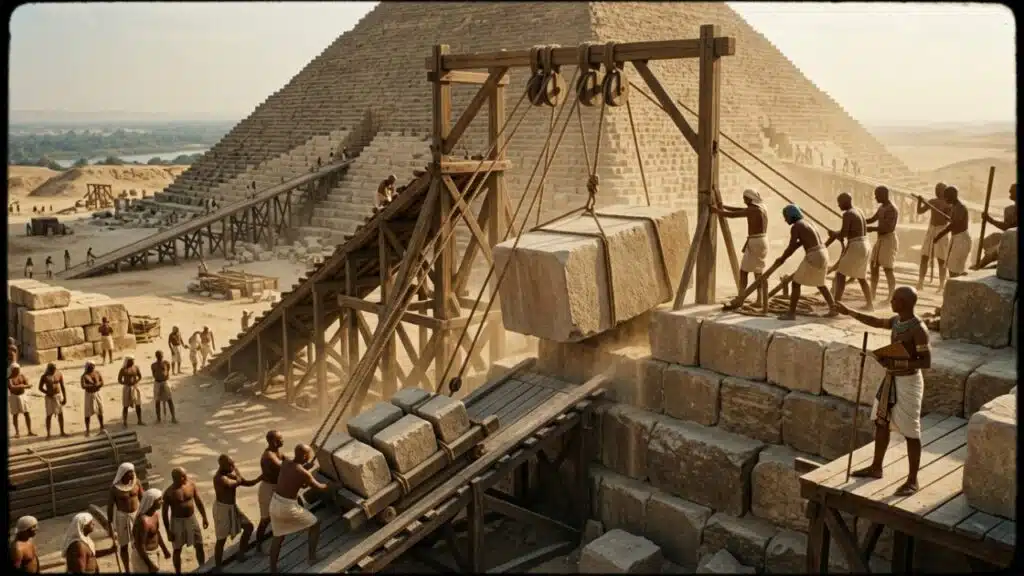
In 2025, Dr. Simon Andreas Scheuring of Weill Cornell Medicine in New York published a proposal that reframed the speed question in how were the pyramids built.
The Great Pyramid was built in approximately 20 years. With 2.3 million blocks, that requires placing an average of roughly 315 blocks per day, or one block every 5 minutes across a 24-hour day, or one every 2.5 minutes across a 12-hour working day. Even with ramps and sledges, achieving that rate with manual labor seems barely possible. Scheuring’s computational analysis proposed that the Egyptians used a mass network of counterweights and pulley-like devices built into the pyramid’s structure as it rose, allowing the weight of descending empty sledges to help pull loaded ones upward.
His calculations indicated that with this system, workers could position a 2.5-tonne block every 60 seconds. Heavier blocks would take longer, but the overall throughput the system could achieve was consistent with the production rate required to complete the pyramid in two decades.
Scheuring identified what he interpreted as mechanical stress markings in the pyramid’s internal passages, patterns of wear that he read as evidence of sliding loads rather than foot traffic, as physical evidence for the system’s use.
What the Papyrus Inspector Merer Recorded
Perhaps the most humanizing single document in the entire question of how were the pyramids built is the Diary of Merer, because it takes the abstract engineering problem and converts it into a daily work log written by an actual person who was there.
Merer was an inspector overseeing a team of approximately 200 workers during the reign of Khufu. His papyrus, discovered in 2013 at the ancient harbor of Wadi al-Jarf on the Red Sea and dated definitively to 2560 BCE, records voyages to transport white Tura limestone from the quarries on the eastern bank of the Nile to Giza. Each entry describes the date, the activity, the route, the canal used, and the overnight stops.
What Merer’s diary confirms is that the stone transport for how were the pyramids built was a highly organized logistical operation with precise scheduling, named officials, known routes, and state-supplied food and resources for the workers. His team was not anonymous labor moving random loads. They were a named unit of skilled workers executing a specific task within a larger supply chain that fed the construction operation at Giza.
Merer never describes lifting the blocks onto the pyramid itself. His job was transport, and transport was what he recorded. But his diary, the oldest logbook ever found, proved that the conversation about how were the pyramids built does not require speculation. It requires finding more documents like the one he left behind.
Conclusion: The Engineering Was the Wonder All Along
The question of how were the pyramids built has never actually required a supernatural answer. What it required was better technology for finding the evidence, and the patience to look in the right places.
The Ahramat Branch explains the transport mystery that stumped researchers for generations. The internal ramp model explains the lifting problem that made the external ramp theory geometrically unworkable. The hydraulic elevator at Djoser demonstrates that the Egyptians understood water-powered mechanics earlier than any previous evidence had suggested. Wet sand and sledges explain horizontal transport with simple physics confirmed by modern tribology. The worker village and the Diary of Merer prove that the people who answered how were the pyramids built were organized, skilled, cared for, and documented.
The answer to how were the pyramids built is not one answer. It is a system, developed and refined over centuries of accumulated engineering knowledge, applied by a civilization that understood logistics, hydrology, material science, and labor organization at a level that modern researchers are only now fully appreciating.
The wonder was never supernatural. The wonder was always the engineering.
And the engineering, it turns out, was even more impressive than the aliens.
Discover a Hidden Maya City
Deep in Mexico’s jungle, LiDAR has revealed a massive lost city of 30,000 people—reshaping everything we know about Maya civilisation.
In 2024, a team of archaeologists made a discovery that could change everything: they found a lost city beneath the pyramids.
Click below to watch the full story:
https://www.youtube.com/@EchoesofAntiquity-egypt/videos
Sources
- Nature Communications Earth and Environment (May 2024) — Eman Ghoneim et al., “The Egyptian pyramid chain was built along the now abandoned Ahramat Nile Branch.” DOI: 10.1038/s43247-024-01379-7 — nature.com
- Phys.org / Communications Earth and Environment — “Discovery may explain why Egyptian pyramids were built along long-lost Ahramat branch of the Nile” (May 16, 2024) — phys.org
- Nature Middle East — “Ancient hidden waterway brought workers to build Giza’s pyramids” (2024 Ahramat Branch coverage) — natureasia.com
- NPR — “Engineers have a new theory on how Egypt’s first pyramid was built” (Landreau hydraulic elevator interview, August 14, 2024) — npr.org
- Newsweek — “How Were the Pyramids Built? Engineers Suggest a New Theory” (hydraulic system, Step Pyramid of Djoser) — newsweek.com
- Bricks and Bytes — “How Were the Pyramids Built? The Theories, Rated by the Evidence” (Rosell Roig internal ramp, Landreau hydraulic, Scheuring counterweight) — bricks-bytes.com
- Yahoo News / Popular Science — “Researchers Believe They Finally Figured Out How the Great Pyramids Were Built” (Rosell Roig npj Heritage Science internal ramp model) — yahoo.com
- GB News — “Bombshell new study reveals how Egypt’s Great Pyramid was REALLY built” (Dr. Simon Scheuring, Weill Cornell Medicine, counterweight network) — gbnews.com
- Archaeology Magazine Online — “New study reveals Egyptian pyramids were built along a long-lost Ahramat branch of the Nile” (May 2024) — archaeologymag.com
- EarthSky — “Egyptian pyramids new finding: Just add water” (Ahramat Branch, May 2024) — earthsky.org
- Smithsonian Magazine — “A Secret Tunnel Found in Mexico” (Diary of Merer contextual background) and general pyramid worker village context — smithsonianmag.com
- arXiv — “Timekeeping at Akhet Khufu, as shown by the Diary of Merer” (Ghoneim 2024 reconstruction with Merer papyrus context) — arxiv.org
- npj Heritage Science (2024) — Vicente Luis Rosell Roig, “A computational framework for evaluating an edge-integrated, multi-ramp construction model of the Great Pyramid of Giza” — cited via arxiv.org
- Hidden Hydrology — “Lost Channels of the Nile: Ahramat Branch research context” — hiddenhydrology.org

