Göbekli Tepe Mystery: 8 Facts That Rewrote Human History
The Shepherd, the Stone, and the End of Everything We Knew
In 1963, a Kurdish shepherd walking a hilltop in southeastern Turkey noticed something strange. Limestone slabs jutting from the earth, arranged in patterns that did not look natural. He reported what he had found. Researchers from Istanbul and Chicago visited the site, saw the exposed stones, and concluded it was probably a medieval cemetery.
They walked away from the most significant archaeological discovery of the twentieth century.
Thirty-one years later, in 1994, a German archaeologist named Klaus Schmidt arrived at the same hilltop with different eyes. He had been studying the prehistoric landscape of Anatolia for years, and he recognized immediately what the earlier team had missed. The stones were not medieval headstones. They were something far older. Something that, once fully understood, would permanently destroy the story humanity had been telling itself about how civilization began.
The Göbekli Tepe mystery begins with that recognition, and it has not stopped generating consequences since.
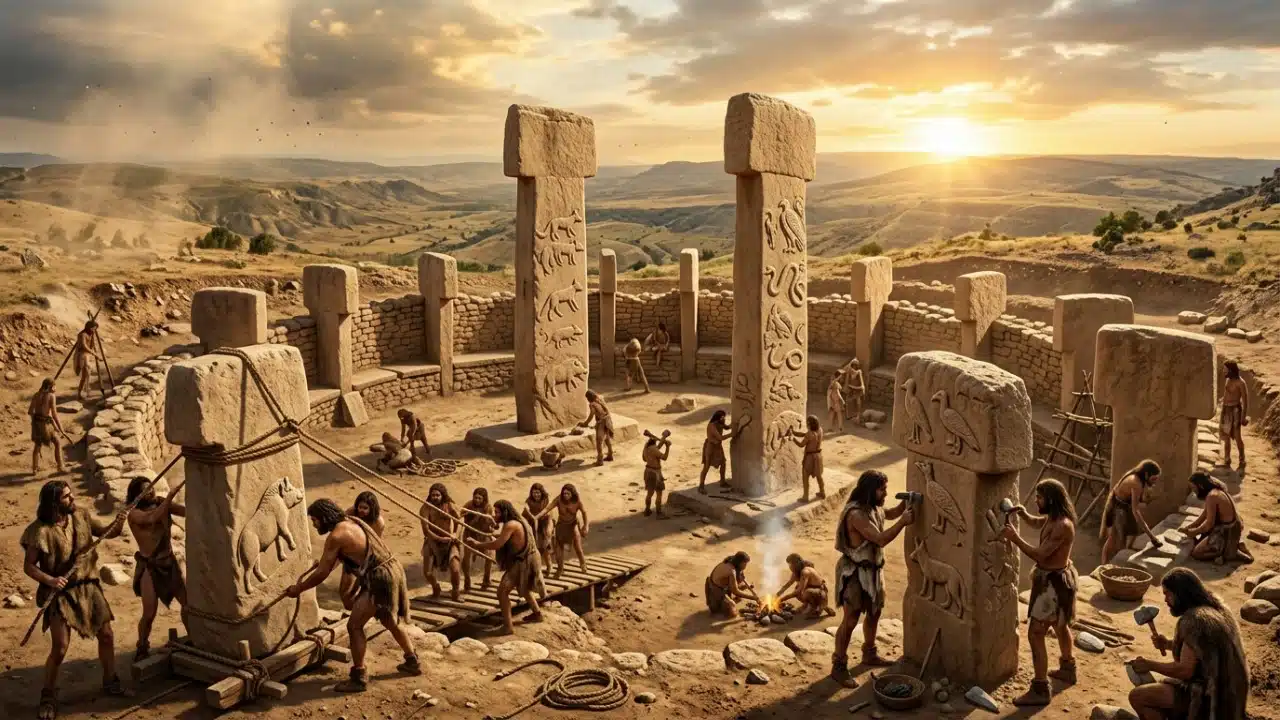
What Schmidt uncovered on that hilltop near the modern Turkish city of Sanliurfa was a temple complex built approximately 11,500 years ago, at a time when, according to everything archaeology had previously established, human beings were not yet capable of building temples. They were hunter-gatherers. They had no pottery, no metal tools, no permanent settlements, no agriculture, no writing. They were, by the standard model of civilization’s development, thousands of years away from the kind of organized social complexity that monumental architecture requires.
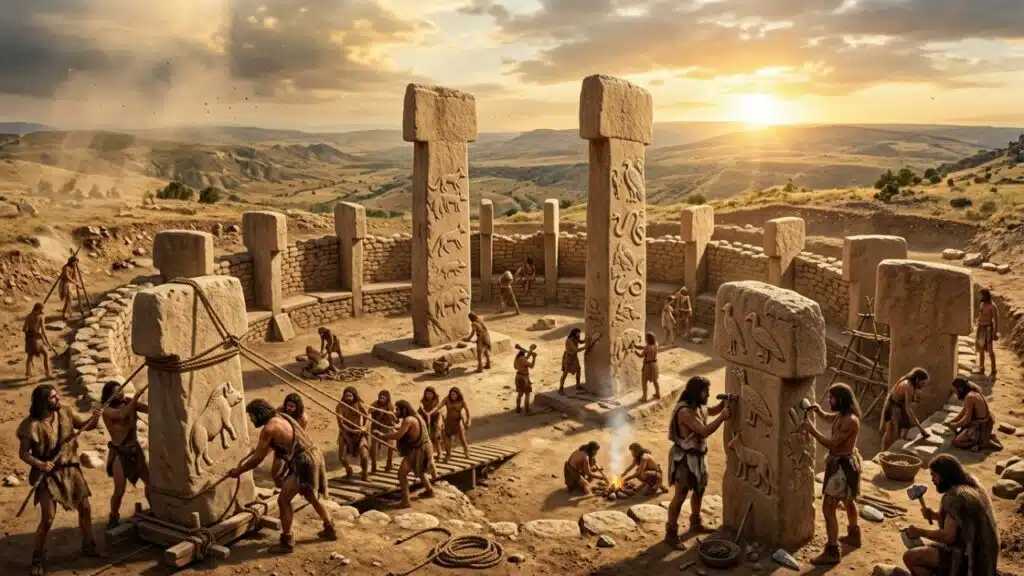
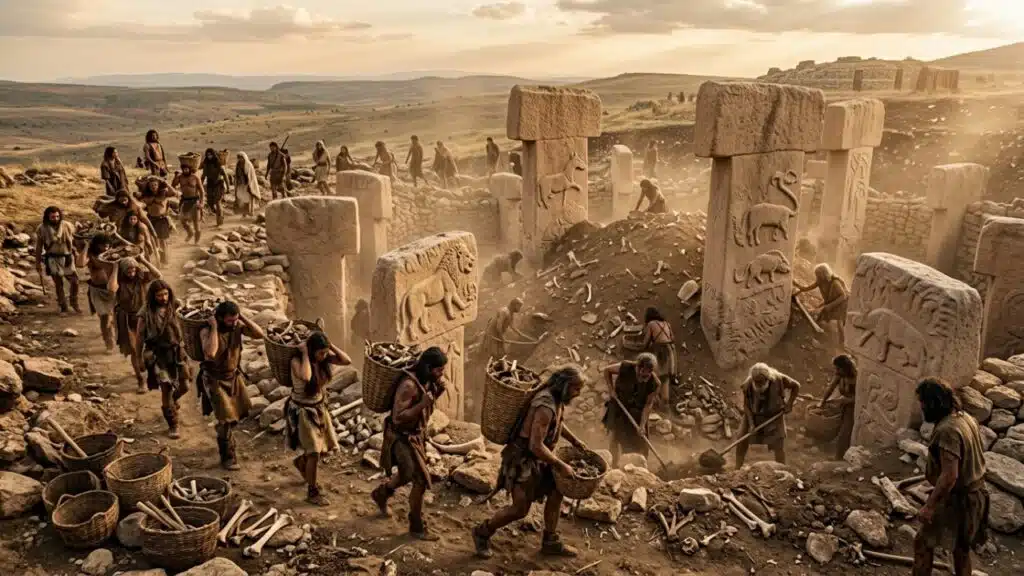
And yet there it was. Carved limestone pillars up to six meters tall and weighing up to fifty tonnes, arranged in precise circles, covered with extraordinarily detailed reliefs of animals. A construction project that required coordinating hundreds of workers across years or decades of sustained effort.
The Göbekli Tepe mystery did not just add a new chapter to the history of civilization. It tore up the original script and demanded a completely different story.
Quick Answer: Göbekli Tepe Mystery
What is Göbekli Tepe and why is it significant?
Göbekli Tepe is an ancient archaeological site in southeastern Turkey, dated to approximately 9600 BCE, making it roughly 6,000 years older than Stonehenge and 7,000 years older than the Great Pyramid of Giza. It is significant because it was built by hunter-gatherers who had no pottery, no metal tools, and no agriculture, overturning the established sequence of civilization development. The Göbekli Tepe mystery forced archaeologists to reconsider whether religion and monumental architecture came before farming, rather than after it.
Who built Göbekli Tepe?
Göbekli Tepe was built by pre-agricultural hunter-gatherers. All animal bones found at the site belong to wild species, confirming the builders were not farmers keeping domestic animals. Extracting and erecting the massive T-shaped pillars required an estimated 500 or more workers coordinating over sustained periods. No evidence of permanent dwellings was initially found at the site, suggesting it functioned as a gathering place for communities living across a wide surrounding region.
Why was Göbekli Tepe deliberately buried?
Around 8000 BCE, after approximately 1,500 years of use, Göbekli Tepe was deliberately and carefully filled in with tons of earth, animal bones, and stone debris. The reason remains one of the central unresolved aspects of the Göbekli Tepe mystery. Klaus Schmidt proposed it represented ritual closure, a conscious ending of the site’s sacred function. Other researchers suggest the burial coincided with the transition from hunter-gatherer life to settled agriculture, and that the burial was a symbolic farewell to an older world. The material used to fill the enclosures was brought from elsewhere, confirming the burial was an organized communal act, not natural accumulation.
What new discoveries have been made at Göbekli Tepe recently?
Between 2024 and 2025, several significant discoveries expanded the Göbekli Tepe mystery. In August 2024, a study in the journal Time and Mind identified carvings on Pillar 43 as potentially the world’s oldest lunisolar calendar, dated to approximately 13,000 years ago, and proposed they recorded a devastating comet impact. In February 2025, excavations confirmed the presence of grinding mills, flint sickles, and plant residues suggesting early food processing at the site, challenging the purely ceremonial model. In September 2025, a rare human statue was discovered embedded in a wall between Enclosures B and D. In November 2025, Turkey announced major new discoveries at nearby Sefertepe and Karahantepe expanding the regional network of related sites.
Mystery no 1 : The Oldest Temple Was Built Before Everything Else
The Göbekli Tepe mystery rests on a timeline so extreme that even experienced archaeologists who work with ancient dates every day find it difficult to hold clearly in mind.
Göbekli Tepe was built around 9600 BCE. Stonehenge was built around 3000 BCE. The Great Pyramid of Giza was built around 2560 BCE. Sumerian writing, the oldest known writing system, emerged around 3100 BCE. The wheel appears in the archaeological record around 3500 BCE.
Every landmark of civilization that history books identify as a beginning came thousands of years after Göbekli Tepe was already operational. This is not a minor chronological discrepancy. It is a structural argument about the sequence of human development. The accepted model held that organized religion and monumental architecture were products of complex settled societies, which were themselves products of agriculture, which allowed populations to grow and specialize beyond subsistence hunting. Build farms, grow populations, develop specialization, then build temples.
Göbekli Tepe is a temple built before any of that. Its builders had none of those prerequisites. According to every theory of civilizational development that existed before 1994, Göbekli Tepe should not exist.
As World History Encyclopedia states directly, the site predates pottery, metallurgy, the invention of writing, the wheel, and the beginning of agriculture. The Göbekli Tepe mystery is, at its core, the mystery of where in the human story complexity actually begins.
Mystery no 2: The Pillars That Required 500 Workers and No Machinery
The T-shaped limestone pillars of Göbekli Tepe are not rough stones dragged to a hilltop and propped upright. They are precision-engineered architectural elements, carved from the local bedrock at a quarry a short distance from the site and then somehow transported and erected in their intended positions.
The largest known pillar at the site weighs approximately fifty tonnes. The average pillar weighs between ten and twenty tonnes. Extraction marks are still visible in the quarry rock, showing exactly where workers removed the pillars from the bedrock using stone tools. No metal. No wheels. No draft animals.
Schmidt and his colleagues calculated that extracting, transporting, and erecting the pillars at Göbekli Tepe required an organized workforce of at minimum 500 people working in coordination. More recent assessments have placed the number higher for the most ambitious construction phases. These workers had to be fed while they worked. Excavations at the site have found stone basins large enough to produce significant quantities of food and what Schmidt identified as evidence of beer production, fermented grain beverages that were a staple of prehistoric feasting cultures across the ancient Near East.
The Göbekli Tepe mystery embedded in the logistics is not how the stones were moved. Modern experimental archaeology has demonstrated that ropes, sledges, and organized human teams can move multi-tonne stones without advanced machinery. The mystery is who organized those 500 people, fed them, and directed their labor with sufficient precision to erect a complex of circles aligned with each other and with celestial bodies overhead.
No writing exists from this period. No administrative records survive. No named leaders have been identified. The coordination required to build Göbekli Tepe existed, demonstrably, because the building exists. The mechanism of that coordination is unknown.
Mystery no 3: First Came the Temple, Then the Farming
The phrase that Klaus Schmidt used to summarize the Göbekli Tepe mystery became one of the most repeated sentences in modern archaeology: first came the temple, then the city.
What Schmidt meant was a specific and radical reversal of the accepted sequence. The standard model of civilization placed agriculture at the foundation of everything. Feed people reliably, populations grow, specialists emerge, social complexity develops, religion and monumental architecture follow. The Göbekli Tepe mystery collapses this sequence.
If hunter-gatherers built Göbekli Tepe before agriculture existed, then the need to feed the workers at Göbekli Tepe may have been what drove the invention of agriculture, rather than the other way around. Organized ritual gatherings created the demand for food surpluses that only farming could reliably supply. The temple came first. The farm came to serve it.
Supporting this interpretation is a fact of agricultural genetics that has never been fully absorbed into the popular account of the Göbekli Tepe mystery. The wild ancestors of domesticated wheat were first cultivated at Mount Karaca Dag, approximately thirty kilometers from Göbekli Tepe. DNA analysis of modern domesticated wheat shows that its genome is closest in structure to the wild wheat strains still found near Gobekli Tepe’s immediate region. The world’s first deliberately cultivated grain emerged precisely where it would have been most useful: within walking distance of the site that needed feeding.
This does not prove that Göbekli Tepe caused agriculture. It proves that the geographical and temporal coincidence between the world’s first known monumental religious site and the world’s first known agricultural domestication is not a coincidence.
Mystery no 4: The Pillar That May Have Recorded a Comet Strike
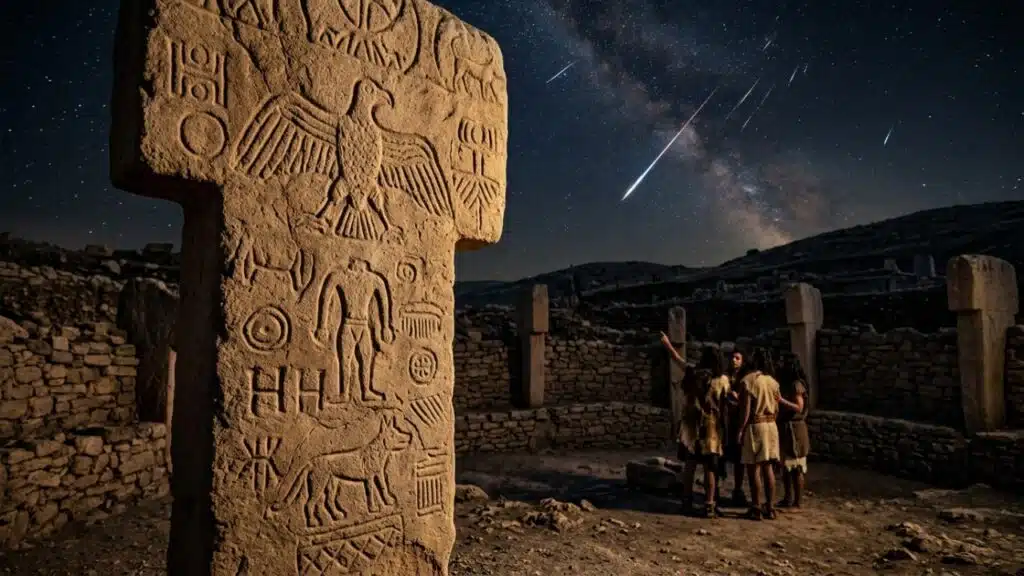
In August 2024, a study published in the journal Time and Mind by Dr. Martin Sweatman proposed a reading of Pillar 43 at Göbekli Tepe that added an entirely new dimension to the Göbekli Tepe mystery.
Pillar 43, also known informally as the Vulture Stone, is covered with carvings of animals and geometric symbols that Sweatman’s team argued were not decorative but astronomical, specifically a lunisolar calendar recording celestial events with precision. If their interpretation is correct, the carvings constitute the world’s oldest known calendar, tracking lunar and solar cycles with systematic notation approximately 13,000 years ago.
The more controversial element of the study was its proposal for what the calendar was recording. Sweatman’s team identified a configuration of symbols on the pillar that they interpreted as depicting the Taurid meteor stream, a recurring celestial phenomenon associated with periodic comet fragment showers. They proposed that Göbekli Tepe itself was built in response to a catastrophic comet impact event around 10,900 BCE, during the Younger Dryas period, a sudden and severe climate cooling that dramatically disrupted life across the Northern Hemisphere.
The Göbekli Tepe mystery, in this reading, becomes a monument to collective trauma. A community of hunter-gatherers survived a catastrophic sky event that caused sudden climate collapse, killing much of their familiar world and the animals they depended on. They built a sanctuary to memorialize it, to track the celestial forces they now knew were dangerous, and to conduct the rituals they hoped would prevent recurrence.
Not every researcher accepts this astronomical interpretation. But the study was peer-reviewed and published in a specialist journal, and it represents one of the most specific attempts yet to explain not just what Göbekli Tepe was, but why it was built at that particular moment in human history.
Mystery no 5: The Site Was Not Just a Temple
For decades after Schmidt’s excavations began, the Göbekli Tepe mystery was framed around a single interpretation: the site was a purely ceremonial space, a sanctuary where scattered hunter-gatherer communities gathered for ritual purposes, and where no one lived permanently. Schmidt himself was firm on this point. Göbekli Tepe was a cathedral on a hill, not a village.
In February 2025, that interpretation was formally complicated.
New excavations at Gobeklitepe revealed evidence that directly challenged the purely ceremonial model. Researchers found grinding mills, flint sickles, and plant residues at the site, evidence of food processing activities that go beyond the preparation of ritual feasts. Greek Reporter covered the findings, which suggested that the site’s builders may have engaged in early farming or food processing as an integrated part of their activities at the site rather than purely ceremonial functions.
Rectangular stone-built structures uncovered north of the main archaeological zone in the most recent excavation season, reported by Turkiye Today in August 2026, appear to have functioned as living quarters. Professor Necmi Karul, coordinator of the Tas Tepeler Project and head of the Gobeklitepe excavation, confirmed these structures were found just beneath the surface in a newly opened area and may represent residential spaces associated with the site’s construction or operation.
The Göbekli Tepe mystery is evolving from the question of whether anyone lived here to the question of how many people did, for how long, and in what relationship to the ritual enclosures that originally defined the site in the archaeological imagination.
Mystery no 6: The Human Figure Buried in the Wall
In September 2025, a discovery announced by Turkey’s Ministry of Culture and Tourism sent a direct shock through the Göbekli Tepe mystery.
Between Enclosures B and D, excavators working on the Stone Hills Project uncovered a rare human figure statue, deliberately embedded within the structure of a wall. The statue had a defined head and torso. Its placement within the wall was clearly intentional rather than incidental, suggesting it served a specific ritual or symbolic function at the moment of the wall’s construction.
Turkey’s Minister of Culture Mehmet Nuri Ersoy commented on the find by noting that similar examples had been found at Karahan Tepe, another major Neolithic site in the broader regional network, but that this figure from Göbekli Tepe itself was particularly valuable for understanding the site’s spiritual and social functions. Human statuary at Göbekli Tepe is exceptionally rare, which makes each confirmed example a significant data point for understanding who the builders thought they were building for.
The Göbekli Tepe mystery includes, embedded in its walls, a face that is still looking outward from the stone.
Mystery no 7: A Whole Network of Sites Was Hiding in Plain Sight
Göbekli Tepe was the first site of its kind to be recognized and excavated, but it was never alone.
In November 2025, Turkey’s Ministry of Culture and Tourism announced a new wave of discoveries from Gobeklitepe, Sefertepe, Karahantepe, and Sayburc, a network of related Neolithic sites across the same region of southeastern Turkey that the Göbekli Tepe mystery had always implied should exist but whose full extent was only beginning to emerge. Researchers from Turkey’s Tas Tepeler Project, meaning Stone Hills, have been systematically surveying the region and confirming that Göbekli Tepe was the best-known node in a much wider sacred landscape.
Karahantepe, excavated from 2019 onward, has produced its own extraordinary finds: a room carved entirely from bedrock containing lifelike human busts emerging from the walls, one complete figure with a realistic face, and the oldest known three-dimensional human sculpture in the region. Sefertepe has yielded symbolic sculptures and ritual objects that expand what researchers understand about the symbolic vocabulary of the period.
The Göbekli Tepe mystery is no longer the mystery of a single inexplicable site. It is the mystery of an entire ceremonial landscape that stretched across southeastern Anatolia, used by people who did not yet farm, coordinating across distances and generations to build a world of shared sacred meaning before they built anything else.
Mystery no 8: Why the Builders Buried Their Own Temple
The final and perhaps deepest Göbekli Tepe mystery is the one that the stones themselves encode most directly: why was it buried?
Around 8000 BCE, approximately 1,500 years after the site’s initial construction, the people who used Göbekli Tepe undertook a massive, organized operation to fill the enclosures with earth, animal bones, stone debris, and settlement refuse. This material was brought from elsewhere specifically for the burial. It was not natural accumulation or the product of the site’s gradual abandonment. The filling was deliberate, thorough, and clearly the result of collective effort.
The same community that had devoted extraordinary resources to building the enclosures devoted comparable resources to sealing them permanently.
Klaus Schmidt interpreted this as ritual closure, a ceremonial ending of the sacred space’s active function, perhaps marking a transition in the community’s spiritual life. Others have proposed that the burial coincided with the broader transition from hunter-gatherer existence to settled agricultural life, and that Göbekli Tepe was buried as a symbolic farewell to the old world. The worldview of hunting peoples, expressed in its animal carvings and open enclosures oriented toward the sky, may have been consciously retired as the community transformed into something new.
Ironically, the deliberate burial is precisely why the Göbekli Tepe mystery is available to be solved at all. The filling that sealed the enclosures protected them from 10,000 years of erosion, weathering, and human disturbance. The builders, by burying their temple, inadvertently preserved it for the shepherd who stumbled across the protruding stones in 1963, and for the archaeologist who arrived in 1994 and recognized what he was seeing.
They buried it so thoroughly that it survived long enough for the world to find it.
Conclusion: The Temple That Arrived Before Its Time
The Göbekli Tepe mystery is not a puzzle waiting for a final answer. It is a continuously expanding revelation about the depth of human capacity that existed long before the standard history of civilization begins.
What the hilltop near Sanliurfa has demonstrated over thirty years of excavation is that the people who preceded agriculture were not primitive beings slowly accumulating the basic competencies required for civilization. They were fully human minds capable of coordinating collective labor at massive scale, encoding astronomical observations into stone, expressing symbolic and spiritual life through sophisticated art, and organizing themselves around shared meaning with a precision that required sustained social intelligence across generations.
The Göbekli Tepe mystery forces the question not of when humanity became civilized, but of what civilization actually means. If it means monumental architecture, organized religion, astronomical tracking, and coordinated collective labor, then Göbekli Tepe proves it existed 11,500 years ago, before farming, before pottery, before metal, before writing.
Klaus Schmidt spent twenty years on that hilltop before his death in 2014. He never finished excavating it. Only about ten percent of the site has been uncovered. The enclosures that the builders buried so carefully are still giving up what they sealed away, statue by statue, carving by carving, mystery by mystery.
First came the temple.
Everything else came after.
Discover a Hidden Maya City
Deep in Mexico’s jungle, LiDAR has revealed a massive lost city of 30,000 people—reshaping everything we know about Maya civilisation.
In 2024, a team of archaeologists made a discovery that could change everything: they found a lost city beneath the pyramids.
Click below to watch the full story:
https://www.youtube.com/@EchoesofAntiquity-egypt/videos
Sources
- Archaeology Magazine — “Ancient carvings at Göbekli Tepe may represent world’s oldest calendar” (August 11, 2024, Time and Mind journal, Dr. Martin Sweatman) — archaeologymag.com
- Greek Reporter — “New Göbekli Tepe Discoveries Disprove Earlier Theories About Its Purpose” (February 27, 2025) — greekreporter.com
- Ancient Origins — “Guardian of Gobekli: Human Figure Found Entombed in World’s Oldest Temple” (September 23, 2025) — ancient-origins.net
- Greek Reporter — “Turkey Unveils New 12,000-Year-Old Discoveries at Göbeklitepe and Sefertepe” (November 26, 2025) — greekreporter.com
- Turkiye Today — “New discovery at Gobeklitepe sheds light on where people may have lived” (August 2026) — turkiyetoday.com
- National Geographic — “The Birth of Religion: Göbekli Tepe” (Klaus Schmidt original National Geographic feature) — nationalgeographic.com
- NPR — “Göbekli Tepe archaeology: What we know and what remains mysterious” (August 9, 2025) — npr.org
- Archaeology Magazine — “Last Stand of the Hunter-Gatherers?” (May/June 2021, Klaus Schmidt excavation history) — archaeology.org
- World History Encyclopedia — “Gobekli Tepe: The World’s First Temple?” — worldhistory.org
- arXiv — “Thinking about Archaeoastronomy: Göbekli Tepe” (wheat domestication DNA analysis context, Schmidt calculations) — arxiv.org
- Gobekli-Tepe.com — “Klaus Schmidt: The Archaeologist Who Found Göbekli Tepe” and “Was Göbekli Tepe the First Religion?” — gobekli-tepe.com
- Ancient Mysteries — “The Gobekli Tepe Enigma: Why Did We Bury the World’s First Temple?” — ancientmysteries.org
- Time and Mind Journal (2024) — Sweatman, M., “Representations of calendars and time at Göbekli Tepe and Karahan Tepe support an astronomical interpretation of their symbolism.” DOI: 10.1080/1751696X.2024.2373876 (primary peer-reviewed source)