
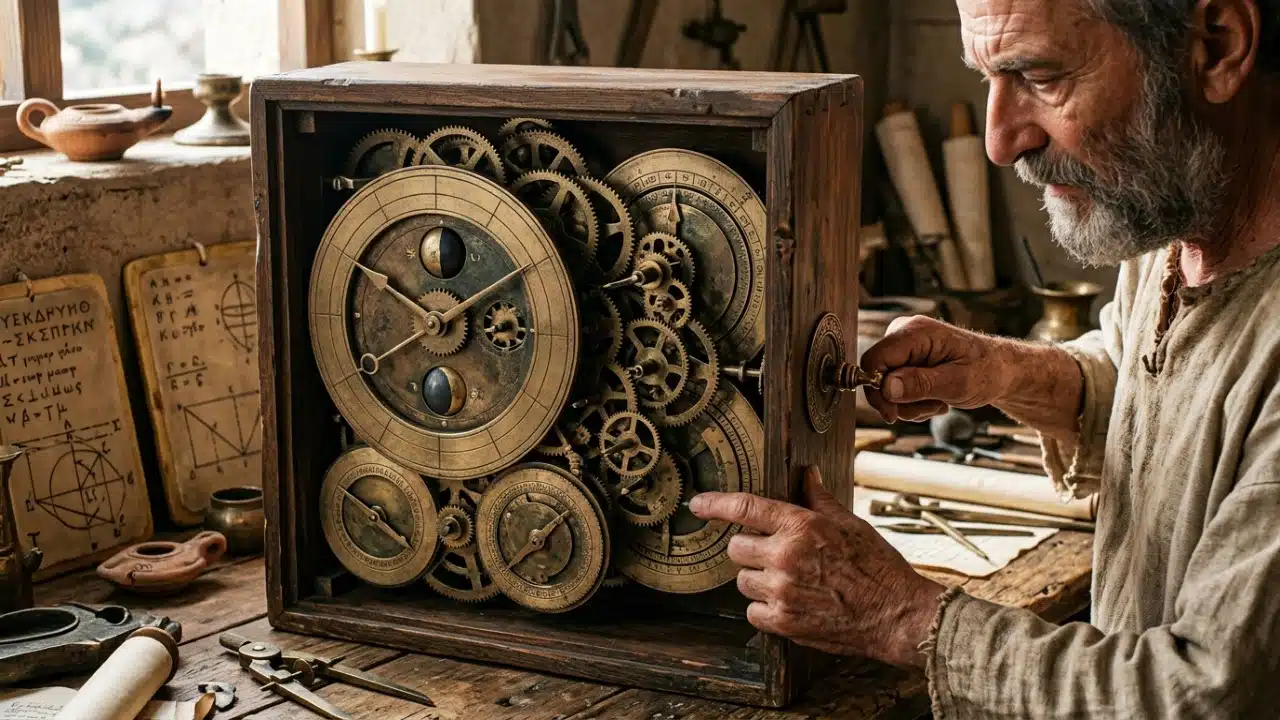
Antikythera Mechanism History: The Ancient Greek Computer Explained
The Most Important Object Nobody Had Ever Seen
In the spring of 1900, a group of Greek sponge divers returning from North Africa was caught by a storm and forced to shelter near the small island of Antikythera, in the waters between Crete and the Greek mainland. When the storm passed, they dived into the waters nearby, as sponge divers do, scanning the seafloor for their harvest.
What they found instead was a shipwreck.
Over the following months, they brought up treasures that still stagger the imagination: bronze and marble statues of extraordinary quality, glassware, jewelry, coins, and an assortment of objects from what was clearly a Roman-era vessel carrying the spoils of Greek culture. The wreck was dated to approximately 60 to 70 BCE. Archaeologists descended on the site, and the recovered objects were transported to the National Archaeological Museum in Athens.
One lump of corroded bronze, encrusted with barnacles and fused together with other fragments, was set aside. Nobody knew what it was.
In 1902, an archaeologist named Valerios Stais looked more carefully at the encrusted lump and noticed something that nobody else had seen: inside the corrosion, barely visible, were the teeth of a gear. A precisely manufactured bronze gear, inside an object from the first century BCE, from a civilization that historians were certain had never produced anything of the kind.
Antikythera mechanism history begins with that moment of recognition. And what followed has been a century of steadily deepening astonishment.

Quick Answer: Antikythera Mechanism History
What is the Antikythera mechanism?
The Antikythera mechanism is an ancient Greek analog computing device dated to approximately 100 to 150 BCE, discovered in a Roman shipwreck off the Greek island of Antikythera in 1901. It is the oldest known mechanical computer in human history, containing at least 37 interlocking bronze gears inside a wooden case roughly the size of a shoebox. The Antikythera mechanism’s history spans more than two thousand years from its construction to its ongoing decipherment, with new research in 2024 and 2025 still revealing previously unknown functions.
What did the Antikythera mechanism do?
The Antikythera mechanism tracked the positions of the sun and moon in the zodiac, predicted solar and lunar eclipses using the 223-month Saros cycle, displayed the Greek lunisolar calendar and Egyptian solar calendar, tracked the four-year Olympic Games cycle, and most likely displayed the positions of all five planets visible to the naked eye. A user turned a hand crank at the front, and the internal gear system mechanically calculated and displayed all these outputs simultaneously through pointers on front and back dials.
When was the Antikythera mechanism built?
Antikythera mechanism history places the device’s construction between 200 and 60 BCE, with most scholars settling on approximately 100 to 150 BCE based on astronomical calibration of the eclipse sequences encoded in its Saros dial. The shipwreck that carried it has been dated to approximately 60 to 70 BCE. Some researchers have proposed the device may have originated in Rhodes, possibly connected to the workshop tradition of the astronomer Hipparchus.
What did the 2024 and 2025 research reveal about the Antikythera mechanism?
Two major studies advanced antikythera mechanism history in this period. In June 2024, researchers at the University of Glasgow used statistical analysis techniques developed for detecting gravitational waves to analyze the calendar ring, concluding with high confidence that it contained 354 to 355 holes corresponding to the lunar year, overturning the century-old assumption of a 365-hole solar calendar. In April 2025, a simulation study published in Gizmodo by a team from Argentina proposed that manufacturing flaws in the gear teeth may have caused the mechanism to jam regularly, raising questions about whether the original device functioned as intended.
What Was Inside the Box
To understand antikythera mechanism history properly, it helps to understand exactly what sits in the fragments at the National Archaeological Museum in Athens, because the physical reality of the device is the source of everything astonishing about it.
The wooden case that housed the mechanism measured roughly 34 by 18 by 9 centimeters. That is approximately the size of a large hardcover book. Inside that case, ancient Greek craftsmen built a system of at least 37 interlocking bronze gears, with gear teeth approximately one millimeter in size, cut with a precision that modern researchers have measured and repeatedly confirmed to be extraordinary by any standard, ancient or modern.
The largest surviving gear is approximately 13 centimeters in diameter and originally had 223 teeth. Each pair of meshing gears performed a mathematical division based on their tooth counts, with the result of each calculation feeding into the next gear pair in the chain. The entire system cascaded from a single input, a hand crank at the front of the device, through layer after layer of calculated relationships, to produce outputs on multiple dials simultaneously.
The front face showed the positions of the sun and moon in the zodiac, the phase of the moon, and most likely the positions of the five planets known to the ancient Greeks: Mercury, Venus, Mars, Jupiter, and Saturn. The back face contained two large spiral dials. The upper spiral tracked the Metonic cycle of 235 months, the period after which the moon returns to the same phase on the same day of the solar year. The lower spiral tracked the Saros cycle of 223 synodic months, the period used to predict eclipses.
Every function was implemented simultaneously through the geometry of the gears alone. There was no software. There was no programming. The computation happened in the physical arrangement of bronze teeth, and every time the user turned the crank, the entire system updated across every display at once.
This is what makes antikythera mechanism history so difficult to absorb. It is not that the ancient Greeks built a clever toy. It is that they built, in the first or second century BCE, a functional multi-variable analog computer that would not be replicated in its complexity until the astronomical clocks of medieval Europe, more than a thousand years later.
The Century That Missed the Point
For most of the twentieth century, antikythera mechanism history was a story of scholarly bafflement.
After Stais noticed the gears in 1902, a series of researchers attempted to understand what they were looking at. The Austrian historian Albert Rehm made the first serious progress in the early 1900s, identifying connections to astronomical cycles. Derek J. de Solla Price, a physicist and historian of science at Yale University, published the first comprehensive analysis in 1974 under the title Gears from the Greeks. Price concluded that the device was an astronomical calculator of extraordinary sophistication and estimated a gear count of over 30 interlocking components. His work established antikythera mechanism history as a legitimate field of serious scholarly inquiry rather than a curiosity.
But the tools available to Price were limited. The fragments were severely corroded, many pieces were fused, and the internal structure was almost entirely invisible without damaging what remained. Price worked from X-ray images of limited resolution. He got a great deal right, but significant functions of the device remained invisible to him.
The transformation of antikythera mechanism history came in 2005 and 2006, when an international research consortium called the Antikythera Mechanism Research Project, led by Cardiff University professor Mike Edmunds and colleagues from Greece, the United States, and the United Kingdom, applied high-resolution X-ray computed tomography to all surviving fragments. The CT scans revealed something Price had not been able to see: thousands of inscribed Greek characters on the surfaces of the device, including what researchers interpreted as a user’s operating guide on the back cover plates, a manual explaining the dial functions in language accessible to the device’s owner.
The inscriptions confirmed functions that the gears had suggested but not proven. They also revealed the scale of what had been lost. The surviving fragments represent only a portion of the original device. Entire sections, including what would have been the full planetary display mechanism, are missing entirely.
The 2021 Breakthrough That Reconstructed the Planets
For decades, the planetary display of the Antikythera Mechanism history’s most complex proposed function- remained theoretical. The surviving gear fragments showed the mechanism could track the sun and moon with mechanical sophistication. But the five planets, whose positions were reportedly inscribed on the device’s front dial, could not be reconstructed from what remained.
In March 2021, Professor Tony Freeth of University College London and his team published a reconstruction in Scientific Reports that proposed a complete solution for the first time. The key insight that unlocked antikythera mechanism history’s planetary puzzle was the recognition that the mechanism reused gear ratios across multiple planetary trains, using rational approximations for synodic cycles built from small prime factors, particularly the numbers 7 and 17.
This elegance solved a practical problem. Five planetary displays plus the sun and moon mechanisms had to fit within the depth of the front face of the wooden case. Previous reconstructions had proposed gear trains that were simply too thick to fit in the available space. The UCL team’s shared gear approach reduced the total component count while preserving the astronomical accuracy, making the physical reconstruction geometrically possible for the first time.
The proposed design used epicyclic gearing, meaning gears mounted on moving carriers rather than fixed axles, to replicate the known planetary period relations. Venus required a 462-year cycle approximation. Saturn required a 442-year cycle. Each planet had its own rational approximation, all implemented through the same integrated gear system driven by the single hand crank at the front.
When the BBC covered the UCL team’s findings, the headline described the work as unlocking mysteries that had resisted more than a century of conventional scholarship. That description was accurate.
The Gravitational Wave Discovery of 2024
The most unexpected chapter in recent antikythera mechanism history came from a field that has nothing to do with ancient Greece: gravitational wave astronomy.
In June 2024, researchers at the University of Glasgow, Graham Woan and Joseph Bayley, published a study in the Horological Journal that resolved a debate that had been running since 2020. The question concerned the calendar ring, one of the mechanism’s most important components: a ring of holes that tracked the days of the year. Previous analysis by researcher Chris Budiselic and colleagues had suggested the ring contained somewhere between 347 and 367 holes. Earlier scholarship had assumed it contained exactly 365 holes, making it a solar calendar.
Woan and Bayley applied two statistical analysis techniques developed for detecting gravitational waves from colliding black holes and neutron stars to the positioning of the surviving holes in the calendar ring’s X-ray images. The techniques were designed to extract precise measurements from faint and noisy signals, which made them exceptionally suited to the problem of inferring hole positions from corroded and incomplete fragments.
Their analysis concluded that the calendar ring most likely contained 354 to 355 holes, a number that matches the lunar year of approximately 354.37 days with far greater probability than any solar calendar count. A 354-hole ring, the study found, was hundreds of times more probable than a 360-hole ring, which had also been proposed as a possible count.
The finding overturned a century-long assumption about a fundamental component of the device and confirmed that antikythera mechanism history’s calendar function was tracking the Greek lunar calendar rather than the Egyptian solar calendar that previous scholarship had assumed. Joseph Bayley noted that the result gave him a new appreciation for the Antikythera mechanism and the precision of its Greek craftspeople, since the positioning of the holes would have required highly accurate measurement techniques and an incredibly steady hand to execute.
The 2025 Controversy: Did It Ever Actually Work?
The most provocative contribution to antikythera mechanism history in recent years arrived in April 2025, and it came not from a revelation about what the device could do but from a challenge to whether it did anything at all.
A simulation study, covered by Gizmodo and building on gear accuracy analysis by Mike Edmunds of Cardiff University, proposed that manufacturing flaws in the triangular gear teeth could have caused the mechanism to jam or slip with enough frequency to make it practically unusable. The simulation found that even tiny deviations from perfect gear tooth geometry, deviations well within the range of what ancient craftsmen might have produced, could create sufficient friction and binding to prevent the mechanism from turning smoothly.
The study raised a question that had hovered at the edges of antikythera mechanism history since the device was first identified: was this a functional instrument or an extraordinarily ambitious prototype that never quite worked as intended? Some scholars had always questioned whether the mechanism’s complexity was matched by its precision. The 2025 simulation gave that skepticism a mathematical foundation.
The counter-argument, which many researchers in the field maintain, is that the level of manufacturing precision demonstrated by the surviving gear components is itself evidence of extraordinary skill. The gear teeth, at approximately one millimeter in size, show regularity and accuracy that imply techniques far beyond casual workmanship. Whether the surviving fragments represent the quality of the original device or a somewhat degraded version after two thousand years of corrosion, chemical reaction with seawater, and physical stress from the shipwreck remains an open question.
What the 2025 controversy added to antikythera mechanism history was a recognition that the device exists at the boundary between what ancient technology could conceive and what it could reliably manufacture. It may have been a genius invention that worked imperfectly, or a genius invention that worked brilliantly. The answer depends on precision measurements that the corrosion of two millennia has made impossible to obtain with certainty.
The Question of Who Built It
The history of the Antikythera mechanism has never definitively answered the question of where the device came from or who commissioned its creation. The gear ratios and astronomical cycles encoded in the mechanism reflect the astronomical knowledge of the Hellenistic world, and several locations have been proposed as the place of manufacture.
The most frequently cited candidate is the island of Rhodes, which was a major center of astronomical and mathematical learning in the second and first centuries BCE. The historian Cicero described seeing a device in the possession of his friend Posidonius, a Stoic philosopher based on Rhodes, that tracked the movements of the sun, moon, and planets through the use of bronze. Whether Cicero’s device was identical to, related to, or simply similar to what was recovered from the Antikythera wreck is unknown, but the description is close enough to have been noted by every serious researcher in Antikythera mechanism history.
The astronomer Hipparchus of Rhodes, active in the second century BCE, developed mathematical models for the irregular motion of the moon, including the variation in the moon’s apparent speed as it moved between its closest and farthest points from Earth. The Antikythera Mechanism, history’s most sophisticated gear, a pin-and-slot mechanism that caused a gear to speed up and slow down as it rotated, replicates exactly the kind of irregular motion that Hipparchus described. This has led researchers to speculate that Hipparchus may have been consulted in the design of the mechanism, or that the device was built by craftsmen working in the tradition his mathematics established.
No inscription on the device names its maker. No ancient document refers to it specifically. Its origin, like so much of antikythera mechanism history, remains an inference built from extraordinary physical evidence and incomplete historical records.
What It Means for the History of Technology
Prior to its discovery, the ancient Greeks were understood to have built gears for simple applications like windmills and watermills. Fixed gears for transferring rotational force. The idea that they had mastered epicyclic gearing, gears mounted on moving carriers to represent the complex and irregular motions of celestial bodies, was not part of any historian’s understanding of ancient technology.
Antikythera mechanism history demolished that understanding.
The device demonstrates that at least one tradition of ancient Greek mechanical engineering had achieved a level of integrated gear design that would not be replicated until the astronomical clocks of medieval Europe in the fourteenth century CE, more than a thousand years later. The precise cutting of one-millimeter gear teeth in bronze, the design of epicyclic gear trains to represent planetary period relations, the integration of multiple calendar systems into a single hand-operated device-, these are not the products of early experimentation. They are the products of a mature engineering tradition with accumulated knowledge of materials, manufacturing, and mathematical modeling.
What happened to that tradition is another of antikythera mechanism history’s unanswered questions. No comparable device from antiquity has ever been found. No ancient text describes how to build one. The knowledge that produced the Antikythera mechanism appears to have vanished as completely as the device itself, sitting on a seafloor for two thousand years, waiting for a sponge diver to stumble onto it by accident in the middle of a storm.
Conclusion: The Machine That Keeps Rewriting Its Own History
Antikythera mechanism’s history is still being written. The University of Glasgow used black-hole detection mathematics to resolve its calendar ring. UCL engineers spent years reconstructing its planetary display. Researchers in Argentina ran simulations asking whether it could even turn. And more than eighty surviving fragments of the original device, all kept at the National Archaeological Museum in Athens, have still not yielded all their secrets.
The inscription on the back cover plates has been partially read. It describes the dials and their functions. It tells the user what each pointer indicates. It is, in effect, the oldest surviving user manual for a mechanical device ever found, written for a piece of technology that would not be replicated for a millennium.
Antikythera mechanism history forces a question that archaeology rarely gets to ask with such clarity: what else did the ancient world know that we have simply not found yet? The device is unique in the archaeological record. But uniqueness in archaeology often reflects the accidents of survival rather than the reality of what once existed. If one such device survived by chance in a shipwreck off a small Greek island, how many others were built, used, worn out, melted down, and lost to the ordinary entropy of time?
The Antikythera mechanism was not a miracle. It was a product. Something made it, and something made the tradition that produced it. Both are gone, leaving only this one bronze survivor in a museum case in Athens, still being read, still being decoded, still rewriting what we thought we knew about the minds of the ancient world.
Discover a Hidden Maya City
Deep in Mexico’s jungle, LiDAR has revealed a massive lost city of 30,000 people—reshaping everything we know about Maya civilisation.
In 2024, a team of archaeologists made a discovery that could change everything: they found a lost city beneath the pyramids.
Click below to watch the full story:
https://www.youtube.com/@EchoesofAntiquity-egypt/videos
Sources
- Archaeology Magazine Online — “New research reveals the Greek lunar calendar tracking in the Antikythera mechanism” (June 2024, Horological Journal study by Graham Woan and Joseph Bayley, University of Glasgow) — archaeologymag.com
- University of Glasgow — “Gravitational wave researchers cast new light on Antikythera mechanism mystery” (June 27, 2024) — gla.ac.uk
- Gizmodo — “The Famous Antikythera Mechanism Was a Mechanical Disaster, New Research Suggests” (April 11, 2025, Argentina simulation study) — gizmodo.com
- Scientific Reports (March 2021) — Tony Freeth et al., UCL team reconstruction of planetary display — cited via origin-trace.com and sciencesensei.com
- History.com — “How the Secrets of an Ancient Greek ‘Computer’ Were Revealed” (Updated 2025) — history.com
- Jerusalem Post — “Greece’s Antikythera Mechanism upends timelines of technology” (May 2025) — jpost.com
- Artnet News — “A New Study Shakes Up Our Understanding of the World’s First Analog Computer” (University of Glasgow, June 2024) — news.artnet.com
- Sci. News — “Astronomers Shed Light on Antikythera Mechanism’s Calendar Ring” (June 2024) — sci.news
- Kotsanas Museum — “The Antikythera Mechanism: How It Works” (working model documentation) — kotsanas.com
- Eternal Gadgetry / Antikythera Mechanism Research — “Working Principles of the Antikythera Mechanism” — eternalgadgetry.com
- Neural Grimoire — “Antikythera Mechanism 2.0: Rebuilding the Ancient Greek Computer” (2025 comprehensive analysis) — neuralgrimoire.com
- arXiv — Voulgaris et al., “The Draconic gearing of the Antikythera Mechanism: Assembling the Fragment D” and “Reconstructing the Antikythera Mechanism’s Central Front Dial” (2024 and 2025 peer-reviewed preprints) — arxiv.org and arxiv.org
- Wikipedia — “Mike Edmunds” (Antikythera Mechanism Research Project lead) — en.wikipedia.org
- Science Sensei — “Antikythera Mechanism: The 2,100-Year-Old Computer That Still Baffles Scientists” — sciencesensei.com