
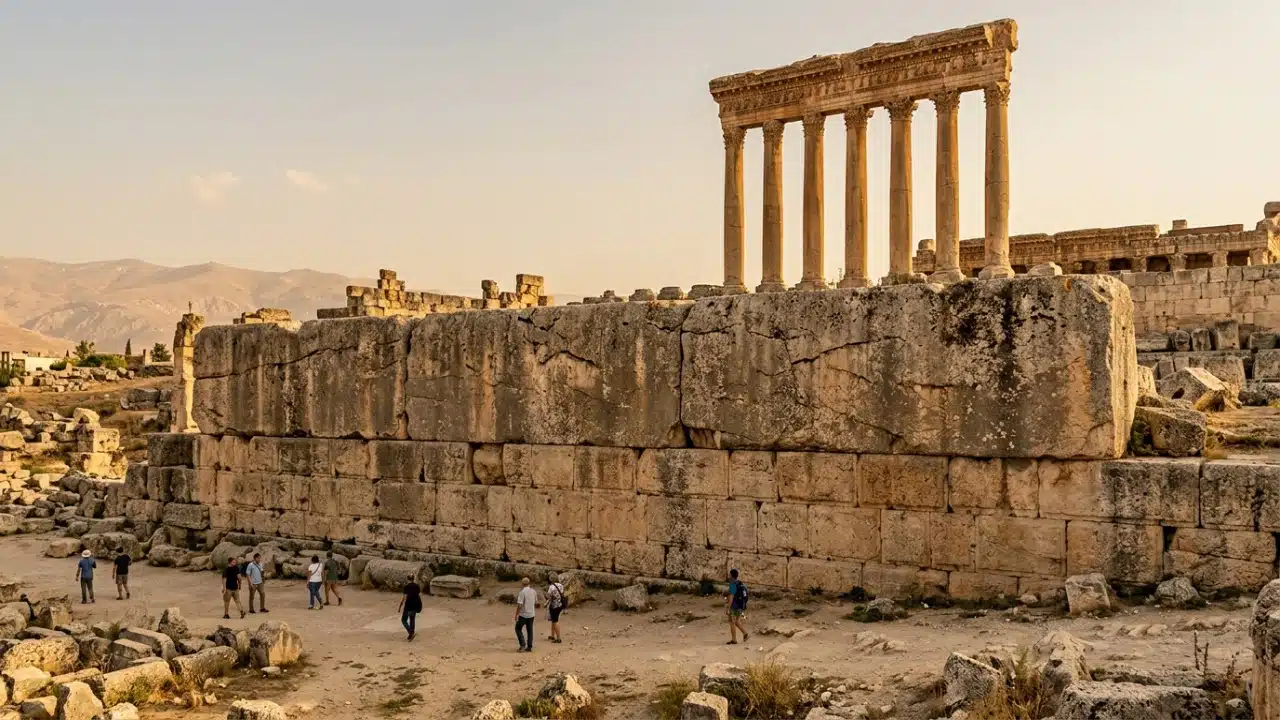
Baalbek Megaliths: How Did Ancients Move 1,650-Ton Stones?
The Stones That Should Not Exist
In the Bekaa Valley of Lebanon, at an altitude of roughly 1,170 meters above sea level, there is a quarry that has been confusing archaeologists for over a century.
The quarry is not particularly hidden. It sits less than a kilometer from one of the most famous ancient temple complexes in the world, the Roman sanctuary of Baalbek, known in antiquity as Heliopolis, the city of the sun. The quarry is open, accessible, and has been examined by researchers from Germany, France, Lebanon, and the United States. Everything about it is visible and documented.
And yet the central question it poses has never been answered.
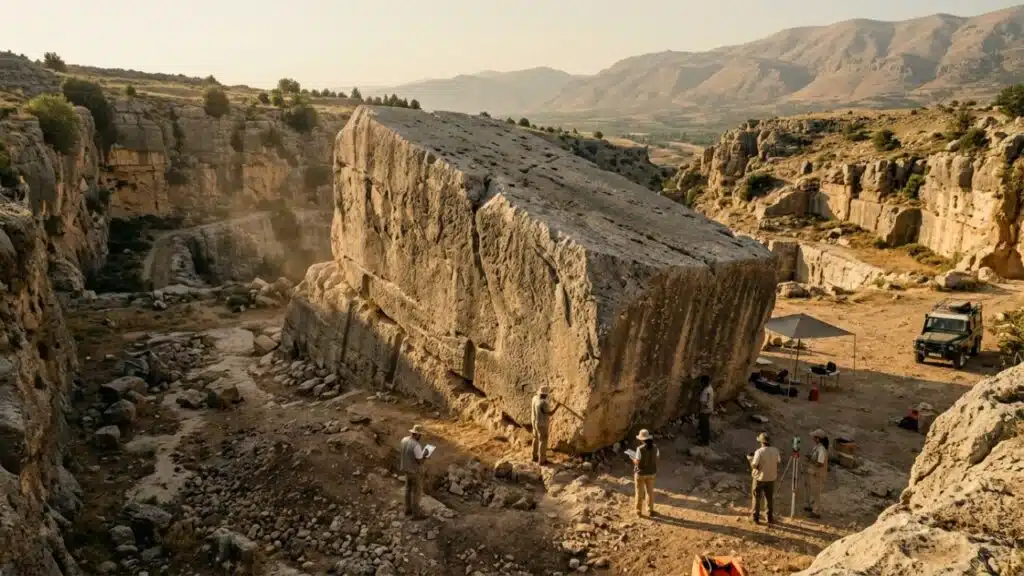
Lying on the quarry floor, half-extracted from the bedrock and never moved from the spot where ancient craftsmen cut them, are some of the largest stones ever shaped by human hands. The Stone of the Pregnant Woman weighs approximately 1,000 tonnes. The Stone of the South, identified in 2014, weighs approximately 1,242 tonnes. Beneath it, found in the same excavation by the German Archaeological Institute, lies a third block: the Forgotten Stone, measuring 19.6 meters long, 6 meters wide, and at least 5.5 meters high, with an estimated weight of 1,650 tonnes.
That last number is not a misprint. 1,650 tonnes is heavier than two fully loaded Boeing 747 aircraft. It exceeds the lifting capacity of the largest modern cranes. It is the heaviest known cut stone block in human history.
And in the foundation of the Temple of Jupiter at Baalbek, three stones almost as large were successfully moved from this quarry, placed in position, and built upon. The Baalbek megaliths are not a mystery of imagination. They are a mystery of physics, and the physics still does not have a fully satisfying answer.
Quick Answer: Baalbek Megaliths
What are the Baalbek megaliths?
The Baalbek megaliths are a collection of massive ancient cut stone blocks located at Baalbek in Lebanon’s Bekaa Valley, dating primarily to the Roman Imperial period. They include the Trilithon, three foundation stones each weighing approximately 800 tonnes, incorporated into the podium of the Temple of Jupiter, and three additional stones left unfinished in the nearby quarry: the Stone of the Pregnant Woman at 1,000 tonnes, the Stone of the South at approximately 1,242 tonnes, and the Forgotten Stone discovered in 2014 at approximately 1,650 tonnes. The Baalbek megaliths are the largest cut stone blocks in recorded human history.
How were the Baalbek megaliths moved?
No definitive answer exists. The quarry sits slightly higher than the temple complex, meaning the stones did not need to be lifted upward during transport and could theoretically have been moved downhill. Researchers have proposed wooden sledges, earthen ramps, wooden rollers, and organized rope-and-labor systems. A February 2025 academic study proposed four new technological methods, including platform weight distribution and oxen-assisted sledge systems. Czech experimental archaeologist Pavel Pavel calculated that 160 workers using ropes and wooden sledges could theoretically move an 800-tonne stone. No physical evidence for any specific method has been confirmed at Baalbek.
Who built the Baalbek megaliths?
The Roman attribution for the temple construction is accepted by mainstream archaeology. The Roman sanctuary at Baalbek was one of the most ambitious building projects in the entire Roman Empire, dedicated to Jupiter, Bacchus, and Venus. However, a significant debate exists about whether the massive foundation stones, the Baalbek megaliths now visible in the podium wall, were quarried and placed by the Romans or represent an earlier pre-Roman construction phase that the Romans built upon. Evidence of two distinct construction eras at the site has been noted by multiple researchers.
Why were the large quarry stones never moved?
The German Archaeological Institute’s 2014 excavation determined that the Stone of the Pregnant Woman was left in the quarry because defects in the stone quality on one edge made it vulnerable to damage during transport. The Forgotten Stone beneath it appears to have been fully cut but never moved for unknown reasons. The abandonment of these stones suggests the construction project at Baalbek was either interrupted, changed in design, or encountered problems that remain undocumented in surviving ancient records.
The Scale That Defeats Modern Technology
Before examining how the Baalbek megaliths were moved, it is worth sitting with the scale problem long enough to feel it properly.
The largest modern mobile crane, the Liebherr LTM 11200-9.1, has a maximum lifting capacity of approximately 1,200 tonnes under ideal conditions. That is less than the weight of the Stone of the South. The Forgotten Stone, at 1,650 tonnes, exceeds it entirely. These are not engineering problems that modern technology solves easily.
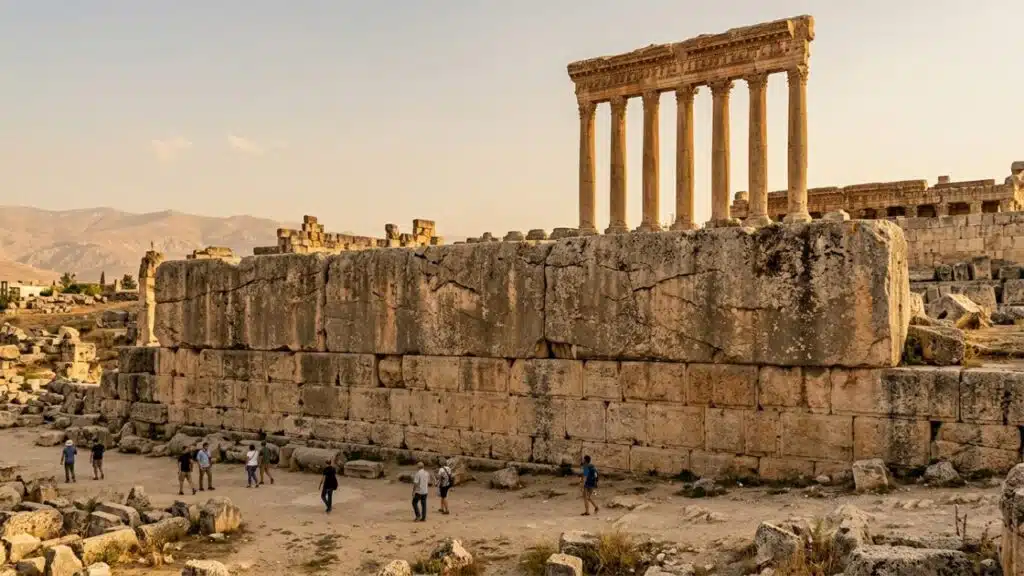
The three Trilithon stones actually incorporated into the foundation wall of the Temple of Jupiter each weigh between 750 and 800 tonnes. They are positioned at a height of approximately 8 meters above the surrounding ground, running in a horizontal row that forms part of the temple’s massive platform. Each stone is roughly 19 meters long. Together they form what archaeologists call the Trilithon, from the Greek word for three stones, and they have been in continuous scholarly attention since German expeditions began examining the site in 1898.
The Baalbek megaliths in the podium wall are not isolated curiosities. They are structural components of a functioning architectural system, placed at height, integrated with surrounding masonry, and supporting the enormous columns and entablature of a temple that was, in its Roman period, one of the most impressive religious complexes in the known world. Whoever moved them did not move them casually. They moved them as part of a precision construction operation.
The quarry sits approximately 800 meters from the temple site, at a slightly higher elevation. This geographical detail is one of the few physical facts that helps constrain the transport problem. The Baalbek megaliths did not need to be lifted during their horizontal journey because the ground slopes downward from the quarry to the construction site. The transport challenge was primarily one of controlled descent and directional movement rather than pure vertical lifting.
This makes the problem somewhat more tractable. Somewhat.
What Roman Engineering Could Actually Do
Mainstream archaeology’s position on the Baalbek megaliths is that the Romans built the temple complex and moved the foundation stones, and that position is supported by significant evidence.
The Romans were not strangers to moving enormous weights. Throughout the empire, they transported obelisks from Egypt to Rome, some weighing over 400 tonnes. They moved granite columns tens of meters long across the Mediterranean by ship. The Colosseum’s construction involved moving hundreds of thousands of tonnes of travertine limestone from quarries miles away. Roman engineering was systematic, organized, and capable of achievements that still impress modern civil engineers.
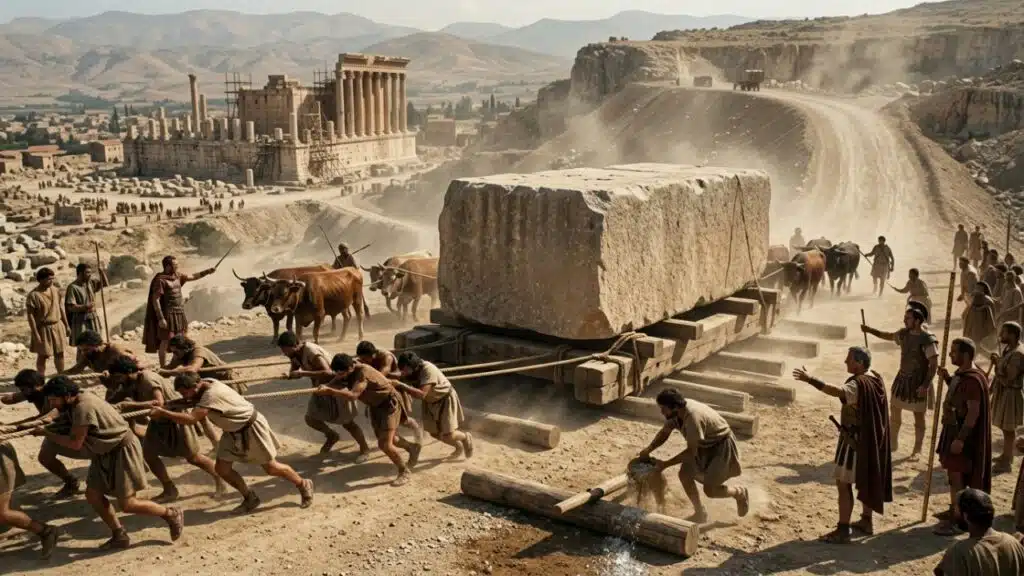
The specific methods available to Roman engineers for the Baalbek megaliths included wooden sledges pulled by teams of oxen and humans, earthen ramps constructed to create manageable slopes, wooden rollers placed beneath sledges to reduce friction, rope-and-pulley systems multiplying mechanical advantage, and the careful preparation of the transportation route to minimize obstacles.
A February 2025 academic study published through academia.edu examined the Baalbek megaliths specifically and proposed four new technological approaches for how the stones could have been moved. The proposals included wooden trolley systems with distributed weight platforms, oxen-assisted movement using parallel rope teams, and a staged relocation method involving temporary earthen berms that were raised and lowered as the stone advanced. The study referenced writings by Pliny the Elder and archaeological evidence from Roman construction sites elsewhere in the empire to build the engineering case.
Czech experimental archaeologist Pavel Pavel, who has spent decades testing ancient construction methods on heavy stones, calculated that approximately 160 workers using ropes and wooden sledges could theoretically move one of the 800-tonne Trilithon stones. This is not a small workforce, but it is a plausible one for a Roman-era imperial construction project that commanded the resources of an empire.
The Baalbek megaliths, in this interpretation, represent the extreme upper end of Roman engineering ambition, using known techniques at a scale that pushes against the physical limits of what those techniques could achieve, but does not exceed them by so much as to require any alternative explanation.
The Geology That Demanded This Scale
One question that rarely appears in popular accounts of the Baalbek megaliths is why the Romans would have used stones this large in the first place. Enormous stones are not inherently better building materials than well-cut smaller blocks. The Parthenon, the Pantheon, and most other celebrated Roman and Greek monuments used manageable stone components assembled with precision rather than monstrous single blocks.
The answer lies under the ground at Baalbek.
The Beqaa Valley sits on karst limestone terrain, a geological formation characterized by dissolved bedrock, underground voids, and irregular surface topography. Building a monumental temple complex on karst ground requires foundations of exceptional mass and stability, because the irregular subsurface cannot be trusted to distribute load evenly the way solid flat rock or compacted soil can.
The Baalbek megaliths in the foundation podium are not architectural showmanship in the first instance. They are a geological engineering response. Stones of this scale create a platform whose mass and lateral extent distribute the enormous load of the temple columns and roof across a wide enough area to prevent differential settling into the karst voids below. Smaller blocks, even carefully laid, would not provide the same foundation integrity on this terrain.
This is why the stones had to be so large. The architecture demanded it because the ground demanded it. The Baalbek megaliths exist not because ancient engineers wanted to impress observers from above, though they clearly did, but because the physics of the site left no other viable option for a temple of this ambition.
Two Construction Eras: The Oldest Mystery at Baalbek
The most contested aspect of Baalbek megaliths research is not how the stones were moved but when, and by whom, they were first quarried and placed.
A careful examination of the site reveals something that multiple independent researchers have noted but that mainstream archaeology has not fully resolved: the Baalbek megaliths in the foundation podium show characteristics that appear to belong to a different construction tradition than the Roman temple built above them. The massive blocks are not placed at the base of the foundation structure as would be expected if the Romans designed the platform from scratch. They appear at an intermediate height, with different-sized blocks both below and above them.
Researcher and archaeologist Jean-Pierre Adam, whose work on Roman construction techniques is widely cited, proposed that the Romans may have encountered an already existing structure at Baalbek and incorporated it into their own construction. Under this reading, the Baalbek megaliths represent a pre-Roman foundation of unknown date and unknown builders, onto which the Romans laid their temple complex when they arrived in the first century BCE.
This interpretation explains the visual inconsistency between the megalithic foundation stones and the surrounding Roman masonry: they were made by different people at different times, using different techniques and different scales of ambition. The Romans, encountering stones of this size already in place, built around and above them rather than replacing them.
No ancient inscription identifies who built the original podium. No text from antiquity describes its construction. The Baalbek megaliths in the foundation wall are, in this reading, older than the temple they support, and their builders are unknown.
The Three Stones That Never Left the Quarry
While the Baalbek megaliths in the temple podium have been studied for well over a century, the quarry stones present their own separate and unresolved set of questions.
The Stone of the Pregnant Woman, known in Arabic as the Hajjar al-Hibla, has been visible and known to researchers since the nineteenth century. It is approximately 20 meters long and weighs around 1,000 tonnes. The German Archaeological Institute’s 2014 excavation determined from examination of the machining marks that it was left in the quarry because defects in the stone quality on its edge made it vulnerable to cracking during transport. This is the clearest explanation for one quarry stone’s abandonment.
The Stone of the South, measuring approximately 19.5 to 20.5 meters long and weighing an estimated 1,242 tonnes, was discovered during the same 2014 excavation and appears to have been fully cut and prepared for transport but never moved. The reason for its abandonment is unknown.
The Forgotten Stone, measuring 19.6 by 6 by at least 5.5 meters and estimated at 1,650 tonnes, lay directly beneath the Stone of the South and was found during the same excavation. The German Archaeological Institute confirmed it was cut to be transported without further size reduction, meaning it was intended to move as the single largest stone block ever prepared for construction in human history.
It never moved. Whatever interrupted the construction program at Baalbek did so before the Forgotten Stone could be relocated. What caused that interruption is not recorded in any surviving ancient text, not traceable in the archaeological sequence with certainty, and not explained by any physical evidence yet recovered from the site.
The Baalbek megaliths that sit in the quarry are, in a sense, more mysterious than those in the temple wall. The ones in the wall were used. The ones in the quarry were prepared and abandoned, and the preparation itself raises a question nobody has answered: what structure at Baalbek was planned to require a 1,650-tonne foundation stone, and why was it never built?
What Modern Science Has and Has Not Resolved
The Baalbek megaliths have attracted multiple scientific investigations using methods unavailable to earlier generations of researchers. Ground-penetrating radar has been used to examine the subsurface below the temple platform. Photogrammetric surveys have produced millimeter-accurate three-dimensional models of the quarry stones and their machining marks. The German Archaeological Institute’s stratigraphic analysis of the quarry has added precise information about quarrying sequences and tool marks.
What these investigations have confirmed is that the stones were cut using iron tools, that the quarrying sequence is consistent with Roman-period construction techniques, and that the geography of the site, with the quarry slightly above the temple, made downhill transport theoretically feasible.
What they have not resolved is the specific transport mechanism. No wooden sledge fragments, no remains of earthen ramps, no rope anchors, and no roller debris have been identified in direct archaeological association with the Baalbek megaliths transport route. The physical evidence for how the stones moved from quarry to temple simply does not survive, if it ever existed in recoverable form, which for organic materials in a continuously occupied site over two thousand years is not surprising.
The baalbek megaliths will, in all probability, never yield a definitive answer on the specific transport method. What the site will continue to yield is a better understanding of the construction sequence, the building phases, and the engineering logic of a project whose ambition was, by any measure, extraordinary.
Conclusion: Engineering at the Edge of the Possible
The Baalbek megaliths are not evidence of lost technology, supernatural intervention, or civilizations unknown to history. They are evidence of something that is in some ways more impressive: the maximum possible achievement of human engineering within the constraints of the ancient world.
Roman engineers at Baalbek solved a genuine geological problem with the largest stones they could extract, move, and place using the most sophisticated version of the tools and methods available to them. They pushed those methods to a scale that modern experimental archaeology confirms is theoretically achievable with organized labor, mechanical advantage from ropes and sledges, and meticulous preparation of the transport route.
Whether they found those enormous foundation stones already in place, laid by earlier builders whose identity remains unknown, or whether they quarried and moved every stone themselves, the result is the same: a platform of extraordinary mass and stability on which one of the Roman Empire’s most ambitious religious complexes rose and stood for centuries.
The baalbek megaliths ask a question that engineering history rarely gets to ask quite so directly. Not simply how did they do it, but how did they even conceive of doing it? What kind of accumulated knowledge, organizational capacity, and institutional confidence in their own methods allowed ancient builders to look at a 1,000-tonne block of limestone and decide it was movable?
The answer is still being worked out. The quarry still has secrets. The foundation still holds questions no excavation has yet reached.
And the Forgotten Stone still lies where it was cut, 1,650 tonnes of silent limestone, waiting for someone to explain why it never made the journey it was prepared for.
Discover a Hidden Maya City
Deep in Mexico’s jungle, LiDAR has revealed a massive lost city of 30,000 people—reshaping everything we know about Maya civilisation.
In 2024, a team of archaeologists made a discovery that could change everything: they found a lost city beneath the pyramids.
Click below to watch the full story:
https://www.youtube.com/@EchoesofAntiquity-egypt/videos
Sources
- German Archaeological Institute (DAI) — “Biggest ancient stone block in Baalbek/ancient Heliopolis” (2014 excavation, Oriental Department, Lebanese-German team) — archaeology.wiki
- Heritage Daily — “Research team discover the world’s largest ancient stone block in Baalbek” (December 2, 2014) — heritagedaily.com
- Academia.edu (February 3, 2025) — “Lifting and Transportation of Monolith Stone in Baalbek” (four new technological proposals for moving the megaliths) — academia.edu
- ResearchGate — “The Baalbek Enigma” (Jean-Pierre Adam framework, two construction eras analysis, pre-Roman foundation hypothesis) — researchgate.net
- Ancient Origins — “Baalbek’s Stone of the Pregnant Woman: How Was This 1000-Ton Megalith Moved?” — ancient-origins.net
- Ancient Origins — “Largest known megalithic block from antiquity revealed at Baalbek” — ancient-origins.net
- Curiosmos — “How ancient engineers moved stones heavier than jumbo jets” — curiosmos.com
- Missed History — “Baalbek: Roman Temples Rise Above Enigmatic Megaliths” (August 2026) — missedhistory.com
- Ancient Civilizations — “Baalbek Megaliths: The Largest Cut Stones in the World” — ancientcivilizations.org
- The 961 — “How Lebanon Ended Up With The Largest Manmade Block On Earth” — the961.com
- Wikipedia — “Baalbek Stones” — en.wikipedia.org
- Wikipedia — “List of largest monoliths in the world” (weight and dimension verification) — en.wikipedia.org
- Wikipedia — “Pavel Pavel” (experimental archaeology calculations for Baalbek stone transport) — en.wikipedia.org
- Ancient Pages — “Gigantic Horizontally Lying Stones of Ancient City of Baalbek” — ancientpages.com