
Beachy Head Woman DNA Rewrite Britain’s Roman Past
Beachy Head Woman DNA Rewrite Britain’s Roman Past
Beachy Head Woman DNA has become one of the most talked-about archaeological revelations of recent years, not because it introduced a new skeleton, but because it completely upended how historians and the public interpreted her identity.
Before her true ancestry was finally discovered through advanced DNA research, the remains of this Roman-era woman, who was initially believed to be of African origin but subsequently perhaps Mediterranean, generated discussion and fascination for more than ten years.
This change in perspective goes beyond the origins of a single ancient woman. It emphasizes how advancements in science have the power to alter historical accounts once they have been established.
An Undiscovered Skeleton That Was Later Forgotten
In 2012, the remains—later named Beachy Head Woman—were found again in a box in the basement of Eastbourne Town Hall in southern England. No official excavation documents survived, despite the fact that she had been discovered decades earlier, most likely in the 1950s close to the chalk cliffs of Beachy Head. Her death occurred during the Roman rule of Britain, between AD 129 and 311, according to radiocarbon dating. She was slightly over 4.9 feet tall and, according to skeletal study, was between 18 and 25 years old when she passed away. A healed leg injury implies that she had survived severe damage earlier in life.
Her narrative remained mysterious for years.
Early Interpretations: Africa and the Mediterranean
The first major scientific interpretations of her origin were not genetic. Instead, they relied on morphometric analysis—the study of skull shape and measurements,which in her case suggested sub-Saharan African ancestry. This finding captured public imagination and was even highlighted in the 2016 BBC series Black and British: a Forgotten History, where she was presented as a possible example of early African presence in Britain.
She may have Mediterranean ancestry, maybe from places like Cyprus, according to later unpublished DNA evidence from 2017. However, because of the scant and poor quality of the DNA data, scientists were cautious about this notion.
Although the mystery was maintained by these divergent interpretations, they lacked the clarity that comes from high-quality genomic sequencing.
The DNA Breakthrough That Changed Everything
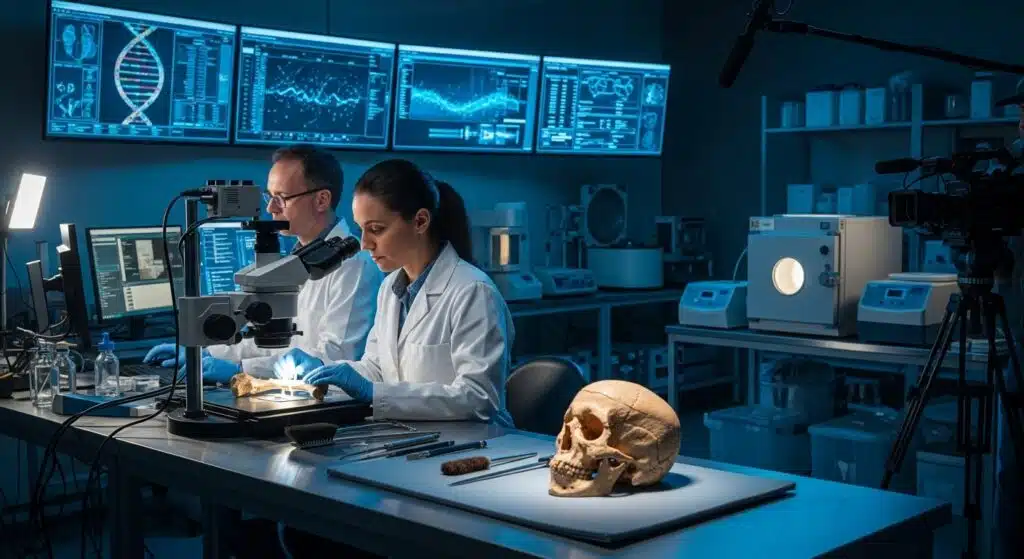
In late 2025, researchers from the Natural History Museum and University College London (UCL), led by Dr Selina Brace and Dr William Marsh, completed the first comprehensive genetic analysis of the Beachy Head Woman’s remains. Using the latest advances in ancient DNA sequencing that were unavailable in earlier attempts, the team was able to securely sequence high-quality DNA and compare it with extensive genomic databases.
The results were clear:
- Her DNA showed strong genetic affinity with individuals from Roman-era rural Britain.
- There was no evidence of recent sub-Saharan African ancestry.
- There were also no signals of Mediterranean genetic admixture.
In other words, the Beachy Head Woman was most likely local to southern Britain, genetically similar to people living in the region during the Roman period and today.
This challenges preconceived notions and emphasizes how advancements in technology may both strengthen and occasionally challenge historical interpretations.
What Her DNA Says About Her Appearance and Life
Beyond where she came from, the DNA data allowed researchers to predict aspects of her appearance, which were then used in updated digital reconstructions:
- Probable light skin pigmentation
- Likely blue eyes
- Light-colored hair
- Dietary indicators (carbon and nitrogen isotope levels) consistent with a seafood-rich diet, fitting for a life near the southern English coast.
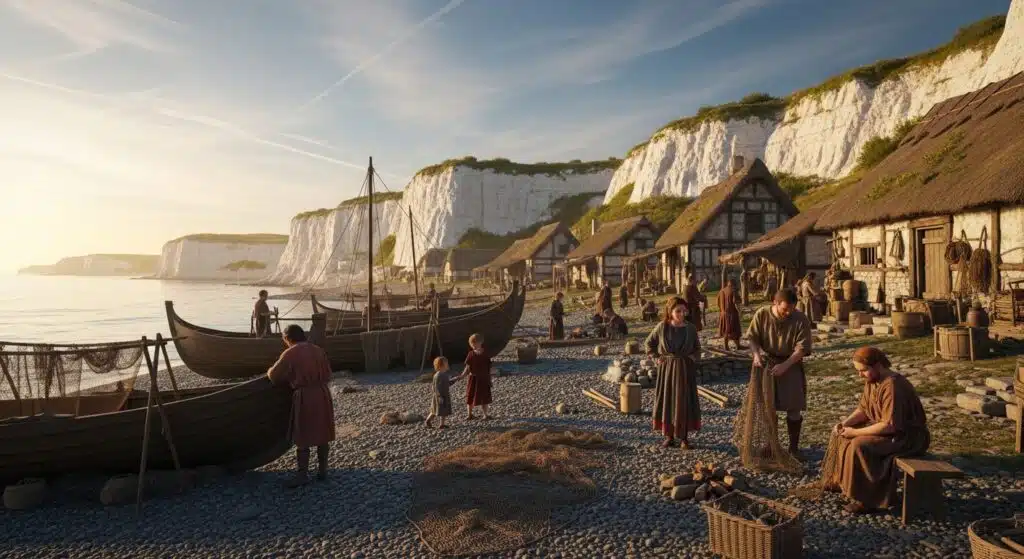
These insights humanize her, turning a once-anonymous skeleton into a young woman who lived, ate, and possibly worked near the chalk cliffs of Beachy Head nearly two millennia ago.
Why Previous Opinions Were Incorrect—And What This Tells Us
The DNA discovery of the Beachy Head Woman reveals numerous crucial insights on the interpretation of archaeology:
- Morphology by Itself Can Be Deceptive
Once employed to determine ancestry, skeletal dimensions and skull shape are now known to be unreliable in the absence of genetic evidence. - DNA Is Insufficiently Partial
Due to inadequate preservation and low-quality data, early genetic attempts caused researchers to make inaccurate hypotheses. Scientists could only make solid conclusions with more extensive comparison datasets and sophisticated sequencing. - Scientific Knowledge Develops
The changing interpretations—from Mediterranean to African to local British—illustrate how science self-corrects as instruments advance. This continual improvement improves our historical knowledge rather than undermining trustworthiness.
Public Reaction and Cultural Impact
The Beachy Head Woman case captured public and media attention not just because of what it says about Roman Britain, but because it intersected with modern discussions about identity and diversity in history. A plaque once commemorated her as Britain’s earliest known Black person, a designation now removed after the DNA correction.
Her particular story is clarified as one based on local British lineage, even though the latest discoveries do not lessen the diversity of Roman Britain. where soldiers and settlers from all around the empire undoubtedly lived.
Because of this, she is not a representation of global connectivity but rather of how common people in Roman Britain lived their daily lives, whose tales we are only now starting to learn about.
Changing History One Genome at a Time
The Beachy Head Woman teaches us that history is not static. Scientific advances like improved DNA sequencing allow us to revisit old conclusions and, when necessary, rewrite them based on better evidence.
Her story goes beyond a single skeleton; it represents how technology reshapes our understanding of the past, giving voice to individuals who might otherwise remain anonymous.
And as ancient DNA science continues to advance, we can expect more historical mysteries to be resolved—and more stories rewritten in the light of new evidence.
Explore Rome’s Economic Collapse
While science rewrites Britain’s Roman past, another powerful lesson comes from the fall of the Roman Empire itself.
Read:
Roman Inflation Parallels: Lessons for America’s Future
https://antiqueechoes.com/roman-inflation-parallels-lessons-for-america-future