

Did the Myth of Atlantis Hide a Real Disaster?
The Story That Refused to Die
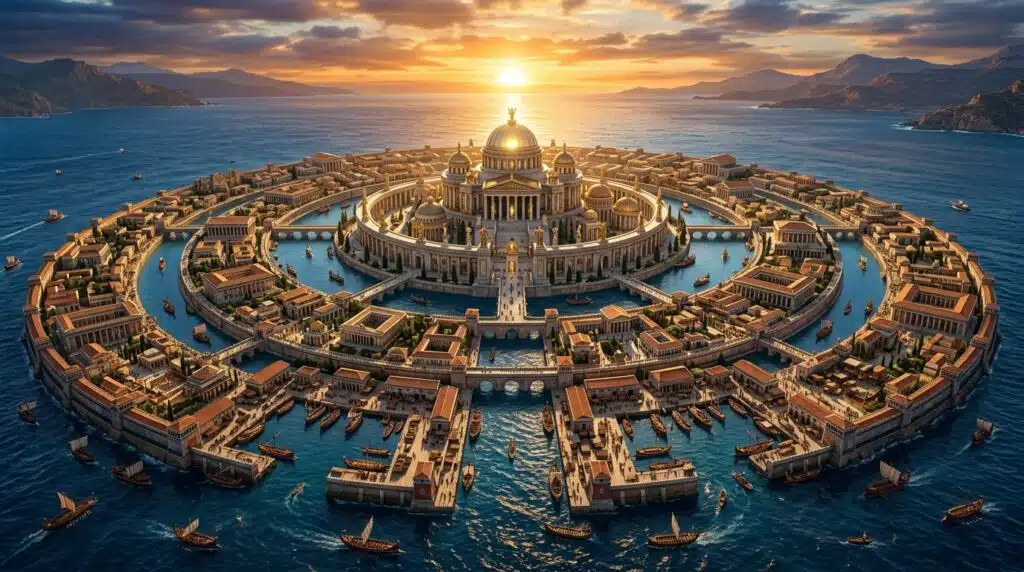
Around 360 BC, a Greek philosopher sat down and wrote about a civilisation that had vanished beneath the sea nine thousand years before his time. He described a powerful island empire ringed by canals, gleaming palaces, a naval force that dominated the ancient world, swallowed whole by the ocean in a single night.
His name was Plato. And the myth of Atlantis has not left us alone since.
For over two millennia, scholars have argued over what Plato was really doing. Was it pure philosophical allegory — a moral fable about the dangers of greed and hubris? Was it history passed down through generations of oral tradition, distorted beyond recognition? Or was it something in between a real catastrophe so devastating that its memory bled into mythology and stayed there, haunting the edges of the ancient world’s imagination?
The answer, it turns out, may be buried under the ash of a volcano.
Quick Answer: The Myth of Atlantis
What is the myth of Atlantis? The myth of Atlantis originates from the Greek philosopher Plato’s dialogues Timaeus and Critias, written around 360 BC. It describes an advanced island empire that sank into the Atlantic Ocean in “a single day and night” after its rulers grew morally corrupt and arrogant.
Did Atlantis actually exist? No confirmed archaeological evidence supports the existence of Atlantis as a real location. Most scholars view it as a philosophical allegory. However, real historical disasters, particularly the catastrophic eruption of the volcanic island of Thera around 1600 BC, may have inspired key elements of the myth of Atlantis.
Where was Atlantis supposed to be? Plato placed it beyond the “Pillars of Hercules”, the modern Strait of Gibraltar, in the Atlantic Ocean. Proposed real-world locations range from the Greek island of Santorini to the Canary Islands, Spain’s Doñana wetlands, and even Antarctica.
Who first wrote about Atlantis? Plato is the sole ancient source for the myth of Atlantis. No other Greek or Egyptian text independently corroborates his account.
What Plato Actually Said
Before examining what the myth of Atlantis might be based on, it is worth returning to the source because most people who talk about Atlantis have never actually read Plato.
In Timaeus, the Athenian lawmaker Solon travels to Egypt and learns from the priests of Sais about a forgotten chapter of history. According to this account, the ancient Athenians once defeated a vast naval empire, Atlantis, that had been attempting to conquer the entire Mediterranean world. Shortly after Athens’s victory, a series of catastrophic earthquakes and floods struck. The Athenian warriors sank into the earth. And the island of Atlantis, as the Egyptian priest told Solon, “disappeared in the depths of the sea.”
The detail that Plato hammers home, the one that scholars keep coming back to, is the timeline. This happened, according to Critias’s dialogue, roughly 9,000 years before Solon’s time. That places the destruction of Atlantis at approximately 9600 BC.
That number is critical. And as we will see, it may be where the myth of Atlantis breaks most sharply from any real historical event we can identify.
The Allegory Argument: Plato the Philosopher
Here is a strong case that the myth of Atlantis is pure invention.
Plato was not a historian. He was a philosopher, and the myth of Atlantis appears embedded in a dialogue that is primarily about cosmology, the nature of the universe, and the ideal state. The story arrives at an extremely convenient moment: Socrates has just outlined his ideal republic, and suddenly Critias steps forward with a tale that happens to feature an ancient Athens that embodied exactly those ideals and heroically defeated a corrupt, imperial enemy.
History doesn’t typically operate that way. Allegory functions in this way.
Plato had significant political intentions, according to academics who consider the tale of Atlantis to be a work of fiction. After losing the Peloponnesian War and being humiliated by the catastrophic Sicilian Expedition, Athens was in decline in the fourth century BC. Plato used the story of Atlantis to support his claims that moral degradation leads to ruin and that Athens’ virtue once saved the entire globe in a far-off, forgotten era.
The story “captures the imagination” because it conveys a universal message about civilisation and collapse, as stated by Bard College classics professor James Romm. The precise location might not be important. The caution does.
The Thera Hypothesis: When Myth Meets Geology
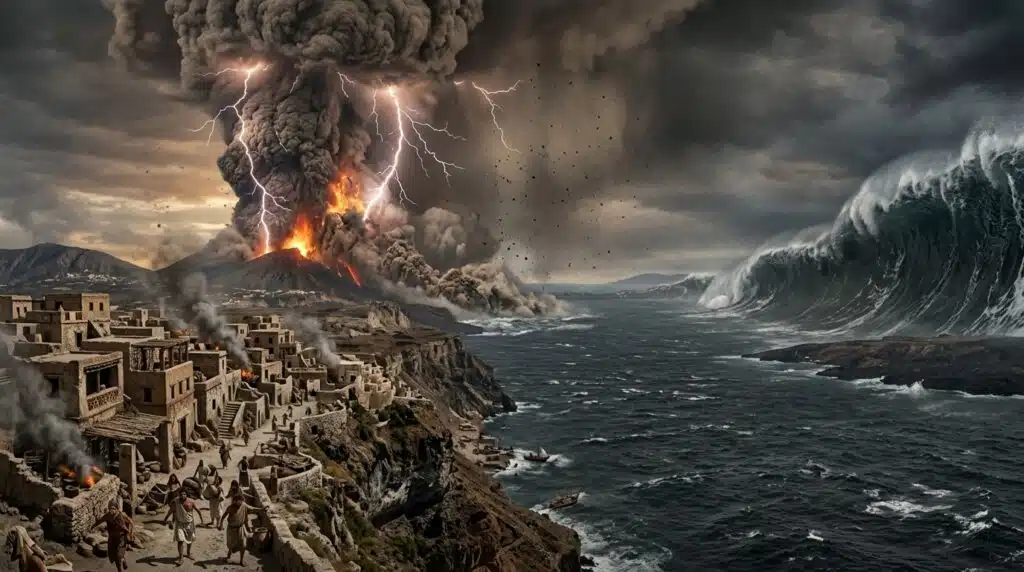
And yet. There is a catastrophe in the ancient Aegean that fits certain elements of the myth of Atlantis with uncomfortable precision.
The volcanic island of Thera, which is now Santorini, saw one of the most cataclysmic eruptions in recorded human history around 1600 BC, give or take a few decades. According to radiocarbon dating reported in Science, the Santorini eruption occurred between 1627 and 1600 BC. According to geologists, it spewed about 60 cubic kilometres of material into the atmosphere, making it a VEI 6–7 event. Its force was similar to that of Krakatoa in 1883, but it was probably far greater.
Massive tsunamis were caused by the subsequent caldera collapse. The eastern Mediterranean was covered in a cloud of ash. And the Minoan civilisation, which dominated the Aegean during the Bronze Age and had a flourishing settlement on Thera itself, was never the same.
A Bronze Age Pompeii frozen in a single catastrophic moment, the Minoan settlement on Thera, now known as Akrotiri, was preserved to such an extent that archaeologists who excavated it after 1967 discovered houses of two and three stories, exquisite frescoes, and painted ceramics. Although it is still up for question, the eruption disrupted trade lines, caused tsunamis to destroy coastal settlements, and ultimately contributed to the demise of Minoan society.
This is where real history and the fiction of Atlantis start to resemble each other.
a strong island society. Abruptly destroyed by the ocean and shifting geology. Gone in what must have appeared to survivors to be a single disastrous night.
Plato’s Critias describes the island sinking “in a single day and night of misfortune.” The myth of Atlantis describes a great maritime power, advanced in architecture and naval strength, erased by divine punishment. The Minoans were a sophisticated Bronze Age culture with impressive art, extensive trade networks, and a powerful maritime presence in the Mediterranean.
The parallels are striking. They are not proof. But they are nothing.
Why the Timeline Doesn’t Fit And Why That Matters
Here is the central problem with reading the myth of Atlantis as a memory of the Thera eruption.
Plato dates the destruction of Atlantis to approximately 9600 BC. The Thera eruption occurred around 1600 BC, a discrepancy of eight thousand years. That is not a rounding error. That is a chasm.
Some scholars have proposed that Plato’s Egyptian sources may have confused Egyptian lunar months, for years, compressing or expanding the timeline dramatically in the process of transmission. Others suggest that as the myth of Atlantis passed through generations of oral tradition from Egyptian priests to Solon, from Solon to Critias’s great-grandfather, through more generations still, the numbers became increasingly unreliable.
This is not impossible. Oral traditions distort timelines. The myth of Atlantis, if it does carry a kernel of real catastrophe, would have passed through at least fifteen hundred years of retelling before Plato ever wrote it down.
There is also the geographical mismatch. Plato places Atlantis beyond the Pillars of Hercules in the Atlantic Ocean. Thera and Crete sit squarely inside the Mediterranean. The myth of Atlantis, as Plato tells it, describes an island “larger than Libya and Asia Minor put together.” Thera is 28 square kilometres.
These are not small discrepancies. The most careful scholars acknowledge that even if the Thera catastrophe contributed some emotional or cultural raw material to the myth of Atlantis, Plato massively amplified, relocated, and reframed it for his philosophical purposes.
Other Theories: What Else Could Have Inspired the Myth?
The Thera hypothesis is the most compelling, but the myth of Atlantis has attracted other serious proposals.
Some scholars have suggested that the Bronze Age world collapsed approximately 1200 BC, when several civilisations in the Eastern Mediterranean collapsed at the same time, including the Mycenaeans, the Hittites, and the Levantine towns. One of the most contentious disasters in history, the “Bronze Age Collapse” caused a psychic wound that persisted for generations in mythology throughout the ancient world.
Others have noted that real cities did disappear into the sea in the ancient Mediterranean. The Greek city of Helike, on the coast of the Gulf of Corinth, was swallowed by an earthquake and tsunami in 373 BC, just thirteen years before Plato wrote the Timaeus. Plato may have had very recent, local news in his mind when he crafted the myth of Atlantis.
The myth of Atlantis may be less a single memory of a single disaster and more a cultural container, a vessel into which the ancient world poured all its accumulated fear of civilizational destruction, filled from multiple sources across centuries of catastrophe.
What the Evidence Actually Tells Us
Let us be precise about what we know and what we do not.
We know the myth of Atlantis originates entirely with Plato. No independent ancient source corroborates it. No Egyptian text discovered in the centuries since Plato’s time references Atlantis or Solon’s supposed conversation with the priests of Sais.
We know a real catastrophe — the Thera eruption — devastated an advanced island civilization in the Bronze Age Aegean and left traces powerful enough to reshape the entire region.
We know that Plato had strong philosophical and political reasons to construct the myth of Atlantis as an allegory, regardless of whether it carried any historical seed.
And we know that the myth of Atlantis has survived for 2,400 years not because archaeologists keep finding new evidence for it, but because something in the story speaks to a fear that never goes away: that civilization is fragile, that power corrupts, that the sea is patient, and that even the greatest empires can vanish without a trace.
Conclusion: A Myth Built on the Bones of Real Catastrophe
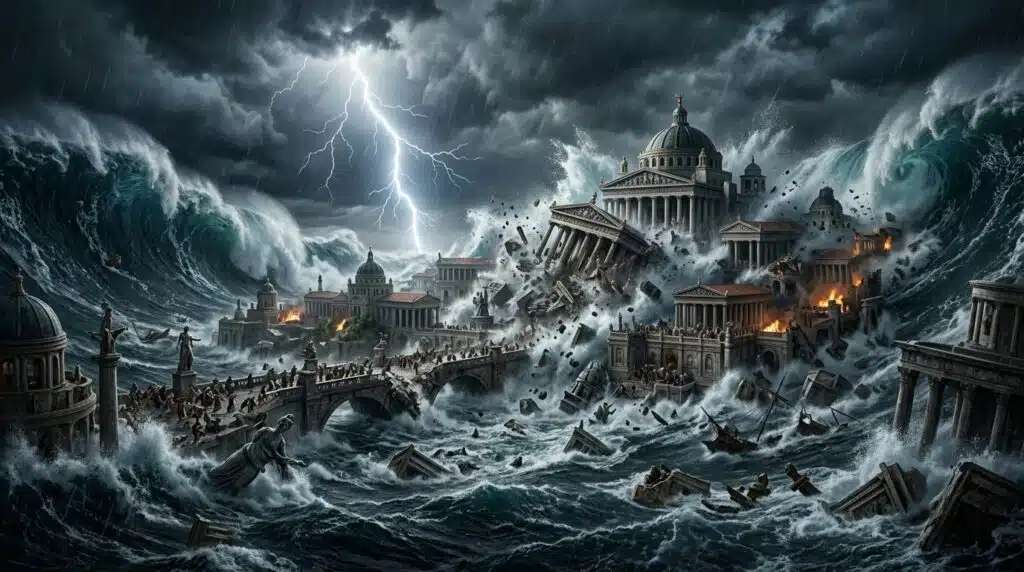
The myth of Atlantis is almost certainly not a literal historical record. But “almost certainly fictional” and “born from nothing” are two very different things.
The Bronze Age Mediterranean was a world of genuine cataclysms, erupting islands, collapsing empires, and coastlines swallowed by tsunamis. The myth of Atlantis, whatever Plato intended it to mean philosophically, carries the emotional signature of a civilisation that had seen real destruction and knew, at some deep level, that it could happen again.
Whether Plato drew on folk memories of Thera, on the sinking of Helike, on Egyptian records of Bronze Age collapse, or wove it all together from pure philosophical imagination, the myth of Atlantis is doing what the greatest myths always do. It takes a catastrophe and gives it a shape the human mind can hold.
The island is gone. The debate is not.
And perhaps that is exactly what Plato intended to leave us with a question we could never fully answer, staring out at a sea that keeps its secrets better than any philosopher ever could.
Discover a Hidden Maya City
Deep in Mexico’s jungle, LiDAR has revealed a massive lost city of 30,000 people—reshaping everything we know about Maya civilization.
In 2024, a team of archaeologists made a discovery that could change everything: they found a lost city beneath the pyramids.