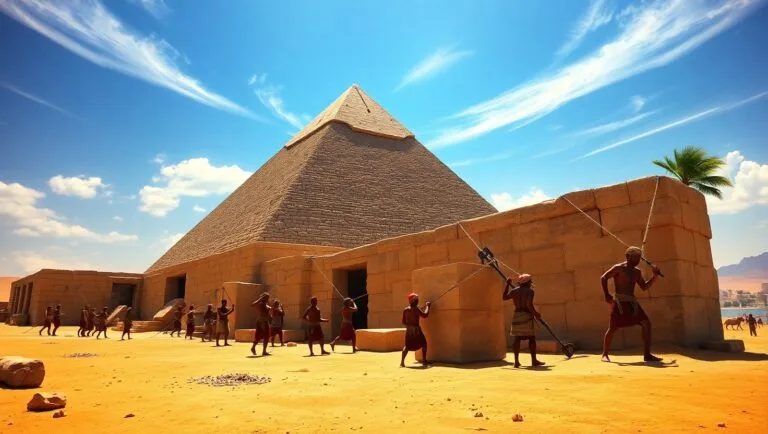

Who Burned the Library of Alexandria? The Shocking Truth
The Story We Were Told Was Always Wrong
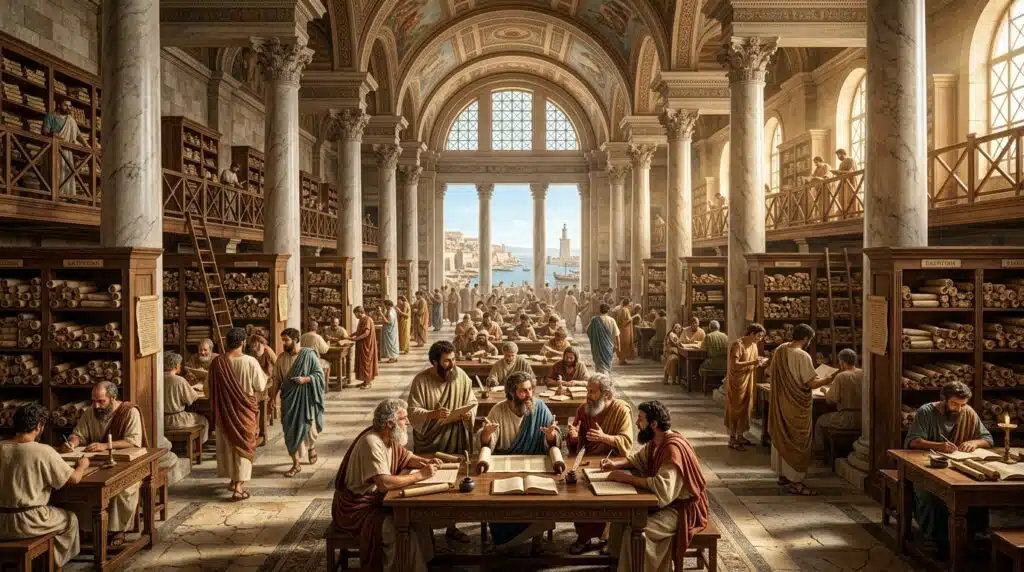
Picture this. A single night. A roaring fire. Hundreds of thousands of scrolls containing the entire knowledge of the ancient world were reduced to ash before morning. One man is responsible. One catastrophic moment.
It is a perfect story. Dramatic, clean, tragic.
It is also almost entirely wrong.
The Library of Alexandria did not burn in a single night. No one moment erased it. No single villain carries the full weight of its loss. What actually happened to the most celebrated repository of knowledge in human history is both more complicated and, in many ways, more disturbing than the fire story we have been telling for centuries.
The real history of the Library of Alexandria is not about flames. It is about something far harder to dramatize — and far harder to stop.
Library of Alexandria
Who burned the Library of Alexandria? No single person destroyed the Library of Alexandria. Historians today broadly agree that the library suffered a gradual decline over several centuries due to loss of royal patronage, neglect, underfunding, and repeated episodes of civil conflict. Julius Caesar, Christian patriarch Theophilus, and Arab Caliph Omar have all been blamed at various points, but the scholarly consensus is that the library had largely ceased to function as a major institution long before any of these events.
When was the Library of Alexandria destroyed? There is no single destruction date. The library declined progressively from around 145 BCE, when Ptolemy VIII expelled foreign scholars, through the Roman period, the Christian dismantling of the Serapeum in 391 CE, and finally the Arab conquest of Alexandria in 641 CE. By the 7th century, scholars believe the original library had already largely ceased to exist.
How many scrolls did the Library of Alexandria contain? At its height, the Library of Alexandria reportedly held between 500,000 and 700,000 papyrus scrolls. It collected works from Greece, Egypt, Assyria, Persia, and India, making it the most comprehensive repository of ancient knowledge ever assembled in one location.
Did Julius Caesar burn the Library of Alexandria? Caesar’s harbor fire in 48 BCE likely damaged warehouses near the docks and destroyed some scrolls. However, the Library of Alexandria survived this fire as an institution. Mark Antony later gave Cleopatra 200,000 scrolls from the Library of Pergamon to replenish what was lost, confirming the library still functioned after Caesar’s time.
What the Library of Alexandria Actually Was
Before untangling who destroyed it, it is worth understanding what the Library of Alexandria actually was, because most accounts get this wrong, too.
The library was not a quiet building full of shelves. It was part of a much larger institution called the Mouseion, essentially a state-funded research university built under Ptolemy I around 300 BCE and expanded dramatically by his son Ptolemy II Philadelphus. Scholars received salaries, housing, and meals in exchange for their work. The library collected texts on mathematics, astronomy, medicine, literature, philosophy, and geography.
Historians have estimated that at one time the Library of Alexandria held over half a million documents from Assyria, Greece, Persia, Egypt, India, and many other nations. Over 100 scholars lived at the Museum full-time to perform research, write, lecture, or translate and copy documents.
The library was so large that it required a second location. The library was so large that it had another branch or “daughter” library at the Temple of Serapis. This daughter library, the Serapeum, would later become central to one of the most consequential episodes in the library’s long decline.
What made the Library of Alexandria extraordinary was not just its size. It was the ambition behind it. Ptolemaic agents traveled the known world buying texts. Ships docking at Alexandria’s harbor had their books confiscated, copied, and the originals kept, while copies were returned to the owners. The library consumed knowledge the way empires consume territory — aggressively and without apology.
The First Blow: Julius Caesar and the Harbor Fire
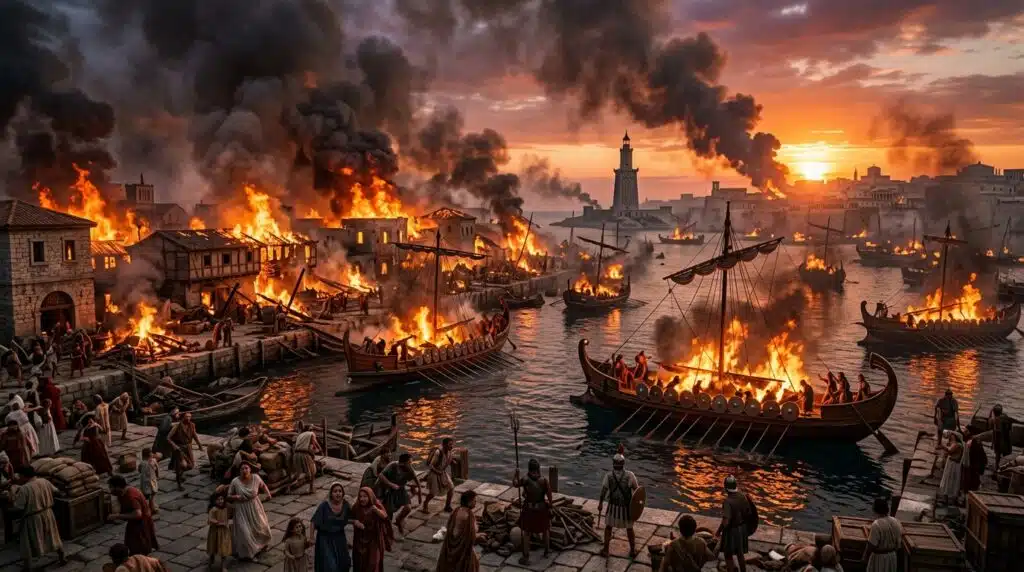
The story most people know about the Library of Alexandria begins with Julius Caesar, and it is not entirely fabricated. It is simply far smaller than legend suggests.
In 48 BCE, Caesar arrived in Alexandria, caught between the power struggle of Cleopatra and her brother Ptolemy XIII. Outnumbered and trapped near the royal harbor, Caesar set fire to ships in the harbor as a diversion, but the flames spread to the city, burning portions of the royal palace and the Mouseion, including at least part of the library.
The ancient sources disagree on the scale. Ancient historians vary as to how much of the collection was destroyed: Plutarch claimed it all went up in flames, Cassius Dio reported that a great number of fine books were burned, while other writers don’t mention the library at all in their accounts of the fire.
Roman philosopher Seneca recorded that at least 40,000 scrolls were destroyed in a single warehouse near the harbor. But crucially, that was a warehouse, not the library itself.
The clearest proof that Caesar did not destroy the Library of Alexandria comes from what happened immediately after. Mark Antony, according to Plutarch, gave the entire collection of 200,000 books from the Library of Pergamon to Cleopatra VII in 43 BCE for the library — so, clearly, a library still existed in Alexandria after Caesar’s death in 44 BCE.
Caesar’s fire damaged the Library of Alexandria. It did not end it. The institution survived, recovered, and continued for centuries. Anyone who tells you Caesar burned the library is telling you a fraction of the truth and presenting it as the whole.
The Long Silence: When Rome Stopped Caring
Here is the part of the story that almost nobody tells, and it is the most important part.
After the Ptolemaic dynasty ended and Rome absorbed Egypt, the Library of Alexandria began dying a different kind of death. Not by fire. By indifference.
The most probable explanation for its fall is a loss of patronage by the later Ptolemaic rulers, after Ptolemy VIII expelled foreign scholars in 145 BCE, and uneven support by Roman emperors, leading to a decline in the upkeep of the collection and buildings.
During a royal power struggle, Ptolemy VIII Physcon drove out many of the city’s intellectuals, including head librarian Aristarchus of Samothrace. The building and collection remained, but the nature of royal patronage changed.
Under Roman rule, the situation worsened. Over time, the Library of Alexandria “rather slowly demised due to neglect,” writes librarian and curator Sebastian Modrow in Libraries, Archives and Museums. Once a seat of Greek knowledge, Alexandria was now under Roman rule, and Roman leaders seem to have largely ignored the repository.
Imperial funding dried up. Scholars stopped coming. Copying ceased. The collection stopped growing and began to shrink due to neglect, occasional violence, and the slow decay of papyrus in a humid climate.
This is the answer nobody wants. Not a villain with a torch. Just centuries of bureaucratic disregard, budget cuts, and the quiet assumption that someone else was maintaining what everyone claimed to value.
The Christian Destruction: Theophilus and the Serapeum
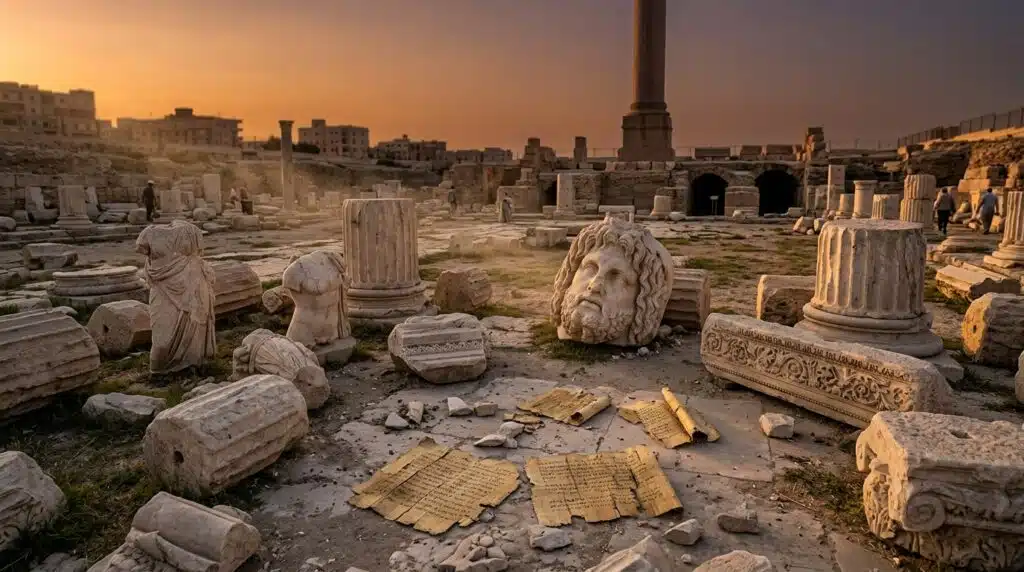
The second major blow came in 391 CE, and this one was deliberate.
By the late 4th century, Christianity had become the official religion of the Roman Empire. Emperor Theodosius issued an edict prohibiting pagan worship across the empire. In Alexandria, the man who carried out its implications with the most destruction was Theophilus, Patriarch of Alexandria from 385 to 412 CE.
In 391, Theophilus, the Patriarch of Alexandria, destroyed some pagan temples in the city, which may have included the Museum and certainly included the Serapeum, a temple for the worship of Serapis and the daughter library to the Great Library.
Riots were provoked by Theophilus, and the Temple of Serapis was torn down by a Christian mob, to be replaced by a church beside the old temple enclosure.
The Temple of Serapis was estimated to hold about ten percent of the overall Library of Alexandria’s holdings. It was not everything. But it was significant, and the symbolic destruction was total. The great Serapeum, one of the most magnificent buildings in the ancient world, was razed to its foundations.
Then, in 415 CE, came a moment that historians have never been able to fully close the chapter on. Hypatia of Alexandria, described by Britannica as a mathematician, astronomer,r and philosopher, and the daughter of Theon, the last recorded member of the Alexandrian Museum, was murdered by a Christian mob in the streets of the city. Hypatia became the victim of a particularly brutal murder at the hands of a gang of Christian zealots.
Her death did not physically destroy the Library of Alexandria. But it marked the final extinguishing of the intellectual tradition the library had sustained for six hundred years. The last person connected to the Museum was gone. The institution died not with a fire but with a murder in broad daylight.
The Arab Conquest: A Story Built on Very Thin Evidence
The third and most dramatic version of the Library of Alexandria’s destruction involves Caliph Omar, Arab forces, and the legendary claim that the scrolls were burned as fuel to heat Alexandria’s public bathhouses for six months.
The Muslim ruler Caliph Omar supposedly asserted that the library’s contents would “either contradict the Koran, in which case they are heresy, or they will agree with it, so they are superfluous.” The contents of the library were then supposedly used as tinder for the city’s bathhouses. Even then, it is said that it took six months for all the materials to burn.
It is a compelling story. It is also the least credible of the three.
By the 7th century, when the Muslim Arabs are said to have burned the library’s collection, there is no evidence that those books, or even the buildings that would have housed them, still existed in Alexandria.
The story of Caliph Omar and the bathhouses first appears in sources written five hundred years after the alleged event. No contemporary Arab account mentions it. No Byzantine source records it. Historians who have examined the claim most carefully, including those at the World History Encyclopedia, have concluded that the Library of Alexandria had in all likelihood already ceased to exist as a functioning institution centuries before Arab forces arrived.
The Omar story served a political function in later centuries, providing a convenient villain at a time when Christian Europe needed one. It says more about medieval propaganda than about what actually happened in 641 CE.
The Real Killer: Neglect Has No Villain
Here is the conclusion that historians keep arriving at, and that popular storytelling keeps refusing to accept.
Although some depictions draw on historical events, they do not capture the modern historical consensus of what became of the Library of Alexandria: it was gradually destroyed over centuries of decline and neglect, a loss driven by political and financial concerns and punctuated with smaller fires.
The fires were major incidents in which many books were lost, but the institution of the Library of Alexandria disappeared more gradually, both through organizational neglect and through the gradual obsolescence of the papyrus scrolls themselves.
Papyrus does not last forever. In the humid climate of Alexandria, scrolls that were not actively maintained, recopied, and protected would decay within generations. The Library of Alexandria required constant institutional commitment to survive. When that commitment faded under Roman emperors who saw no political value in Greek scholarship, the collection began dying on the shelves long before any fire touched it.
The works of Aristotle, Euclid, Eratosthenes, Hipparchus, and hundreds of others were not lost in an inferno. They were lost in the gap between one copy and the next, in the decade when no one checked the condition of the scrolls, in the generation when funding was redirected and nobody noticed what was quietly disappearing.
What Was Actually Lost
We know what the Library of Alexandria contained not from its own surviving texts but from references scattered across the works of ancient writers who cited it.
We know Eratosthenes used the library’s resources to calculate the circumference of the Earth to within a few hundred kilometers of the correct answer, around 240 BCE. We know Aristarchus proposed a heliocentric model of the solar system there, 1,800 years before Copernicus. We know Herophilus conducted anatomical research in Alexandria that would not be matched until the European Renaissance.
None of their original works survives. What we have are fragments, summaries, and citations in texts that themselves barely made it through the centuries.
The scale of what was lost is impossible to fully measure precisely because it was lost. We cannot count the books we do not know existed.
Conclusion: The Library of Alexandria and the Warning We Keep Ignoring
The Library of Alexandria was not destroyed by one man, one night, or one fire. It was destroyed by the accumulated weight of centuries of bad decisions, shifting political priorities, religious intolerance, and the quiet human habit of assuming that what matters most will somehow take care of itself.
Caesar’s fire started a story that was already being written by neglect. Theophilus finished what political indifference had begun. The Arab conquest arrived at an institution that had already lost its soul generations earlier.
Today, we must remember that war is not the only way a Library of Alexandria can be destroyed. The long history of attacks on knowledge includes not just deliberate violence but also the willful deprioritization of support for these institutions.
That is the real lesson of the Library of Alexandria. Not that we need to fear the arsonist. We need to fear the administrator who cuts the budget, the empire that stops valuing scholarship, the generation that assumes the scrolls will still be there next year because they were there last year.
The Library of Alexandria burned slowly, over centuries, in full view of a civilization that could have saved it at any moment.
It chose not to.
Discover a Hidden Maya City
Deep in Mexico’s jungle, LiDAR has revealed a massive lost city of 30,000 people—reshaping everything we know about Maya civilization.
In 2024, a team of archaeologists made a discovery that could change everything: they found a lost city beneath the pyramids.