
The Missing Buddha Torso: A 98-Year Mystery Solved
A Head Without a Body — For Nearly a Century
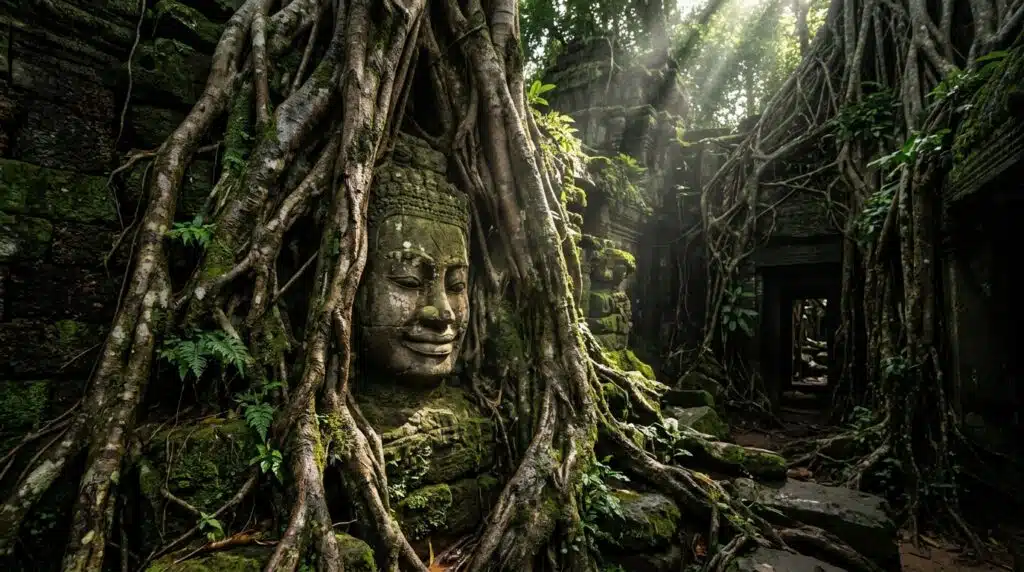
In 1927, French archaeologists working on the ruins of Ta Prohm, the famous jungle-swallowed temple in Cambodia’s Angkor complex, pulled something extraordinary from the earth. A Buddha’s head. Serene. Smiling. Carved in the unmistakable Bayon style, with that calm, half-lidded gaze that somehow feels like it’s looking through you rather than at you.
They catalogued it, transported it carefully, and placed it in the collections of Cambodia’s National Museum in Phnom Penh, where it would sit alone for the next 98 years.
Nobody. No torso. No arms. Just a face, watching the world change around it while its missing half lay buried somewhere in the jungle it came from.
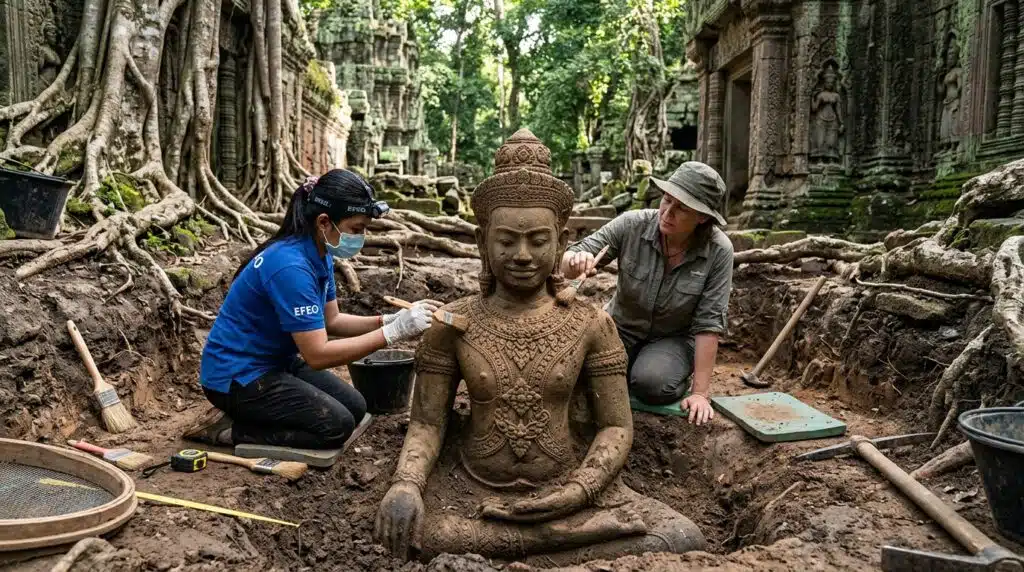
Then, in early 2025, a team of Cambodian and Indian archaeologists plunged their tools into the soil of Ta Prohm’s third gallery — and everything changed.
What they found was the missing Buddha torso. Intact. Preserved. And just 50 meters from where the head had been unearthed nearly a century before.
What Exactly Did They Find?
The torso is not a fragment. It is not a crumbled remnant. It is a statement.
Standing approximately 3.81 feet tall and 1.84 feet wide at the shoulders, the figure arrived from the earth adorned in a carved robe, a veil, and jewellery that speak unmistakably to 12th or 13th century Khmer craftsmanship.
The excavation, carried out in February by the APSARA National Authority in collaboration with the Archaeological Survey of India, recovered the torso from an area outside the laterite enclosure northeast of the temple’s third gallery. Along with it came 29 additional fragments believed to belong to the same statue, a near-complete puzzle finally beginning to reveal its original shape.
However, the archaeologists were completely stopped by one detail.
Researchers have referred to the statue’s left hand crossing its chest as “an uncommon representation in Khmer art.”
This gesture is not typical. This hand stance is unique in the extensive collection of Khmer Buddhist sculptures. It alludes to a certain ceremonial identity, a purposeful theological message engraved in stone by a skilled artisan.
AEO Quick Answer: What Is the Missing Buddha Torso?
What is the missing Buddha torso? The missing Buddha torso is a 12th–13th century Khmer Buddha statue torso discovered in 2025 at Ta Prohm temple in Cambodia’s Angkor Archaeological Park. It matches a Buddha head found at the same site in 1927, nearly reuniting a sculpture separated for 98 years.
Where was the missing Buddha torso found? It was found approximately 50 meters from where the head was discovered in 1927, buried outside the northeast laterite enclosure of Ta Prohm’s third gallery.
Who found the missing Buddha torso? Archaeologist Neth Simon and the APSARA National Authority (ANA) are working jointly with the Archaeological Survey of India (ASI).
What art style is the missing Buddha torso? Bayon style a late 12th-century Khmer artistic tradition known for its calm, finely detailed faces and rich carved ornamentation, associated with King Jayavarman VII.
The Temple That Holds a Thousand Secrets
To understand why finding this missing Buddha torso matters, you have to understand the ground it was buried in.
Ta Prohm was founded by Khmer Emperor Jayavarman VII and built in the Bayon style in 1186 AD. According to inscriptions on the temple’s stele, it was originally called Rajavihara, the monastery of the king, and served as a Mahayana Buddhist complex.
The benign smiles of the Bayon-style features are thought to have been inspired by the real face of King Jayavarman VII, who established Ta Prohm as a monastery and educational centre honouring his mother in the late 1180s.
It’s important to have a personal connection. This monument was more than just a place of worship. It was a monarch’s homage to his mother. A haven of devotion rather than just strength.
Thousands of people lived in the temple, which served as both a monastery and a school. At its peak, Ta Prohm had over 12,000 residents, 18 high priests, hundreds of dancers, and more than 800,000 supporters from nearby villages. It wasn’t a ruin. The world was alive.
And at the centre of that world stood statues like this one, sacred figures that gave the faithful something to focus their prayers on, something tangible in a cosmos that could feel impossibly vast.
The Shattering: Why Was It Buried?
Here is the question that lingers over every broken statue in Angkor. They didn’t fall apart on their own.
The Hindu restoration began around 1243 AD. The next king, Jayavarman VIII, was a Shaivite iconoclast who specialised in destroying Buddhist images and re-establishing the Hindu shrines that his predecessor had converted to Buddhism. During the restoration, cultist statues of the Buddha were replaced by lingams.
In contrast to his predecessors, Jayavarman VIII was a follower of Hindu Shaivism and an aggressive opponent of Buddhism, destroying many Buddha statues in the empire and converting Buddhist temples to Hindu temples.
This is the shattering. A king who looked at his predecessor’s legacy, all those serene Bayon faces, all those carefully carved gestures of devotion, and saw something to be erased.
Heads were the primary targets. Remove the head, and the sacred image loses its identity, its power, its divinity. Excavators at Ta Prohm found a large seated Buddha image buried near the eastern porch, its head deliberately removed. “The pattern of damage points to deliberate destruction, likely tied to religious conflict between Buddhist and Hindu followers,” said archaeologist Neth Simon. The widened stone doorway nearby may have been chiselled out to remove the statue.
So when the French archaeologists found that lonely head in 1927, they weren’t finding an accident of time. They were finding the aftermath of a war against memory, a calculated attempt to silence stone.
The Reunion: How Science Bridged the Divide
The initial response to the torso’s appearance in 2025 was cautious excitement. It suited the Bayon style. The scale seems to be correct. However, “seemed right” is hope rather than archaeology.
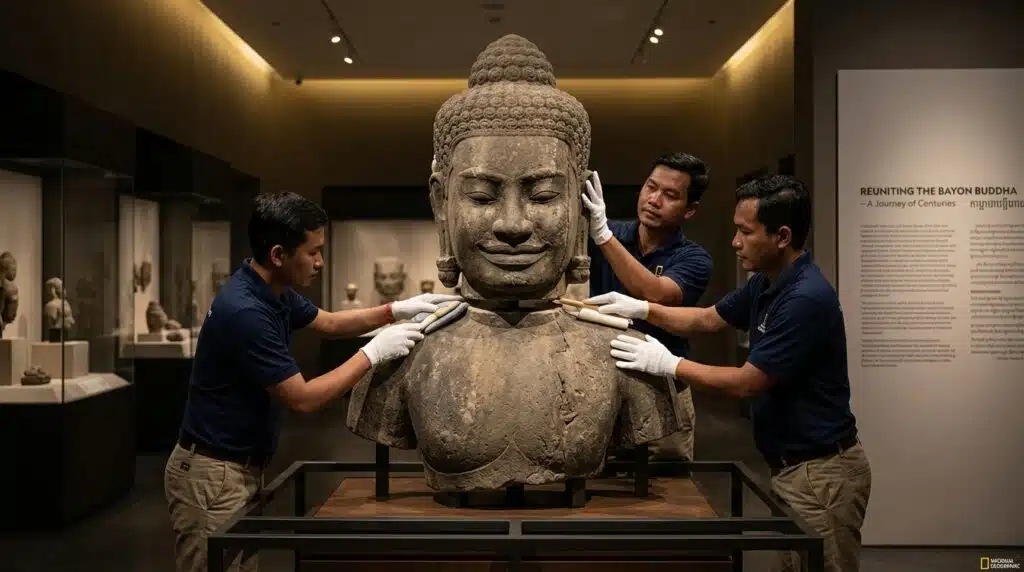
The archeological team used optical electronics to scan the head and body with the aid of contemporary technology, which instantly verified that both pieces were from the same statue.
That moment of confirmation, the moment the data aligned and two fragments separated by 98 years and 50 meters were declared a match, must have felt extraordinary. Here was a reunion that had waited through a world war, through Cambodia’s own catastrophic decades of war and genocide, through generations of archaeologists who had passed the head in its museum case without knowing its body was just a plane ride and an excavation away.
“It was a big surprise when we unearthed this sculpture because all we’d found so far were small pieces,” said Neth Simon of the APSARA National Authority.
The only missing part that has not yet been found is the right hand.
One hand. That’s all that remains absent from what may soon become one of the most complete ancient Buddha statues ever recovered from the Angkor period.
What the Gesture Means
The detail that keeps drawing specialists back is that left hand.
Placed across the chest, not in the earth-touching mudra, not in the teaching gesture, not in the typical meditative pose. Across the chest.
In Buddhist iconography, hand gestures, or mudras, are a language. Each position carries theological weight, communicating the Buddha’s state of mind, spiritual activity, or identity at a specific moment of his teaching. An unusual hand position is not an artistic quirk. It is a sentence written in stone.
Researchers have noted this gesture as uncommon in Khmer art, but its full interpretive meaning is still being studied. The statue is carved with jewellery, a robe, and a sash. The left hand is brought across the chest in a gesture that researchers have called “uncommon” in the period of Khmer art.
Some specialists suggest this may indicate a specific Mahayana Buddhist identity, possibly connected to Bodhisattva traditions, rather than a straightforward depiction of the historical Buddha. Others hold that it reflects a regional artistic variation, a local theological tradition that was simply not widely replicated in surviving sculpture.
What is certain: whoever commissioned this statue was asking for something specific. This was not a mass-produced temple figure. This was a deliberate, individualised creation.
The Bigger Picture: Angkor’s Buried Secrets
This missing Buddha torso is not a singular anomaly. It is a window into how much of Angkor’s artistic legacy remains underground.
In 2001, Japanese archaeologists from Sophia University and Cambodian colleagues conducting research at the late 12th-century temple of Banteay Kdey found 274 pieces of Buddhist statues buried about 2 meters underground and positioned respectfully near the main eastern entrance.
That word respectful is crucial. Not every broken statue was simply abandoned. Some were buried deliberately, carefully, by people who understood that what they were burying was sacred. Perhaps they were protecting these figures from destruction, giving them a kind of underground sanctuary until the political winds shifted.
A near-complete reconstruction of the statue is now possible, as only the right hand of the statue remains missing. This potential reconstruction would represent one of the most complete ancient Buddha statues recovered from the Angkor period, offering invaluable insights into Khmer artistic traditions and Buddhist practices during the empire’s golden age.
The Angkor Archaeological Park spans 155 square miles. It houses the ruins of multiple Khmer capitals across six centuries of empire. And it is still giving up its secrets sometimes, a fragment at a time, sometimes, as in 2025, something that stops everyone and makes them put down their tools.
What This Finding Actually Modifies
This reunion has both a pragmatic and a more profound aspect.
Practically speaking, a rare near-full specimen of Bayon-style sculpture, replete with its peculiar iconographic gesture, is added to Khmer art studies. Scholars researching Buddhist practice under Jayavarman VII now possess tangible evidence that enhances their comprehension of the expression, commissioning, and exhibition of devotion in the late 12th century.
However, it is more difficult to measure the deeper level.
A king built a temple for his mother. A Buddha unlike any other was carved within that temple; it had a hand across its chest, was covered in jewellery and a carved robe, and was in charge of a monastery that held thousands of lives. Then another king came and tore the head away, scattering the stone, burying the sacred.
For 98 years, the head sat in a museum in Phnom Penh, separated from its body, separated from its temple, separated from everything that gave it context.
And then, in the soil of the same jungle where it was born, the rest of it was found.
Conclusion: A Story Still Being Written
The missing Buddha torso is not just an archaeological triumph. It is a story about what survives when empires decide to forget — and what happens when, centuries later, someone decides to remember.
Jayavarman VIII tried to erase it. Time and jungle tried to swallow it. And yet here it is: measured, scanned, confirmed, and slowly being reassembled from the fragments of a civilisation that once stretched across much of mainland Southeast Asia.
The right hand is still out there. Somewhere in the soil of Ta Prohm, or perhaps moved long ago, it waits.
And that is what makes archaeology at Angkor feel less like a profession and more like an act of listening, pressing your ear to the ground and waiting for 800 years of silence to finally say something back.
The missing Buddha torso has been found. But the story of what it meant, who made it, and why it was hidden from the world that story is only just beginning to be told.
Discover a Hidden Maya City
Deep in Mexico’s jungle, LiDAR has revealed a massive lost city of 30,000 people—reshaping everything we know about Maya civilization.
In 2024, a team of archaeologists made a discovery that could change everything: they found a lost city beneath the pyramids.