
Indus Valley Civilization Script: 7 Reasons It Stays Unbroken
A Message Written to Nobody in Particular
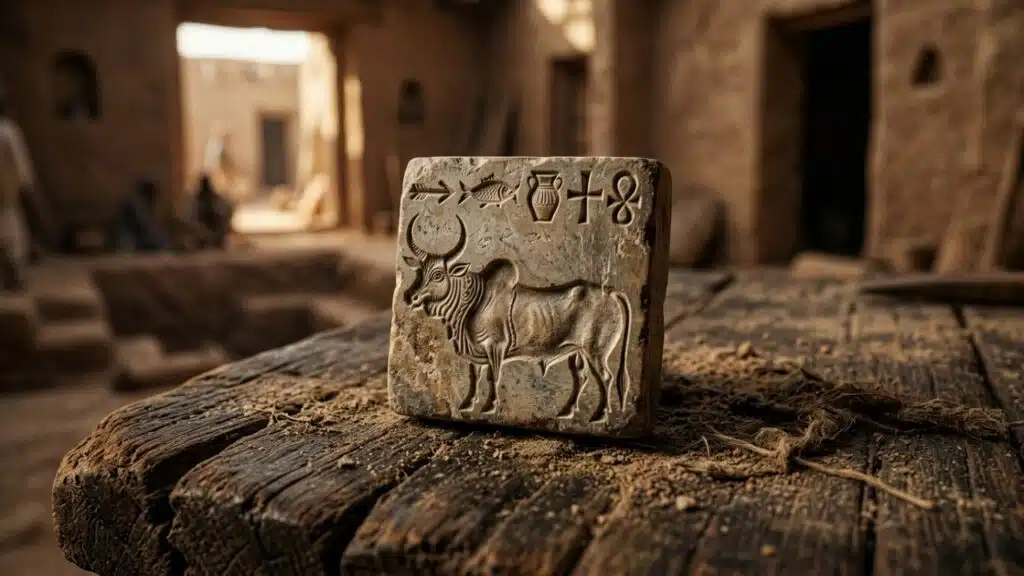
Somewhere in the collection of the National Museum in New Delhi, there is a small square stamp seal barely larger than a postage stamp. It is carved from steatite, a soft grey stone, and on its face are five symbols arranged in a row above the image of a horned bull. The seal is roughly 4,000 years old. The bull is precise and beautifully rendered. The five symbols above it are, in 2025, completely unreadable.
Nobody alive on earth today knows what those five symbols mean. Nobody knows what language they record. Nobody knows if they represent a name, a commodity, a quantity, a prayer, or something else entirely that the modern mind has not thought to consider.
That seal is one of approximately 5,000 inscriptions recovered from the cities of the Indus Valley Civilization, one of the largest and most sophisticated urban cultures of the ancient Bronze Age. And every single one of those inscriptions carries the same problem. The indus valley civilization script, used by a people who built cities with indoor plumbing and standardized weights and measures when most of the world was still organized into scattered villages, has resisted decipherment for over a century of serious scholarly effort.
In January 2025, the government of Tamil Nadu offered a prize of one million dollars to anyone who could read it.
Nobody has collected.
Quick Answer: Indus Valley Civilization Script
Why has the Indus Valley civilization script never been deciphered?
The indus valley civilization script remains undeciphered for four interconnected reasons. The inscriptions are extremely short, averaging only four to five signs per text. No bilingual inscription equivalent to the Rosetta Stone has ever been found connecting the script to any known language. The root language itself is unknown, with scholars divided between Dravidian, proto-Sanskrit, and non-linguistic hypotheses. And the political sensitivity surrounding the script’s linguistic identity has introduced bias into the scholarly debate, with national identity arguments clouding purely linguistic analysis.
How many signs does the Indus Valley civilization script contain?
The exact number is itself contested, which reflects how fundamentally unresolved the indus valley civilization script remains. Estimates range from approximately 400 signs, the figure most commonly cited in scholarly literature, to 676 signs in the analysis proposed by Bryan K. Wells in 2016. Researcher Muhammad’s 2024 grid-based decomposition technique suggests the script may consist of only 40 primary signs with the remainder being combinations. The disagreement over something as basic as the sign count illustrates the depth of the decipherment problem.
What is the $1 million prize for decoding the Indus Valley script?
In January 2025, Tamil Nadu Chief Minister M.K. Stalin announced a prize of one million US dollars for anyone who could successfully decode the indus valley civilization script. The announcement followed a study by researchers K. Rajan and R. Sivananthan comparing over 14,000 ceramic sherds from Tamil Nadu with Indus signs, finding that approximately 60 percent of signs showed similarities with ancient Tamil pottery graffiti marks. The prize renewed global interest and attracted computer scientists, engineers, and linguists, though no successful decipherment has been verified.
What is the Dholavira signboard?
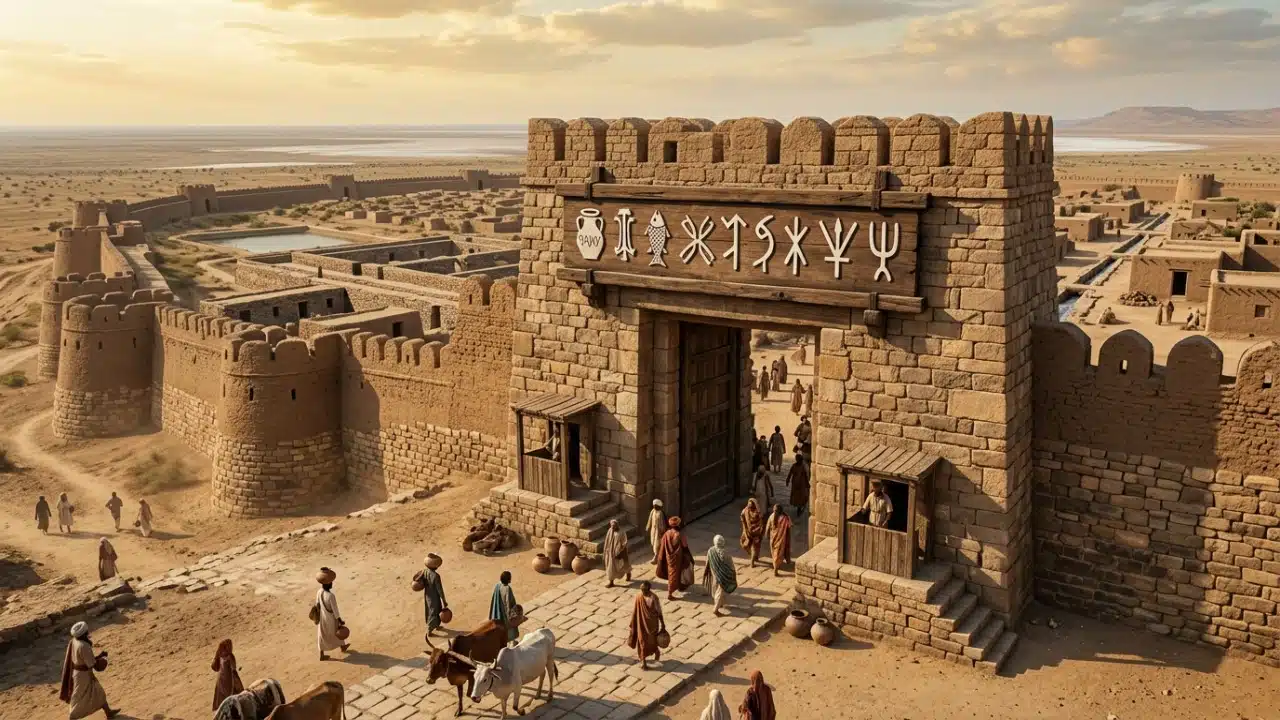
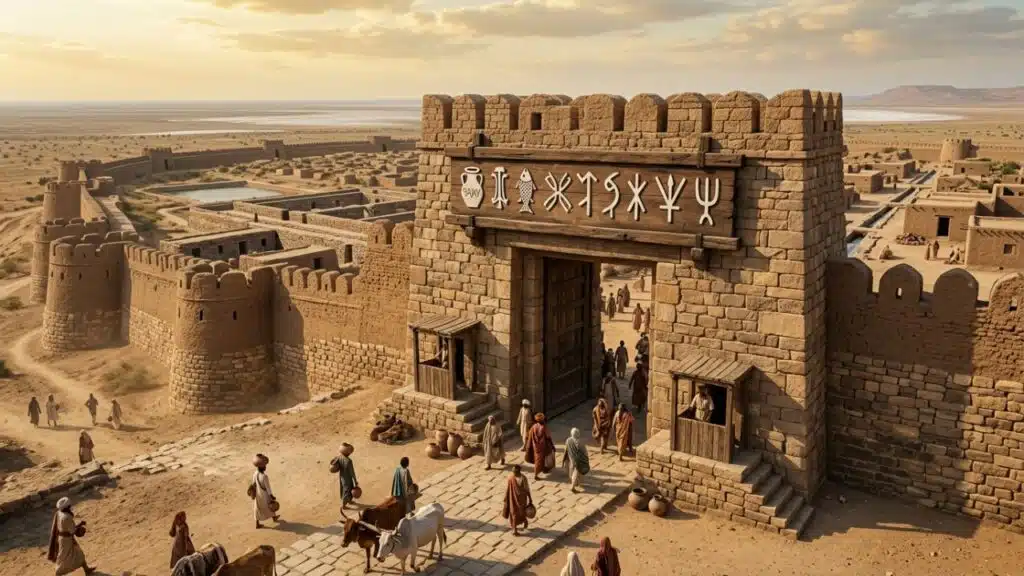
The Dholavira signboard is the largest known inscription in the indus valley civilization script, discovered at the northern gateway of the ancient city of Dholavira in the Rann of Kutch, India. It contains ten large signs displayed prominently at the city’s main entrance, suggesting a public-facing message of civic or administrative significance. The signboard is significant not only for its size but for its placement, which implies the script was used for public communication, not just private trade seals. Even this largest known example remains completely unread.
Reason 1: The Rosetta Stone That Never Existed
Every undeciphered ancient script has a version of the same fundamental problem, and the one that makes the indus valley civilization script essentially unique in its difficulty is the complete absence of any bilingual text.
The Rosetta Stone, discovered in 1799 near the Nile Delta, contained the same decree written in ancient Greek, Demotic Egyptian, and hieroglyphics. Because scholars could read Greek, they had a key. They could compare the known text to the unknown symbols and work backward to meaning. Jean-François Champollion used this method in 1822 to crack hieroglyphics, one of history’s most celebrated intellectual achievements. Linear B, the Mycenaean script that Michael Ventris deciphered in 1952, was unlocked partly because researchers noticed it shared structural similarities with Linear A and had an identifiable connection to Greek. Mesopotamian cuneiform was decoded because bilingual inscriptions linking it to Akkadian, a language scholars could work with, were eventually found.
The indus valley civilization script has no such companion text. In more than a century of excavation across Harappa, Mohenjo-Daro, Dholavira, and hundreds of smaller sites, not a single inscription has been recovered that writes the same message in the Indus script and in any other known language. There is no Indus Rosetta Stone. There may never have been one. The Indus Valley Civilization appears to have existed in a linguistic isolation that left no decipherment foothold for the scholars who came after it.
This is not a solvable problem through effort alone. Without a bilingual text, deciphering the indus valley civilization script requires knowing what language it represents before you can even begin to match symbols to sounds. And the language question is, independently, completely unresolved.
Reason 2: Nobody Knows What Language It Represents
When Champollion sat down with the Rosetta Stone, he knew the script recorded Egyptian because the stone said so in Greek. When Ventris cracked Linear B, the working hypothesis that it recorded Greek guided every step of the analysis. The underlying language was not the mystery. The symbols were.
With the indus valley civilization script, both are mysteries simultaneously. The symbols are unreadable and the language they record is unknown. Scholars have been arguing about the language question for over a century, and the debate has produced three main camps, none of which has been able to prove its case.
The Dravidian hypothesis argues that the script records a language ancestral to Tamil and other South Indian languages, suggesting that Dravidian languages were widely spoken across the Indian subcontinent before later migrations brought Indo-European languages into the region. Asko Parpola, the Finnish Indologist whom the Archaeology Magazine has called one of the world’s foremost authorities on the script, has devoted his academic life to building the Dravidian case. He described the indus valley civilization script as the most important system of writing that is undeciphered, and his monumental work on the subject remains the most comprehensive pro-Dravidian argument in the literature.
The Sanskrit hypothesis argues the opposite: that the script records a proto-Vedic or early Sanskrit language, meaning the Indus Valley Civilization was itself the source of the Indo-European linguistic tradition that spread outward rather than arriving from Central Asia. Several scholars have claimed to have partially deciphered the script on this basis. The claims have not gained widespread acceptance, and some have been characterized in the literature as fraudulent.
The non-linguistic hypothesis is the most unsettling of the three. Scholars Steve Farmer, Richard Sproat, and Michael Witzel published an influential 2004 paper arguing that the indus valley civilization script is not a writing system at all in the conventional sense, but rather a system of non-linguistic symbols used for political, economic, or religious identification purposes, comparable to heraldic symbols rather than written language. If this hypothesis is correct, the script cannot be deciphered because it does not encode speech.
Rajesh PN Rao of the University of Washington and Nisha Yadav of the Tata Institute of Fundamental Research published a counter-analysis using information theory, demonstrating that the conditional entropy of the indus valley civilization script falls between that of natural language and purely non-linguistic symbol systems, consistent with a linguistic or proto-linguistic system. Their finding does not prove the script encodes language, but it makes the pure symbol hypothesis significantly less likely.
The debate continues. The language remains unknown.
Reason 3: The Inscriptions Are Too Short
Even setting aside the bilingual text problem and the language identity problem, the indus valley civilization script faces a third obstacle that is almost as fundamental: the texts themselves are extraordinarily brief.
The average inscription in the entire corpus contains four to five signs. The longest known inscription, the Dholavira signboard displayed at the northern gateway of that ancient city, contains ten signs. In the entire body of approximately 5,000 known inscriptions, not a single text runs to more than 26 symbols.
Compare this to the situation with Egyptian hieroglyphics, where inscriptions of hundreds and thousands of signs existed across papyrus texts, tomb walls, and stone monuments, giving scholars enormous amounts of material to analyze for patterns, grammar, repeated phrases, and structural features. Linear B tablets, while not lengthy, included administrative lists that gave researchers identifiable categories, names that could be cross-referenced with Greek mythology, and repeated formulaic phrases.
The indus valley civilization script offers almost none of this. Short texts make it nearly impossible to identify grammatical structures, distinguish nouns from verbs, identify the boundaries between words, or find the kind of repeated formulaic phrases that give statistical analysis traction. As researcher Steven Bonta of Penn State University noted in a Live Science interview in March 2026, most Indus inscriptions are brief and highly repetitive, which makes the task of reproducible decipherment very difficult. Prior to the mid-1990s, claims of decipherment were published fairly regularly, Bonta observed, but none gained widespread acceptance, with the shortness of the surviving texts making it impossible to prove the accuracy of any proposed reading.
Every potential decipherment of the indus valley civilization script faces the same verification problem. You can propose a reading. You cannot prove it, because the text is too short to test the hypothesis against other examples with sufficient confidence.
Reason 4: The Sign Count Is Itself Disputed
One of the most revealing indicators of how unresolved the indus valley civilization script truly is comes from what might seem like a basic preliminary question: how many signs does it have?
This matters enormously because the number of signs in a writing system tells you what kind of system it is. An alphabet has roughly 20 to 40 signs representing individual sounds. A syllabary, which records syllables rather than individual sounds, typically has 50 to 100 signs. A logographic system like Chinese, where many signs represent whole words or concepts, requires hundreds or thousands. Knowing the sign count tells you the type of system you are dealing with, which determines the entire decipherment strategy.
For the indus valley civilization script, the answer ranges from 40 to 676 depending on the methodology used to count. Most mainstream scholars settle on approximately 400 signs as a working figure, a count that places the script in logosyllabic territory, similar to the early writing systems of Mesopotamia and Egypt. But in 2016, Bryan K. Wells proposed 676 signs after a comprehensive analysis of the corpus. And in 2024, researcher Muhammad’s grid-based decomposition technique suggested the script might consist of only 40 primary signs with the rest being compositional variations, a count that would push it toward an alphabet or simplified syllabary.
Four hundred signs, or 676, or 40. These are not minor variations in measurement. They represent completely different theories about the fundamental nature of the indus valley civilization script. And over a century of analysis has not produced agreement on something that scholars of other ancient scripts resolved relatively early in their decipherment efforts.
Reason 5: Artificial Intelligence Has Not Solved It Either
The announcement of Tamil Nadu’s one million dollar prize in January 2025 brought a wave of technologically optimistic coverage suggesting that machine learning and artificial intelligence might finally crack what human scholars could not. The reality, as researchers who work with AI on exactly this problem have consistently stated, is considerably more cautious.
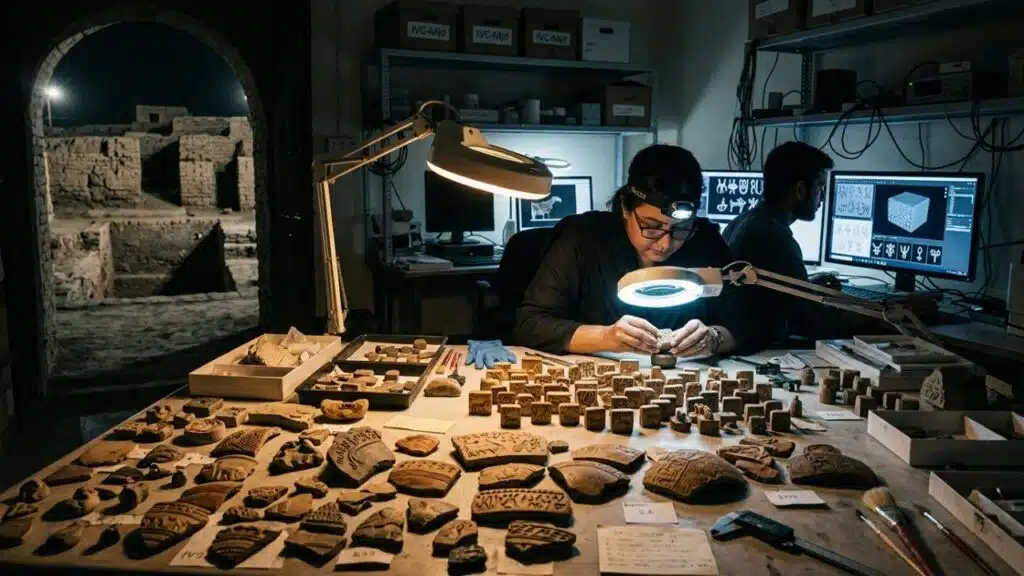
The Tata Institute of Fundamental Research’s Nisha Yadav has applied machine learning to analyze statistical patterns in the indus valley civilization script corpus. Rajesh PN Rao’s information theory analysis used computational methods to examine the script’s conditional entropy. A 2024 deep learning model called ASR-net was developed to digitize Indus seal inscriptions, improving the accessibility and quality of the corpus for computational analysis. Researcher Muhammad’s 2024 grid-based decomposition of over 400 signs used computational methods to propose the 40 primary sign hypothesis.
None of these approaches has produced a decipherment. Each has produced insights into the script’s structure and statistical properties. But as Steven Bonta explained to Live Science, AI is an extension of human intellect and intuition, albeit an extraordinarily powerful one. It cannot substitute for the foundational knowledge that every successful ancient script decipherment has required: a bilingual text, a known language hypothesis, or ideally both.
The indus valley civilization script has neither. AI can find patterns in a corpus it cannot read. Without a key to connect those patterns to meaning, the patterns remain patterns.
Reason 6: Politics Entered the Decipherment Chamber
Any honest account of why the indus valley civilization script remains unread must address a factor that pure linguistic analysis tends to avoid: the decipherment question carries enormous political weight in the Indian subcontinent, and that weight has shaped the debate in ways that have not always served the scholarship.
CNN’s February 2025 investigation into the Tamil Nadu prize noted that the question of what language the Indus script encodes is deeply entangled with contested theories about the origins of Sanskrit and the relationship between the Indus Valley Civilization and the Vedic tradition. One group argues that Sanskrit and its relatives originated in the Indus Valley Civilization itself and spread outward toward Europe, a position that makes the script’s decipherment as Sanskrit a matter of cultural and national identity rather than merely linguistic inquiry. Another group argues the Dravidian case with equal intensity rooted in the cultural claims of South India’s linguistic heritage.
When proposed decipherments arrive shaped by the conclusion they need to reach rather than the evidence they have found, the scholarly community’s ability to evaluate them objectively is compromised. Several Sanskrit-based decipherment claims have been rejected not only on linguistic grounds but on methodological grounds, because the argument was constructed backward from a desired conclusion.
The Tamil Nadu prize was itself announced in the context of political and cultural debate about South Indian identity and the relationship between Tamil civilization and the Harappan world. That context does not invalidate the prize or the research it aims to encourage. But it is a reminder that the indus valley civilization script is not purely an academic puzzle. It is a question about who built what, who came from where, and whose cultural heritage the most sophisticated Bronze Age civilization of the Indian subcontinent actually represents.
Reason 7: The Civilization Itself Left Almost No Other Clues
Deciphering an unknown script from an unknown language is extraordinarily difficult even with abundant contextual material. For the indus valley civilization script, the contextual material is almost entirely absent.
Egyptian hieroglyphics existed alongside a rich tradition of visual art that depicted gods, rituals, royal events, and daily life in explicit narrative detail. Mesopotamian cuneiform tablets recorded legal codes, royal correspondence, trade accounts, and literary texts that gave scholars the content of the language even before every sign was understood. Linear B tablets, though administrative and formulaic, recorded recognizable categories of goods and names that could be cross-referenced with Greek mythology and later texts.
The Indus Valley Civilization left almost none of this. The cities of Harappa and Mohenjo-Daro contained sophisticated infrastructure but remarkably few narrative images. There are no royal tombs with inscribed walls. There are no explicit depictions of named rulers. There are no texts that identify the gods by name or describe religious ceremonies in narrative terms. The indus valley civilization script appears almost exclusively on small seals, pottery, and tablets, in short formulaic sequences that most scholars believe served primarily commercial and administrative purposes, marking goods, identifying merchants, or recording quantities.
Without narrative context, without named deities or rulers whose names might appear in the script and be cross-referenced with later traditions, without the rich surrounding textual culture that made Egyptian and Mesopotamian decipherment possible, the indus valley civilization script stands essentially alone in the archaeological record. Its users took their language and their stories into a silence that five thousand years of accumulated human knowledge has not yet been able to break.
Conclusion: The Code That Refuses to Break
The indus valley civilization script is the most important undeciphered writing system in the world. This is not a casual claim. Asko Parpola, who has spent more decades on this question than most scholars spend on entire careers, chose those exact words to describe it, and the reasoning behind them is sound.
The Indus Valley Civilization was one of the three largest urban cultures of the ancient Bronze Age, alongside Egypt and Mesopotamia. At its peak, cities like Mohenjo-Daro and Harappa housed populations of tens of thousands, with urban planning, drainage systems, standardized weights, and long-distance trade networks that rivaled anything the ancient world produced. These were not primitive communities. They were sophisticated societies that left a written record of their existence in approximately 5,000 inscriptions spread across the largest geographic extent of any Bronze Age civilization.
And we cannot read a single word.
The indus valley civilization script sits in museum cases across India and Pakistan, on seals smaller than a postage stamp, carrying messages that have been waiting to be understood for four thousand years. A million dollars has been offered. Artificial intelligence has been deployed. The greatest linguists of three generations have spent careers on the problem. Over a hundred decipherment attempts have been published and none has achieved acceptance.
What the Indus Valley people said to each other, what they called their gods, what they wrote above the gateway of Dholavira for every visitor to their city to see, what the five symbols above the horned bull on that small steatite seal actually mean: all of it remains, in 2025, completely unknown.
The code has not broken. And every failed attempt is its own reminder that somewhere inside the indus valley civilization script, an entire civilization is still waiting to speak.
Discover a Hidden Maya City
Deep in Mexico’s jungle, LiDAR has revealed a massive lost city of 30,000 people—reshaping everything we know about Maya civilisation.
In 2024, a team of archaeologists made a discovery that could change everything: they found a lost city beneath the pyramids.
Click below to watch the full story:
https://www.youtube.com/@EchoesofAntiquity-egypt/videos
Sources
- Smithsonian Magazine — “Officials Are Offering $1 Million to Anyone Who Can Decode This Ancient Script” (January 30, 2025) — smithsonianmag.com
- CNN — “Indus Valley script: The $1 million prize to decipher the unsolved code thousands of years old” (February 28, 2025) — cnn.com
- Archaeology Magazine Online — “$1 Million Prize Offered to Decipher Indus Valley Script” (January 27, 2025) — archaeologymag.com
- Live Science — “Will the Indus Valley script ever be deciphered?” (Updated March 15, 2026) — livescience.com
- 5 Senses Tours — “Indus Valley Script: The Race to Crack History’s Greatest Code” (July 16, 2026) — 5sensestours.com
- Language Log / University of Pennsylvania — “Decipherment of the Indus script: new angles and approaches” (March 6, 2025) — languagelog.ldc.upenn.edu
- Drishti IAS — “Deciphering the Indus Valley Script” (January 8, 2025) — drishtiias.com
- ClearIAS — “Indus Valley Script: Why is it important to decipher it?” (January 9, 2025) — clearias.com
- History Guild — “Cracking the Code: The Quest to Decipher the Indus Valley Script” (September 17, 2024) — historyguild.org
- ResearchGate / Academia — “Deciphering the Indus Valley Script: New Approaches and AI-Driven Insights” (February 2025) — researchgate.net
- arXiv — “Review of Computational Epigraphy: Indus Script and Machine Learning Approaches” — arxiv.org
- Oxford University Press / Asko Parpola — “Deciphering the Indus Script.” Cambridge University Press, 1994 (foundational reference cited across all major studies)
- Wikipedia — “Indus script” — en.wikipedia.org