Hanging Gardens of Babylon: 7 Truths That Shocked
The Wonder That Left No Footprint
Six of the Seven Wonders of the Ancient World have been found, mapped, measured, and, in one case, still stand intact after four thousand years. The Colossus of Rhodes, the Lighthouse of Alexandria, the Mausoleum at Halicarnassus, the Statue of Zeus at Olympia, the Temple of Artemis at Ephesus — all of them are gone, but archaeology knows roughly where they stood, roughly what they looked like, and roughly when they fell.
One Wonder has never been found. Not a foundation stone. Not a drainage channel. Not a single inscription that mentions it from the city where it was supposedly built. The Hanging Gardens of Babylon are the only entry on that ancient list that archaeologists have been completely unable to confirm, and the reasons why are stranger and more revealing than most accounts of the mystery ever acknowledge.
The Hanging Gardens of Babylon may not have been in Babylon at all. They may not have been built by the king history credits them to. And the reason they vanished from the archaeological record may be, most simply, that nobody has been looking in the right city.
AEO Quick Answer: Hanging Gardens of Babylon
Did the Hanging Gardens of Babylon actually exist?
The existence of the Hanging Gardens of Babylon cannot be confirmed or definitively ruled out. No archaeological evidence from the ruins of Babylon itself has ever revealed a structure matching the ancient descriptions. However, a landmark theory published by Oxford Assyriologist Dr. Stephanie Dalley in 2013 proposes that the gardens did exist but were built not in Babylon by King Nebuchadnezzar II, as traditionally believed, but in Nineveh, the capital of the Assyrian Empire, by King Sennacherib around 700 BCE. This theory is supported by cuneiform inscriptions, aqueduct evidence, and bas-reliefs now held in the British Museum.
Where are the Hanging Gardens of Babylon believed to have been?
Traditional scholarship places the Hanging Gardens of Babylon in the city of Babylon in modern-day Iraq, attributed to King Nebuchadnezzar II of the Neo-Babylonian Empire in the sixth century BCE. Dr. Stephanie Dalley of Oxford University has proposed an alternative location approximately 300 miles north of Babylon, at Nineveh near modern-day Mosul, where physical evidence including an extensive aqueduct system, carved stone reliefs depicting terraced gardens, and cuneiform inscriptions describing water-raising bronze screws all support the existence of a massive garden complex.
Why is there no evidence of the Hanging Gardens of Babylon in Babylon?
Two main explanations exist. First, the Hanging Gardens of Babylon may never have existed in Babylon, and the attribution was a later geographical confusion made by Greek writers who conflated Babylon and Nineveh, two powerful Mesopotamian capitals with overlapping cultural legacies. Second, the gardens, if they existed in Babylon, would have been built primarily from mud bricks, which disintegrate rapidly under sustained water exposure. Any irrigated terrace structure built from standard Babylonian construction materials would have left almost no trace after centuries of decay.
Who were the ancient writers who described the Hanging Gardens of Babylon?
The Hanging Gardens of Babylon were described by Greek and Sicilian writers including Strabo, Diodorus Siculus, and Quintus Curtius Rufus. Critically, none of them were eyewitnesses. Every description was written well after the fall of Babylon in 539 BCE. Babylonian cuneiform records, which document Nebuchadnezzar’s building projects in extraordinary detail, including walls, temples, gates, and palace complexes, never mention a garden. The Jewish historian Josephus is the only ancient writer who specifically identifies Babylon as the location, while most others simply describe a garden in Mesopotamia without precise attribution.
Truth One: The Only Wonder With Zero Archaeological Confirmation
The Hanging Gardens of Babylon hold a distinction that no other entry on the ancient wonder list shares: they are the only one that archaeology has been completely unable to confirm at their supposed location.
The Pyramids at Giza still stand. The foundations of the Temple of Artemis at Ephesus were excavated in the nineteenth century and its location confirmed. The site of the Mausoleum at Halicarnassus was identified and partially excavated. Even the Lighthouse of Alexandria left archaeological traces before the harbor swallowed it.
The Hanging Gardens of Babylon are the only one of the Seven Wonders of the Ancient World that have so far eluded archaeologists and historians. No conclusive archaeological evidence has ever been discovered to provide an indication as to their location or appearance.
This is not for lack of trying. German archaeologist Robert Koldewey spent two decades excavating Babylon at the turn of the twentieth century, from 1899 to 1917, exposing the Ishtar Gate, the processional way, the remains of Nebuchadnezzar’s palace, and the foundations of the great ziggurat. He was so determined to find the Hanging Gardens of Babylon that he made a specific identification: a robust arched structure with unusually thick walls in the northeast corner of the Southern Palace, built with carved stone rather than the standard mud brick. Koldewey and several others believed that this would turn out to be the very structure that had supported the famous gardens. It had thick walls, seemingly strong enough to support a suspended garden, and was made of carved stone, meaning it would be more resistant to moisture than standard bricks.
Experts now believe it was a storeroom. The Hanging Gardens of Babylon were not found because they were not there.
Truth Two: Nebuchadnezzar Never Mentioned Them
Here is the detail that stops every serious researcher in their tracks.
Nebuchadnezzar II was not a modest king. He built extensively, he documented his projects thoroughly, and he left behind some of the most detailed royal building accounts in ancient Near Eastern history. The city of Babylon under his reign was one of the most impressive urban environments of the ancient world, its walls, gates, palaces, and temples catalogued in cuneiform records with the thoroughness of an ancient administrator who wanted posterity to know exactly what he had accomplished.
One set of cuneiform clay tablets called the Topography of Babylon describes the features of Nebuchadnezzar’s capital city in exhaustive detail, from giant constructions like walls, gates, and temples to the names of individual streets. Yet nowhere in this list does anything resembling a massive walled garden appear.
A king who documented the names of individual streets did not mention a garden so magnificent that it became one of the Seven Wonders of the Ancient World.
The silence is deafening. And it is comprehensive. Not one cuneiform tablet from Babylon during Nebuchadnezzar’s reign, not one administrative record, not one royal inscription, not one priestly document references the Hanging Gardens of Babylon or any structure that could correspond to it.Even stranger is the fact that such gardens were common throughout Mesopotamian history, with well-documented examples being constructed by rulers such as Tiglath Pileser at Nineveh in the 12th century BCE, Assurnasirpal II at Nimrud in the ninth, and Marduk-Aplaiddina at Babylon in the eighth.
Gardens existed. They were documented. Nebuchadnezzar documented everything. The Hanging Gardens of Babylon do not appear in a single document from the city of Babylon.
Truth Three: The Oxford Assyriologist Who Changed Everything
For most of the twentieth century, the absence of evidence was treated as a puzzle to be explained away rather than a reason to question the fundamental attribution of the Hanging Gardens of Babylon. Then Dr. Stephanie Dalley arrived.
Dalley is an Honorary Research Fellow at Somerville College, Oxford, a Member of Wolfson College, and a Fellow of the Society of Antiquaries of London. Her academic career has specialized in cuneiform texts across Iraq, Turkey, Syria, and Jordan. She can read the language of ancient Assyria and Babylon the way a classicist reads Greek, and in the 1990s she was working on an inscription from the reign of King Sennacherib of Assyria, who ruled from 705 to 681 BCE, when she noticed something that previous translators had rendered as nonsense.
With a further 70 years of scholarly work now available, including vastly better dictionaries, she was able to show that the passage relates how Sennacherib cast screws in bronze for watering his terraced garden, some centuries before the time of Archimedes, whose name is usually quoted as the inventor. Sennacherib’s own inscriptions show that he was personally proud of his technical achievements in metal-casting, water management, and collecting exotic foreign plants.
A bronze water-raising screw. Terraced gardens. Exotic foreign plants. This was not Nebuchadnezzar in Babylon. This was Sennacherib in Nineveh, a century earlier and three hundred miles north.
Dalley published her conclusion in 2013 through Oxford University Press: the Hanging Gardens of Babylon were built by Sennacherib at Nineveh, and the attribution to Babylon was a geographical and historical confusion that accumulated over centuries of Greek and Roman retelling.
Truth Four: The Evidence That Babylon Never Had
The argument for Nineveh does not rest on cuneiform alone. It rests on a convergence of physical evidence that has no parallel at Babylon.
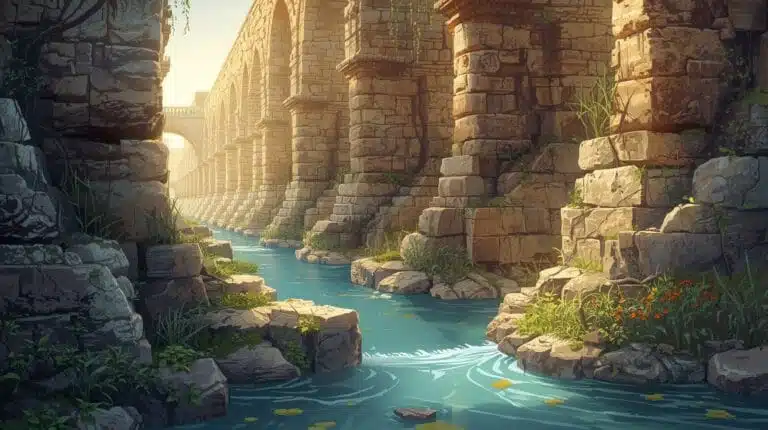
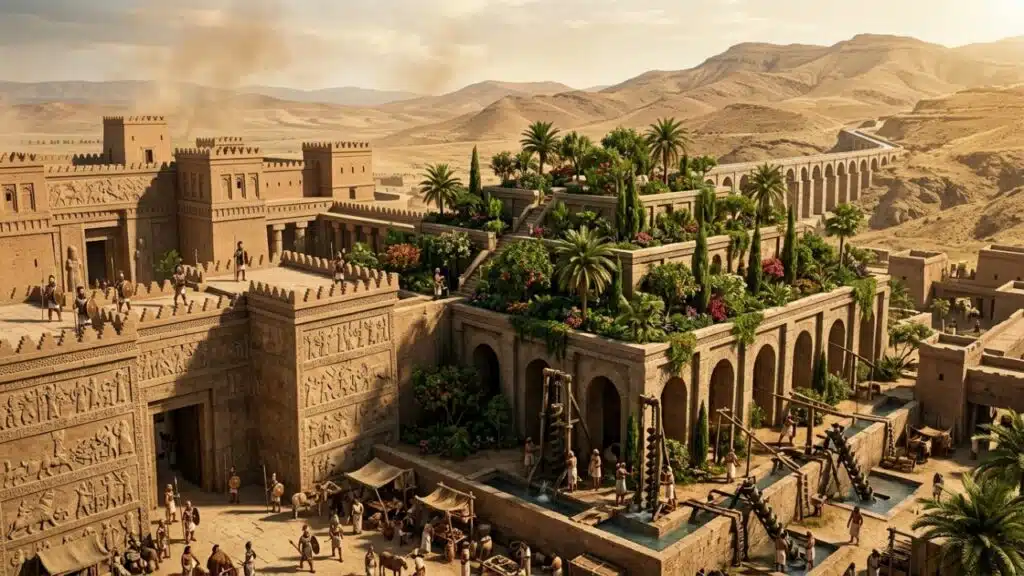
Recent excavations around Nineveh, near the modern-day Iraqi city of Mosul, have uncovered evidence of an extensive aqueduct system that delivered water from the mountains. This aqueduct system brought water from hills approximately eighty kilometers away into the city, using an engineering infrastructure far more sophisticated than anything documented at Babylon. The Jerwan Aqueduct, built during Sennacherib’s reign, spans over three hundred meters and stands as one of the oldest known stone arch aqueducts in human history. It was not a minor irrigation channel. It was a major water management project capable of supplying a substantial elevation-fed garden complex.
The bas-reliefs at Sennacherib’s palace offer a depiction of these gardens planted with trees and equipped with an aqueduct and a system of channels that made it possible to supply elevated irrigation. One of these bas-reliefs is now in the British Museum in London. It depicts a palace with trees growing on elevated terraces, surrounded by columns and approached by a grand staircase. It is, in other words, a visual description of exactly what ancient writers described when they wrote about the Hanging Gardens of Babylon.
In his inscriptions, the king mentioned the invention of a lifting device that made it possible to raise water using a system that was a precursor of the famous Archimedes screw: bronze helicoids positioned above wells, raising water continuously.
At Babylon: no garden documentation, no aqueduct capable of elevation irrigation, no engineering inscriptions describing water-raising devices, no bas-reliefs of terraced gardens.
At Nineveh: cuneiform descriptions of terraced gardens, documented aqueduct infrastructure, engineering inscriptions describing bronze water screws predating Archimedes by four centuries, and carved stone reliefs in the British Museum showing exactly what the ancient writers described.
The evidence is not evenly distributed.
Truth Five: How Babylon Got the Credit
If Sennacherib built the Hanging Gardens of Babylon in Nineveh, why does history call them the Hanging Gardens of Babylon?
The answer involves a particular feature of Sennacherib’s psychology that Dalley documents in her research. Sennacherib had a complicated relationship with Babylon. He conquered it, destroyed significant portions of it in 689 BCE after a rebellion, and then began a deliberate project of transferring Babylon’s cultural and religious prestige to his own capital. Sennacherib had inherited from his father rule over the city of Babylon, but after his son as regent was abducted by enemies, in his fury he removed the city’s gods to Assyria, so that Nineveh, his capital city, became as if a new Babylon.
Sennacherib explicitly rebranded Nineveh as the new Babylon. He appropriated Babylonian religious imagery, Babylonian architectural traditions, and Babylonian royal prestige, transferring them to his own city. In his inscriptions, he referred to Nineveh using terms and titles traditionally associated with Babylon.
When Greek travelers heard stories of a magnificent garden in the heart of Mesopotamia, associated with a great city that called itself a new Babylon, they recorded it as being in Babylon. The confusion was not carelessness. It was the direct result of Sennacherib’s own deliberate propaganda, which had successfully conflated his city with the most famous city in the ancient world.
Only one ancient writer, Josephus, specified Babylon as the location, a minority voice that Dalley finds suspicious, while most other writers describe a garden in Mesopotamia without precise attribution.
The Hanging Gardens of Babylon may have been named for a city they were never in because their builder spent his reign trying to make the world think his city was that city.
Truth Six: What the Gardens Looked Like If They Existed
Setting aside the question of location, the ancient descriptions of the Hanging Gardens of Babylon are consistent enough across multiple sources to reconstruct what they likely looked like.
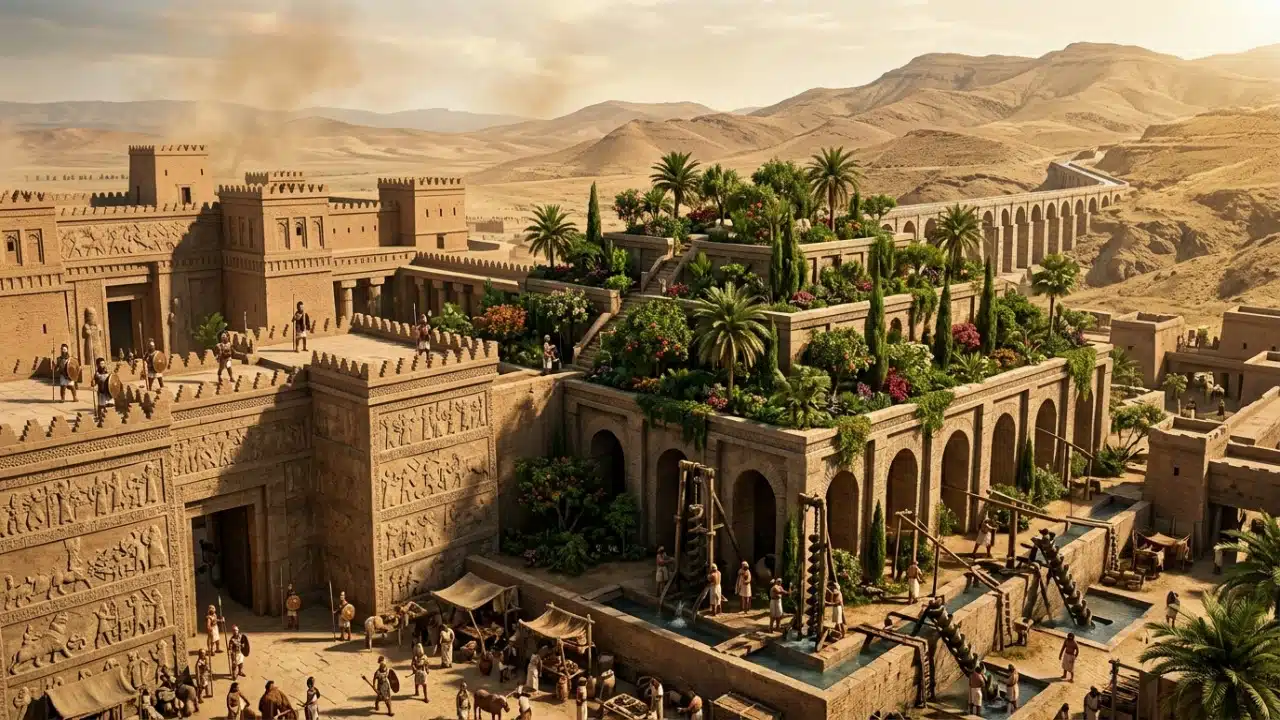
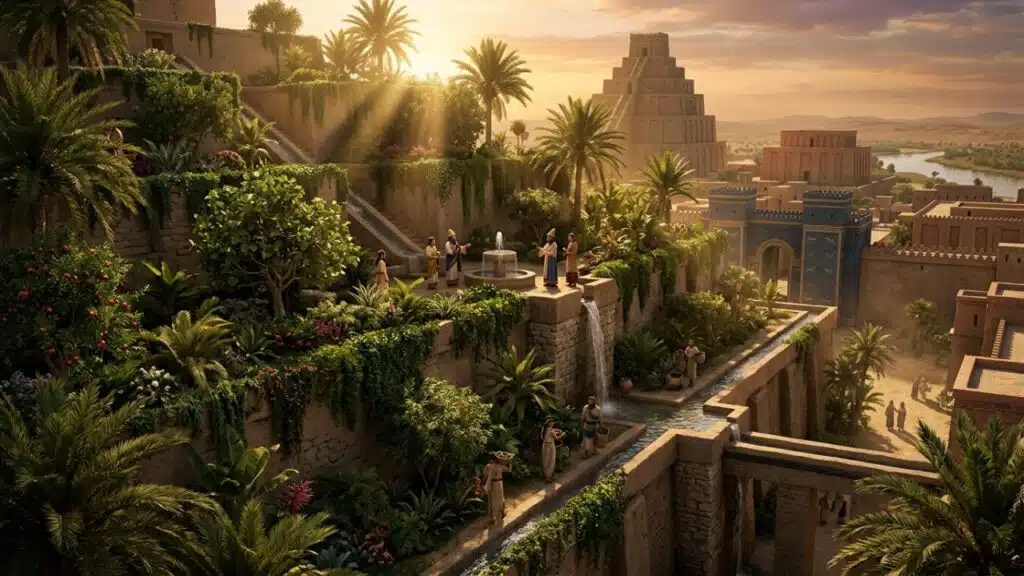
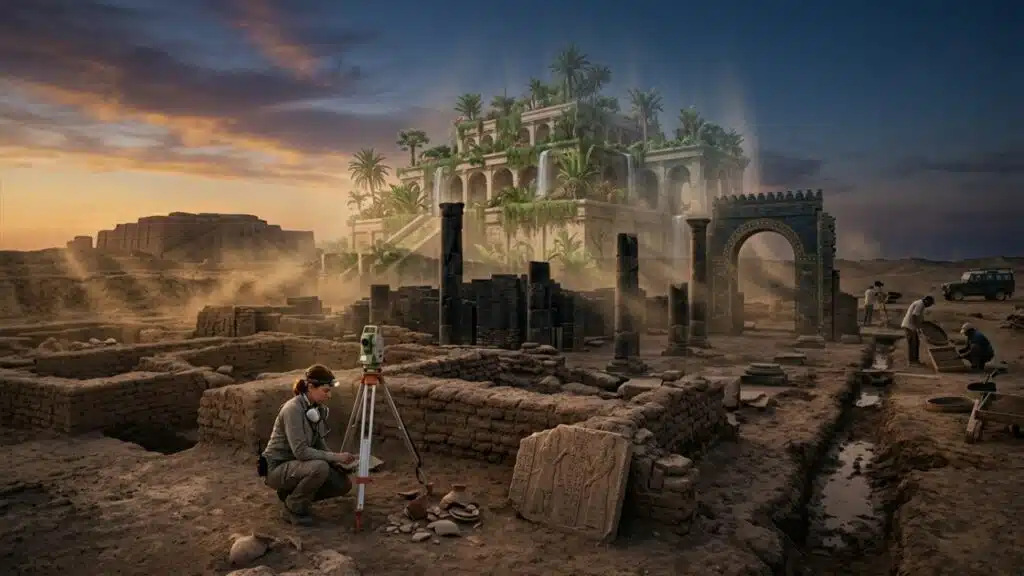
Greek and Roman texts paint vivid pictures of the luxurious Hanging Gardens of Babylon. Amid the hot, arid landscape, lush vegetation cascaded like waterfalls down the terraces of the 75-foot-high garden. Exotic plants, herbs, and flowers dazzled the eyes, and fragrances wafted through the towering botanical oasis dotted with statues and tall stone columns.
The word “hanging” in the name refers not to gardens suspended in the air but to the Greek word “kremastos,” which more precisely means “overhanging,” as in vegetation that cascaded over the edges of elevated terraces and gave the impression of floating greenery. The gardens were terraced structures, each level planted with trees, shrubs, and flowering plants, watered by a continuous irrigation system that brought water from below to the highest level, from which it descended through each terrace in turn.
Dalley’s research confirms the description of later Greek writers that the gardens were, in fact, terraces built up like an amphitheatre around a central pond, with trees growing on the terraces and water supplied by bronze screws raising it from a water source below.
This engineering was extraordinary for its era. Maintaining living trees and dense vegetation at height in a desert climate required a water supply that never stopped. The bronze screw mechanism that Dalley found in Sennacherib’s cuneiform records describes exactly the kind of continuous water-raising device that such a structure would have required. And it predates the device history calls the Archimedes screw by approximately four centuries, meaning the Hanging Gardens of Babylon may have given the ancient world its first example of the technology that Archimedes later made famous.
Truth Seven: The Site That Cannot Be Properly Excavated
The central tragedy of the Hanging Gardens of Babylon mystery is not academic. It is geopolitical.
Whether the gardens were in Babylon or Nineveh, both sites are in Iraq, and both have suffered catastrophic damage in the past four decades that has made proper archaeological investigation nearly impossible.
At Babylon, Saddam Hussein undertook a reconstruction project in 1987 that involved building modern brick structures directly on top of ancient foundations, contaminating the stratigraphy that archaeologists depend on for dating and identification. As recently as October 2025, Iraqi officials reported that increased soil salinity from dry weather is actively damaging hundreds of monuments related to ancient Babylon, meaning the site is deteriorating even now.
At Nineveh, the situation became catastrophic in 2016, when the fundamentalist group ISIL destroyed the Maskhi Gate of Nineveh along with hundreds of artifacts from the nearby Mosul Museum. In 2016, the great Maskhi Gate of Nineveh, along with hundreds of artifacts in the nearby Mosul Museum, were destroyed by ISIL as blasphemous idols. The excavation of Nineveh that might definitively confirm or refute Dalley’s theory has been effectively impossible to conduct safely during the years since.
The Hanging Gardens of Babylon may be answerable. The answer may be buried under a site that the modern world has not yet been able to properly excavate, and that is currently deteriorating while the debate continues among scholars who cannot reach the ground where the evidence lies.
Conclusion: The Wonder That Was in the Wrong Place All Along
The Hanging Gardens of Babylon are the most perfectly constructed mystery in the history of archaeology. Every element of the story is real: the ancient descriptions exist, the engineering they describe was possible, a civilization capable of building such a structure definitely existed in Mesopotamia, and at least one king left cuneiform records of building something that matches the descriptions in extraordinary detail.
What was never real was the address.
The Hanging Gardens of Babylon may have been one of the most magnificent garden complexes in the ancient world, built by an Assyrian king who wanted the world to see his city as the new center of civilization. When he described his palace as a wonder for all peoples and his garden as something that would be spoken of across the earth, he was not exaggerating. The descriptions survived. The location was simply the name he had borrowed from a city he had tried to become.
And when Greek travelers wrote down what they heard, they wrote Babylon, because that is what Sennacherib had taught everyone to call his city.
The Hanging Gardens of Babylon were real. They were just never in Babylon. They were in a city that called itself by Babylon’s name, built by a king who understood that the only way to be remembered forever was to borrow the most famous name in the world and build something extraordinary enough to keep it.
He succeeded beyond any reasonable expectation. The gardens vanished. The name survived. And the search for the Hanging Gardens of Babylon continues, in a desert where the right city has been waiting under the wrong name for twenty-six centuries.
Discover a Hidden Maya City
Deep in Mexico’s jungle, LiDAR has revealed a massive lost city of 30,000 people—reshaping everything we know about Maya civilisation.
In 2024, a team of archaeologists made a discovery that could change everything: they found a lost city beneath the pyramids.
Click below to watch the full story:
https://www.youtube.com/@EchoesofAntiquity-egypt/videos
Sources
- Oxford University Press — Stephanie Dalley, “The Mystery of the Hanging Garden of Babylon: An Elusive World Wonder Traced.” Oxford University Press, 2013 — global.oup.com
- History.com — “Hanging Gardens Existed — But Not in Babylon” (Updated May 28, 2025) — history.com
- National Geographic — “Were the Hanging Gardens of Babylon Actually in Babylon?” (Updated April 19, 2025) — nationalgeographic.com
- The Collector — “The Hanging Gardens of Babylon: The Elusive Ancient Wonder” (Updated August 22, 2025) — thecollector.com
- Biblical Archaeology Society — “Where Are the Hanging Gardens of Babylon?” (Updated December 18, 2025) — biblicalarchaeology.org
- OUP Blog — Stephanie Dalley, “The Mystery of the Hanging Garden of Babylon” (June 2013) — blog.oup.com
- University of Hamburg CSMC — “The Hanging Gardens of Babylon Were at Nineveh!” (January 30, 2018) — csmc.uni-hamburg.de
- World Atlas — “5 Strange Discoveries About the Ruins of Babylon” (December 4, 2025) — worldatlas.com
- Historic Mysteries — “Have Scientists Found the Hanging Gardens of Babylon?” — historicmysteries.com
- Today I Found Out — “Did the Hanging Gardens of Babylon Actually Ever Exist?” (December 26, 2025) — todayifoundout.com
- Wikipedia — “Stephanie Dalley” — en.wikipedia.org
- AbeBooks / Gilbert Taylor review — Stephanie Dalley, “The Mystery of the Hanging Garden of Babylon” — abebooks.com