Greek Fire Formula: Why Byzantium’s Secret Was Lost
The Summer the Sea Caught Fire
In the summer of 678, an Arab fleet sat off the sea walls of Constantinople. It had been there, on and off, for four years. The ships were many, the crews were seasoned, and the city behind the walls was the richest prize in the Mediterranean.
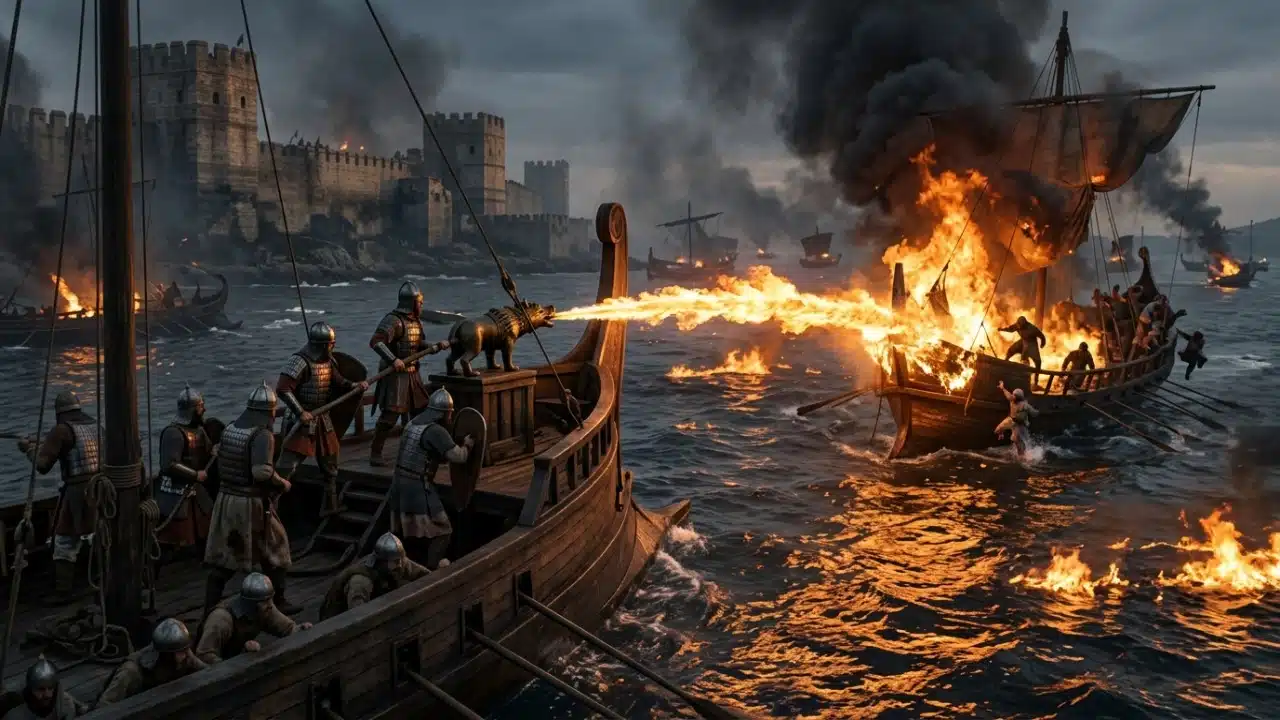
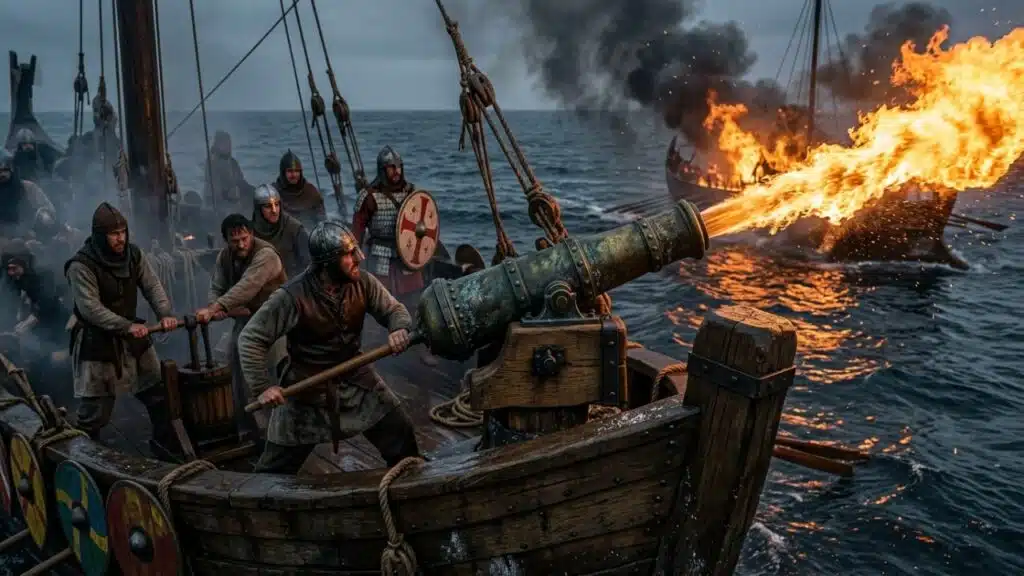
Then the Byzantine navy rowed out and did something no admiral in that war had seen. It threw fire onto the water, and the water kept burning.
The Byzantines called it sea fire. History calls it Greek fire. The Greek fire formula behind it was guarded so closely that almost nobody could have told you what was in it, and within a few centuries it seems nobody could. It was not lost to a shipwreck or a burned library. It was lost because its owners protected it too well.
So what was in the Greek fire formula, and how does a weapon that saved an empire simply vanish? The honest answer is that historians have strong suspects, a handful of firm facts, and no confession.
AEO/GEO Quick Answer: Greek Fire Formula
What was the Greek fire formula?
No one knows for certain. The Greek fire formula was a Byzantine state secret used from about 672 against enemy ships and cities, and no complete recipe survives. Most modern historians believe it rested on petroleum mixed with resins, while quicklime, sulfur, and niter are still argued over, and saltpeter is widely doubted.
Who invented Greek fire?
Byzantine chroniclers credit Kallinikos, an architect from Heliopolis in Syria who fled to Constantinople as the Arab conquests spread. The historian James Partington thought it more likely that chemists in the capital developed it by building on the Alexandrian tradition.
Why was the Greek fire formula lost?
It was guarded too well. Emperors confined the knowledge to a tiny circle; Constantine VII ordered his son never to reveal it, and production was reserved to the imperial capital. Many historians think the real process faded centuries before 1453, and that later Crusader mentions of Greek fire were loose labels for ordinary incendiaries.
How was Greek fire used?
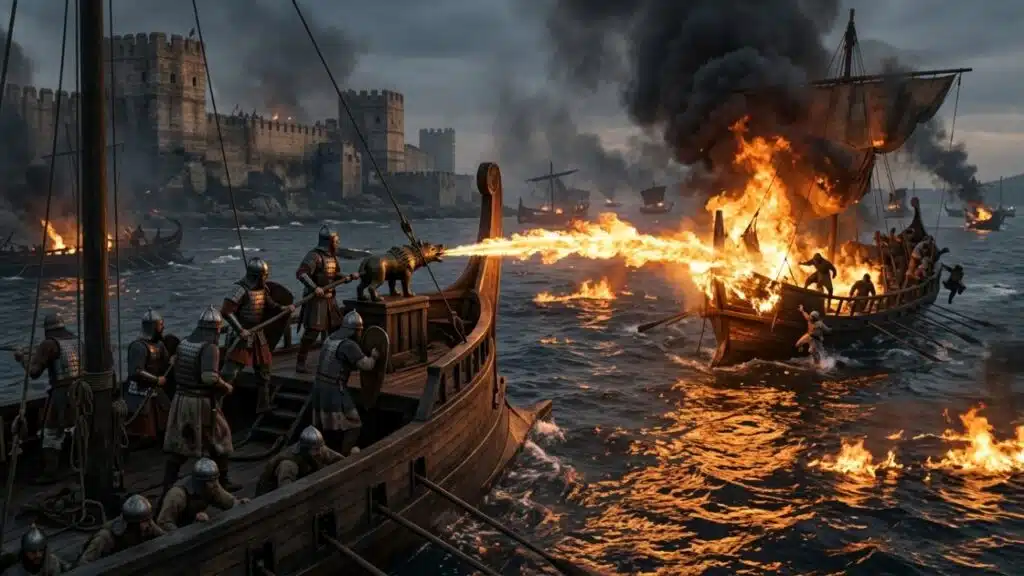
Mostly at sea. Bronze or brass tubes called siphons mounted in ship bows projected the burning liquid at enemy vessels, and it was also loaded into hand thrown containers. It was notoriously hard to put out, which made it a weapon of terror as much as destruction.
The Fleet That Could Not Stop Burning
The first Arab siege of Constantinople ran from 674 to 678, and the new weapon is credited with breaking it. The chronicler Theophanes called it sea fire and wrote that it filled the enemy with terror.
It returned in the second siege of 717 and 718, when the Arab fleet was partly neutralized by it soon after arriving. The Belgian historian Henri Pirenne judged the repulse of the Arabs at Constantinople a turning point as important as any battle in European history. Greek fire later crushed rebel Byzantine fleets in 727 and again during the rebellion of Thomas the Slav between 821 and 823.
For several centuries the Greek fire formula gave the empire an edge that no rival could match.
A Weapon Built Around a Tube
The substance was only half the weapon. The other half was the way it was delivered.
Byzantine warships carried bronze siphons in their bows that threw the liquid in a stream toward enemy hulls. Clay containers and soaked cloth bales were hurled by hand and by catapult. Once it was burning, the fire was extremely difficult to extinguish, with sand and vinegar among the few remedies the sources mention.
Picture a wooden ship watching a fire that sat on top of the sea and would not go out. The terror was part of the design. The Greek fire formula was a chemistry problem, but it was also a psychological weapon.
The Architect Who Arrived at the Right Moment
Theophanes credits Greek fire to Kallinikos, an architect from Heliopolis who reached Constantinople as the Arab conquests overran his homeland. It is a tidy story, and historians handle it with care. A later chronicler, Cedrenus, added that the architect’s family kept the Greek fire formula as an inheritance, handing it down through the generations.
Partington, whose 1960 study remains the classic work, suspected something more ordinary and more interesting. He thought the weapon was not one man’s invention but the product of chemists in the capital who had inherited the discoveries of the Alexandrian school.
Flammable liquids had been used in Greek and Roman warfare for centuries. What Constantinople added was refinement, organization, nd delivery at scale. The Greek fire formula was probably less a flash of genius than a long chemical inheritance, perfected in secret.
What the Greek Fire Formula Was Probably Not
Over the years, writers have proposed that Greek fire was an early form of gunpowder built on saltpeter. Partington rejected the idea. Purified saltpeter was not known in the Mediterranean world that early, and the behavior witnesses described did not fit.
Another popular guess is that the fire ignited on contact with water. But eyewitnesses stress that it kept burning on water, which is a different claim, and no tidy explanation has managed to match every account at once.
Ruling things out is about as far as the Greek fire formula has ever let scholarship go.
What Historians Think Was Inside the Greek Fire Formula
Most modern scholars land on a single idea: a petroleum base mixed with resins. Oil that seeps naturally from the ground around the Black Sea region is the usual candidate for the raw material, which would explain why imperial control over those lands mattered so much.
Anna Komnene, the Byzantine princess who wrote history in the early twelfth century, mentions resin gathered from pine and other evergreen trees in her account of the fire, though she stops far short of a recipe. Sulfur, quicklime and niter appear in other proposals, and none has been proved.
In other words, scholars can name the likely family of ingredients, but they cannot verify a single detail beyond that, because no complete account survives. The Greek fire formula is known only by its outline.
The Emperor Who Blamed an Angel
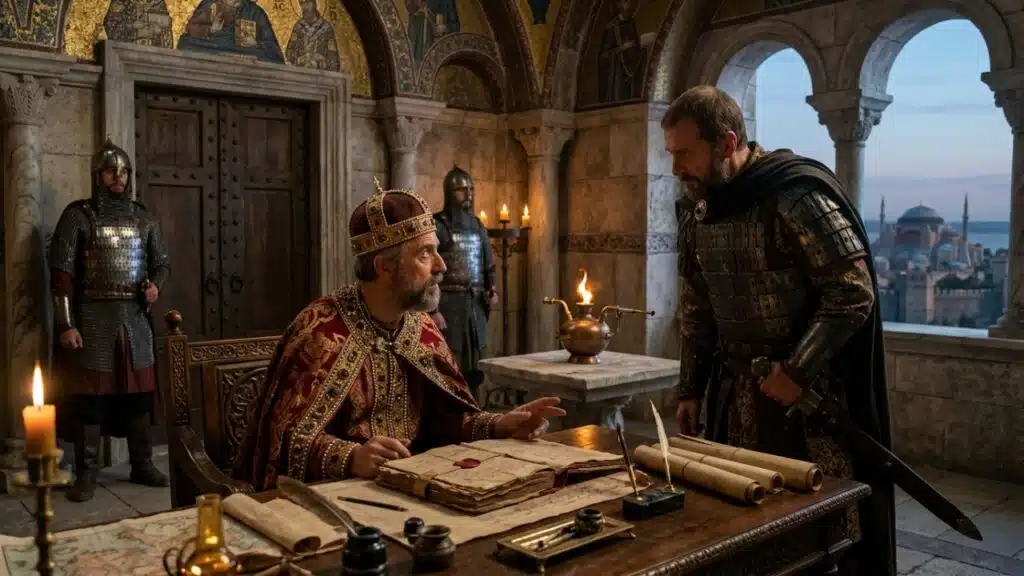
In the middle of the tenth century, Emperor Constantine VII Porphyrogenitus wrote a private guide for his son and heir, Romanos II. One passage deals with Greek fire. If foreigners ever asked for it, the young prince was to refuse.
The emperor explained that an angel had revealed the weapon to Constantine the Great, the first Christian emperor, and had bound him to see that it was made only by Christians and only in the imperial city. To drive the point home, he added a cautionary tale. A military governor, bribed by outsiders, had once handed some of the fire over. As he approached a church, a flame from heaven struck him down.
Modern historians read both stories as sacred packaging. The angel gave the secret authority. The thunderbolt gave it teeth.
Notice what the emperor never does. He never writes down the recipe. He builds a wall of fear around the Greek fire formula and trusts the wall to hold.
Captured, but Never Copied
The secret leaked at the edges and never at the center. The Arabs captured a fireship intact in 827. The Bulgars later seized several siphons and a good deal of the substance itself.
Yet no enemy ever produced a Greek fire weapon of their own. A captured tube is not a captured method, and a captured barrel eventually runs out. The people who could actually make it stayed inside Constantinople, which suggests the Greek fire formula was less a recipe on paper than a craft held in a few trained hands.
The Quiet Death of the Greek Fire Formula
The fade was slow. Anna Komnene describes Greek fire in a naval battle against the Pisans in 1099. But when the Fourth Crusade attacked Constantinople in 1203, the defenders used hastily improvised fireships, and no report confirms that real Greek fire was involved.
Many historians believe the true secret was lost well before 1204, perhaps centuries earlier. The name outlived the weapon. Crusader writers used it for almost any incendiary, at the siege of Acre, in the Nile campaigns against Louis IX, and even in later accounts of the fall of Constantinople in 1453.
When the Ottomans took the city that May, there was no secret weapon left to find.
Why Nobody Can Rebuild the Greek Fire Formula
There is no manual to check against. What survives is a set of chroniclers who watched it burn, an emperor who wanted it hidden, and a princess who described only part of the picture.
Partington’s work shows how far scholarship got: it narrowed the field by elimination. Modern experiments can produce incendiary mixtures, but with no original to test against, nobody can prove they match the Greek fire formula rather than a distant cousin of it.
Historians do not lack curiosity or tools. They lack the one document that the Byzantine state worked hardest to prevent from ever existing.
Conclusion: The Secret That Outlived Its Keepers
The Greek fire formula is a rare kind of lost knowledge. It was not destroyed by an enemy or forgotten through neglect. It was deliberately hidden by the people who owned it, wrapped in religion, taught to almost no one, and defended by fear.
It worked so well that it saved a capital twice. It also worked so well that the secret may have died with the few people allowed to hold it.
What survives is the shape of the mystery: the burning sea, the bronze tube, the warning to a young prince, the long decades when the name lingered after the thing was gone. Somewhere in that story is a lesson Constantine VII never meant to teach his son. A secret that nobody is allowed to share dies the moment its guardians stop.
The Greek fire formula was Byzantium’s greatest protection and, in the end, its most complete loss.
Discover a Hidden Maya City
Deep in Mexico’s jungle, LiDAR has revealed a massive lost city of 30,000 people—reshaping everything we know about Maya civilisation.
In 2024, a team of archaeologists made a discovery that could change everything: they found a lost city beneath the pyramids.
Click below to watch the full story:
https://www.youtube.com/@EchoesofAntiquity-egypt/videos
Sources
- Wikipedia: “Greek fire” (composition debate, Kallinikos, Partington, 827 capture, 1203 siege, later use of the name). en.wikipedia.org
- World History Encyclopedia: “Greek Fire: The Byzantines’ Secret Weapon” (Kallinikos, naphtha, delivery methods, siege chronology). worldhistory.org
- Royal Museums Greenwich: “Greek fire” (petroleum base theory, siphons, extinguishing methods). rmg.co.uk
- Byzantine World: “Greek Fire: Byzantium’s Secret Weapon That Burned on Water” (Partington on saltpeter, Pirenne on 678, decline before 1204, the name outliving the weapon). byzantine-world.com
- The Conversation: “Greek fire was the most devastating weapon in the Eastern Roman Empire. But what was it?” (Constantine VII’s warning, siphons, Theophanes). theconversation.com
- HistoryNet: “The Lost Secret of Greek Fire” (Constantine VII’s letter to his son, the bribed governor). historynet.com
- La Brujula Verde: “Greek Fire, the Byzantine Empire’s Secret Incendiary Weapon That Survived Until the 19th Century” (Cedrenus on the family secret, Anna Komnene’s description, rebellions of 727 and 821 to 823). labrujulaverde.com
- Weird Science History: “Greek Fire: The Byzantine Weapon That Burned on Water” (the angel legend read as propaganda). weirdsciencehistory.com
- Greek Reporter: “Greek Fire: The Powerful Weapon of the Byzantine Empire” (June 2026). greekreporter.com
- Wikipedia: “Siege of Constantinople (717 to 718)” (Greek fire against the Arab fleet). en.wikipedia.org
- Wikipedia: “De Administrando Imperio” (background on Constantine VII’s guide for Romanos II). en.wikipedia.org
- Primary and scholarly works for verification: Constantine VII Porphyrogenitus, De Administrando Imperio (Dumbarton Oaks edition, 1967); Theophanes the Confessor, Chronographia; Anna Komnene, Alexiad; James Riddick Partington, A History of Greek Fire and Gunpowder (first published 1960, reissued by Johns Hopkins University Press, 1999).