Roman Concrete Formula: The Ancient Secret That Heals Itself
Roman Concrete Formula: The Ancient Secret That Heals Itself
The Pier That Refused to Crumble
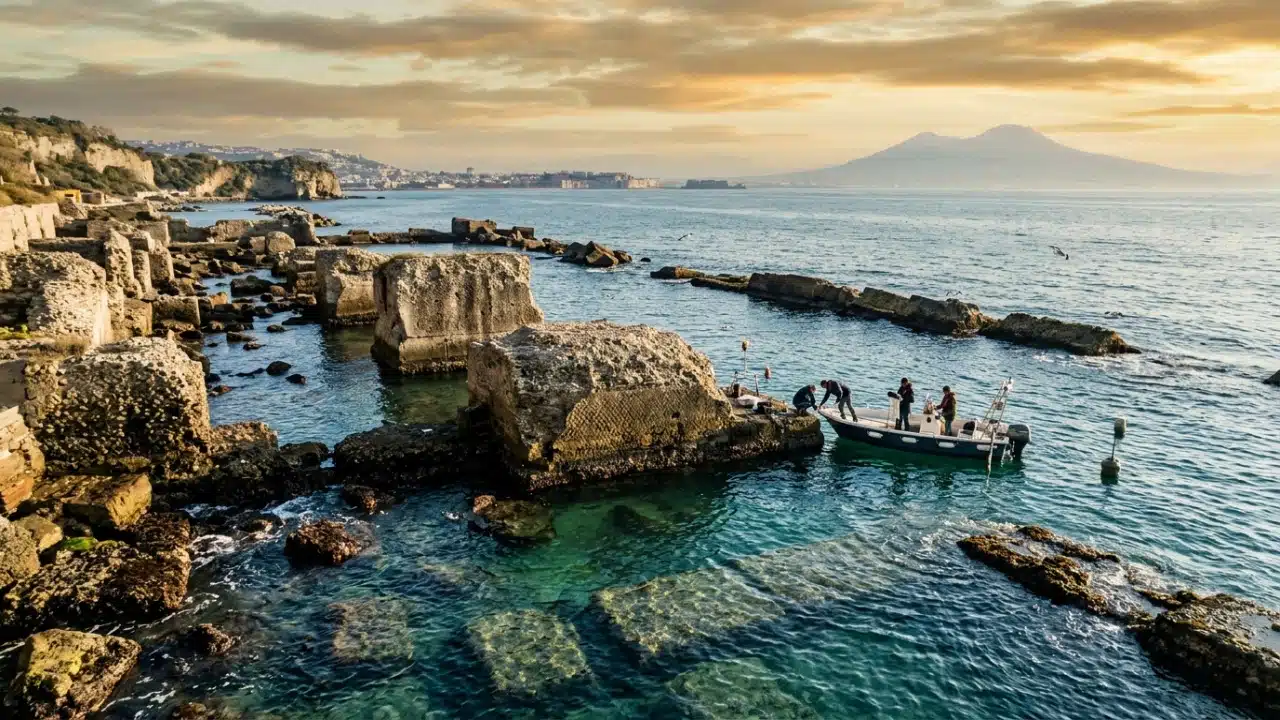
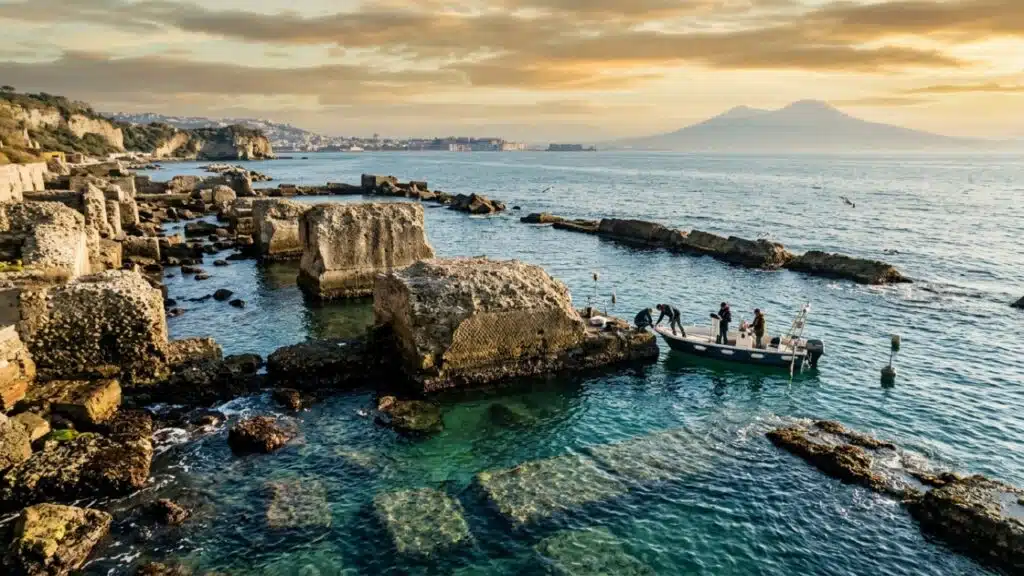
Off the coast of Italy, in harbors that have been battered by salt water, tidal surges, and Mediterranean storms for nearly two thousand years, something is still standing that should not be.
Roman concrete piers. Harbor walls. Breakwaters built during the reign of emperors whose names now appear only in history books. The engineers who poured them have been dead for twenty centuries. The empire that commissioned them collapsed in the fifth century CE. And the concrete they made not only survives but, according to research published by the Lawrence Berkeley National Laboratory, is still getting stronger.
Modern concrete is not doing this. A seawall built in the twentieth century using Portland cement begins to show deterioration within decades of exposure to saltwater. The steel rebar inside it corrodes. The calcium silicate hydrate matrix that gives it initial strength begins to dissolve. After fifty years, significant structural intervention is typically required. After a hundred years, most modern coastal concrete structures require replacement.
After two thousand years, the Roman piers are still there.
For decades, scientists assumed the Roman concrete formula was simply a matter of better ingredients, specifically the volcanic ash from the region around Pozzuoli, near Naples, that the Romans mixed into their concrete. The pozzolana ash had long been recognized as a superior ingredient. What nobody understood was why.
Then MIT happened. And then Pompeii happened again.
AEO Quick Answer: Roman Concrete Formula
What is the Roman concrete formula?
The Roman concrete formula, called opus caementicium, combined volcanic ash known as pozzolana from the Pozzuoli region near Naples, quicklime, seawater in marine applications, and aggregate materials including tuff stone and ceramic fragments. The critical difference from modern concrete was not just the ingredients but the mixing method. MIT research published in 2023 confirmed that Romans likely used a hot mixing process, combining quicklime directly with volcanic ash at extremely high temperatures, which produced lime clasts, small calcium-rich fragments distributed throughout the mix, that give Roman concrete its self-healing properties.
Why does Roman concrete get stronger over time?
The Roman concrete formula gets stronger through two distinct chemical mechanisms. In marine environments, research by the Lawrence Berkeley National Laboratory found that seawater percolating through the concrete triggers the formation of two rare minerals, Al-tobermorite and phillipsite, which grow as interlocking crystal plates in any gaps within the matrix, physically reinforcing the structure over time. In both marine and terrestrial environments, the lime clasts identified in MIT’s 2023 study act as reservoirs of reactive calcium that dissolve when water enters a crack and recrystallize as calcium carbonate, sealing the crack autonomously without human intervention.
What is hot mixing in Roman concrete?
Hot mixing is the manufacturing process identified by MIT professor Admir Masic and his team as the key to the Roman concrete formula’s self-healing properties. Rather than letting quicklime slake in water before mixing, the Romans appear to have mixed quicklime directly with volcanic ash while both were still hot, producing extremely high localized temperatures during the mixing process. This produced lime clasts, small unmixed calcium-rich fragments distributed through the mortar. For over a century, researchers had assumed these clasts were evidence of sloppy workmanship. The 2023 study demonstrated they were the mechanism behind the concrete’s self-repair capability.
What did the 2025 Pompeii discovery reveal about Roman concrete?
In 2025, a building site frozen mid-construction by the 79 CE eruption of Mount Vesuvius was excavated at Pompeii, providing the first opportunity to analyze Roman concrete at the exact moment it was being prepared rather than from a finished structure. Researchers found unmixed building materials alongside partially completed walls, allowing direct comparison of raw ingredients with cured concrete. The site confirmed that the hot mixing process identified in laboratory analysis of finished structures corresponded to actual construction practice, validating the MIT findings with physical evidence of the Roman concrete formula in action during production.
The Ingredient Scientists Misread for a Century
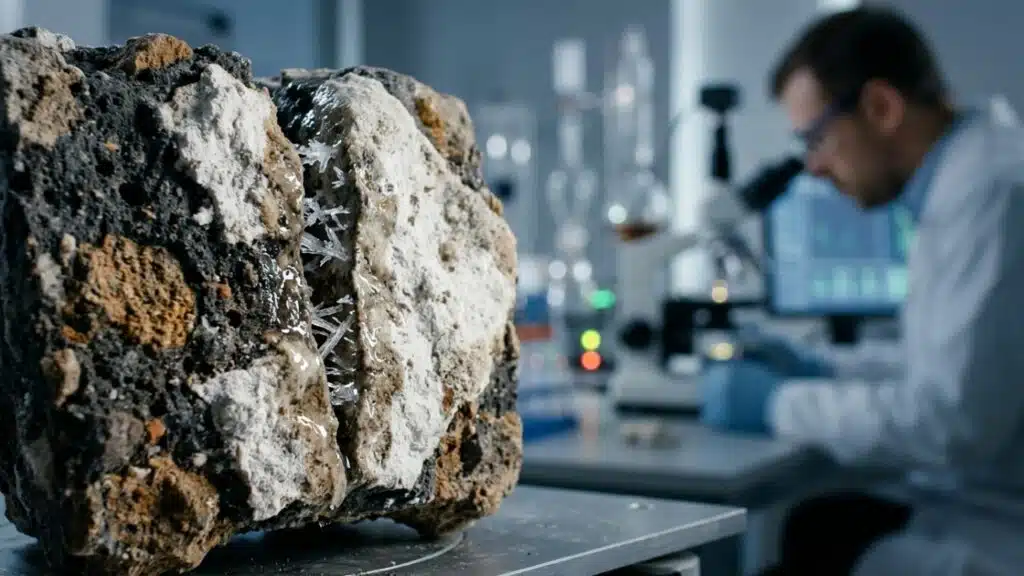
The Roman concrete formula contains something that researchers spent a century treating as a mistake.
In cross-sections of ancient Roman concrete examined under microscopes, scattered throughout the volcanic ash and aggregate matrix, appear irregular white fragments of unmixed lime, calcium-rich clasts sitting in the finished concrete like small islands in a dark sea. Every materials scientist who examined these fragments until very recently drew the same conclusion: the Romans had mixed their concrete poorly. The lime had not been fully incorporated. It was a flaw in ancient manufacturing technique.
MIT professor Admir Masic had a different intuition.
Masic spent years applying advanced characterization techniques to ancient Roman concrete samples, studying the chemical makeup at a precision that earlier researchers had not been able to achieve. What he found when he looked closely at the lime clasts was not evidence of carelessness. The clasts were not random fragments of incompletely mixed material. They had a specific nanoscale structure, a layered internal architecture that was consistent with rapid high-temperature formation rather than slow conventional slaking.
The Roman concrete formula, Masic’s team concluded, was almost certainly made using a process they called hot mixing: quicklime was combined directly with volcanic ash while still reactive and hot, rather than being first slaked in water as modern concrete practice requires. The extremely high temperatures generated during this direct combination produced a different chemical environment than conventional mixing, one in which the lime clasts formed as distinct calcium-rich reservoirs distributed throughout the mortar.
These reservoirs were not a defect. They were a feature. When water entered a crack in the finished concrete, the reactive calcium in the lime clasts dissolved into solution, migrated to the crack faces, and recrystallized as calcium carbonate, filling the crack and restoring structural continuity.
The Roman concrete formula healed itself. The mechanism had been sitting in plain sight in research samples for decades, misidentified as poor workmanship.
The 2023 Proof That Changed Everything
The lime clast hypothesis had been proposed before Masic’s team assembled the full evidence. What the 2023 MIT study, published in Science Advances, added was experimental proof.
The team created test samples of pozzolanic concrete using both ancient-style quicklime mixing and modern slaked lime methods. They deliberately cracked both sets of samples. They then monitored the crack behavior over time under controlled conditions.
The cracked quicklime concrete, made using the hot mixing approach of the Roman concrete formula, healed within two weeks. New calcium carbonate crystals formed along the crack faces, bridging the gap and restoring the structural matrix. The control concrete, made using modern methods without lime clasts, remained cracked. No healing occurred.
The experimental result was direct and unambiguous. The Roman concrete formula’s self-healing mechanism worked as the team had theorized, and it worked at a speed that any structural engineer would immediately recognize as practically significant. Two weeks to seal a crack is not a geological timescale. It is fast enough to matter in real infrastructure.
The team’s findings resolved a mystery that had occupied materials scientists for decades. Roman concrete harbor structures exposed to salt water for two thousand years had been analyzed by the Roman Maritime Concrete Study at the Lawrence Berkeley National Laboratory, which found that the marine applications had developed two specific minerals inside them: Al-tobermorite and phillipsite. These minerals, similar in crystal structure to volcanic rocks, had grown as interlocking plates in gaps within the ancient concrete, physically reinforcing the structure from the inside over centuries of seawater exposure.
The Roman concrete formula, in its marine application, was not just healing cracks. It was continuously incorporating seawater minerals into a growing crystal lattice that made the concrete denser, stronger, and more tightly bound the longer it sat in the water. The researchers at Lawrence Berkeley observed this strengthening process continuing over 180 days in laboratory reproductions, with the crystal networks growing denser and the concrete becoming tougher as they developed.
Modern concrete exposed to seawater deteriorates because its calcium silicate hydrate matrix dissolves under salt exposure. The Roman concrete formula responded to seawater by incorporating it into new mineral growth. What destroys one material was literally feeding the other.
The Emperor’s Toilet That Revealed a Secret
One of the more unexpected sources of evidence for how the Roman concrete formula achieves its durability came from a structure built during the reign of Hadrian, the emperor who constructed his famous wall across Britain and spent much of his reign traveling the empire overseeing ambitious building projects.
Scientists examining Hadrian’s concrete structures found calcite deposits within the matrix, calcium carbonate crystals that had formed long after the original concrete had cured. The presence of secondary calcite in Roman concrete had been noted before but not fully explained within the context of the self-healing mechanism.
Analysis published in Science Advances and covered by Science Alert revealed that the calcite formation in Hadrian’s structures represented exactly the kind of long-term mineral growth that the Roman concrete formula enables. The secondary deposits appeared to have strengthened the concrete at the microscopic level, filling pores and reinforcing the interfacial zones between aggregate particles and the binding matrix.
The findings gave researchers what the title of the Science Alert coverage described as a new appreciation for even the more mundane Roman structures that were nevertheless imbued with engineering prowess. The Roman concrete formula was not reserved for the great monuments. Even utilitarian construction, facilities and functional buildings throughout the empire, benefited from the same chemical intelligence embedded in the mixing process.
What Vitruvius Wrote and What It Actually Meant
The Roman architect and engineer Marcus Vitruvius Pollio, writing in the first century BCE during the reign of Augustus, left one of the most important engineering texts of the ancient world, De Architectura, a comprehensive guide to Roman building practice. He described the volcanic ash from the Pozzuoli region in terms that engineers had been reading for centuries without fully understanding.
Vitruvius noted that the ash, when mixed with lime and water, produced a material that hardened even underwater, a property he considered remarkable enough to describe specifically. He understood that the pozzolana was different from other building materials. He did not have the chemistry to explain why, but his description of the hardening behavior in seawater matches exactly what the Lawrence Berkeley and MIT studies have since quantified.
The Roman concrete formula was not a secret in antiquity. It was written down, described in technical literature, and taught to the engineers who used it across the empire. What was lost was not the recipe but the understanding of why the recipe worked. When Portland cement was developed in the nineteenth century and demonstrated superior initial strength, the Roman concrete formula was set aside as obsolete. The mechanism that made it superior for long-term applications was not understood, and what is not understood cannot be appreciated or deliberately preserved.
The Pompeii Construction Site That Froze the Process in Time
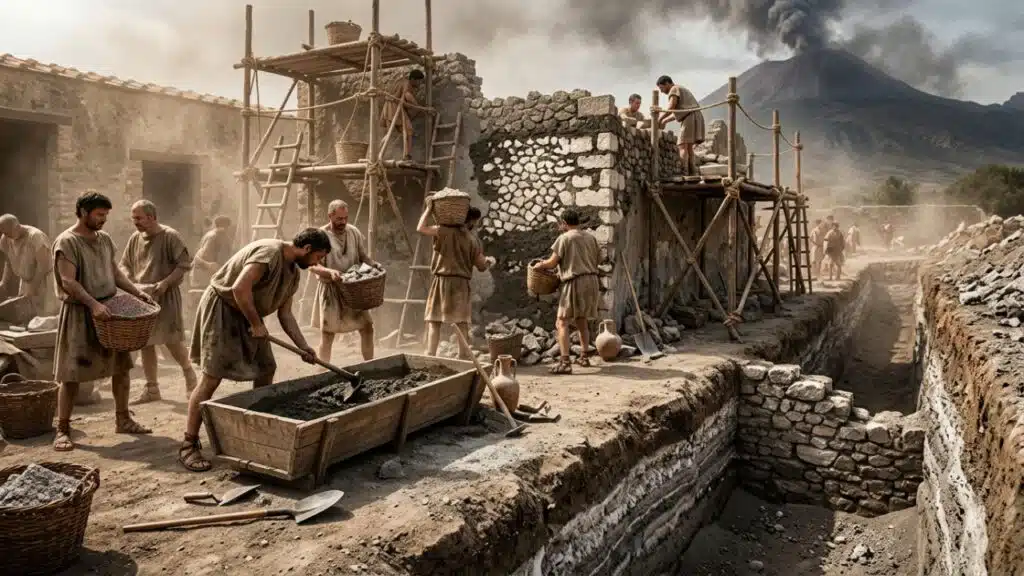
The most significant recent development in understanding the Roman concrete formula came not from a laboratory but from a volcanic catastrophe that had been sitting in southern Italy for nearly two thousand years.
In 2025, archaeologists excavating a building site in Pompeii uncovered something that had not been available to researchers before: a construction site that the eruption of Vesuvius in 79 CE had frozen mid-process. The site contained unmixed raw materials alongside partially completed walls, essentially a snapshot of the Roman concrete formula at the moment of production rather than the finished state that all previous analysis had examined.
The Pompeii construction site allowed researchers to compare the unmixed ingredients with the cured concrete in the same location, confirming that the hot mixing process identified in MIT’s laboratory analysis was not a theoretical reconstruction but an accurate description of actual Roman construction practice. The lime fragments in the raw materials matched the lime clasts found in the finished walls at the same site, providing direct physical evidence that the Roman concrete formula’s self-healing mechanism was a deliberate production outcome rather than an accidental byproduct of random mixing variation.
Futura Sciences covered the discovery with a specific focus on what the mid-construction evidence meant for validating the hot mixing theory. The site had been waiting under the ash of Vesuvius for almost two thousand years. When it emerged, it confirmed what the chemistry had been suggesting since 2023.
The Startup That Is Reviving It
The scientific understanding of the Roman concrete formula has moved faster in the past three years than in the previous century. And it has moved quickly enough to produce a commercial application.
In 2021, MIT professor Admir Masic co-founded DMAT, a startup working with Italian entrepreneur Paolo Sabatini, with the explicit goal of translating the Roman concrete formula’s principles into modern construction practice. The approach was not to simply replicate ancient Roman concrete directly, which would face challenges with initial compressive strength requirements for contemporary building codes, but to develop additives based on the self-healing mechanism that could be incorporated into standard modern concrete mixes.
A 2025 study comparing the raw material and energy requirements of Roman-style concrete to modern Portland cement found that while the Roman concrete formula requires more water and initial energy input during the hot mixing process, its dramatically longer functional lifespan makes it more sustainable over time. The environmental case is significant: the production of Portland cement is responsible for approximately 8 percent of global carbon dioxide emissions annually. Concrete that lasts two thousand years rather than fifty to one hundred years requires far less manufacturing over any given timespan.
DMAT secured safety and performance certifications in the European Union and is working to ensure its formulations fit modern concrete-making practices. The Roman concrete formula is not being archaeologically preserved as a curiosity. It is being commercially deployed as a solution to a contemporary infrastructure problem.
The Pantheon, one of the most complete ancient Roman structures in existence, was built using early versions of the Roman concrete formula approximately nineteen hundred years ago. Its dome, the largest unreinforced concrete dome in the world, shows no structural cracks. It is open to visitors every day.
Modern engineers are only now building the scientific foundation to understand why.
Why Modern Concrete Cannot Do What Roman Concrete Does
The Roman concrete formula’s superiority in specific applications is real, but it requires context to understand properly.
Modern Portland cement concrete has far higher initial compressive strength than any Roman concrete. It can be poured into complex forms. It sets predictably. It is compatible with steel reinforcement. It is produced and mixed at industrial scale with consistent quality control. These are the reasons it became the dominant construction material of the twentieth century and remains so today, with 19 billion tonnes used annually worldwide.
What thRomanan concrete formula does that modern concrete cannot is respond to its environment over time rather than simply resist it. Modern concrete treats water as an enemy, using chemical admixtures and waterproofing systems to keep it out. The Roman concrete formula treats water as a resource, using it to trigger ongoing mineral growth that continuously reinforces the structure.
Modern concrete begins strong and weakens over time as its calcium silicate hydrate matrix degrades under environmental stress. The Roman concrete formula begins slightly weaker and gets stronger over time as its Al-tobermorite crystal networks grow, its phillipsite reinforces the internal matrix, and its lime clasts seal any cracks that develop.
For most modern applications, the initial strength advantage of Portland cement is what matters. For infrastructure that needs to last centuries rather than decades, the Roman concrete formula’s trajectory is the more relevant one.
The Roman harbor walls knew this. They have been proving it for two thousand years.
Conclusion: The Formula That Was Never Really Lost
The Roman concrete formula was not lost. It was misread.
For over a century, the lime clasts that make self-healing possible were dismissed as impurities. The hot mixing process that created them was assumed to be less sophisticated than modern slaking methods. The volcanic ash that interacts with seawater to grow strengthening minerals was understood as a useful ingredient without understanding the chemical mechanism behind its usefulness.
What MIT, Lawrence Berkeley, and the Pompeii construction site together accomplished between 2023 and 2025 was a comprehensive reinterpretation of evidence that had been available for decades. The Roman concrete formula was not waiting to be discovered. It was waiting to be read correctly.
The implications extend beyond construction materials. A two-thousand-year-old manufacturing technique, dismissed as primitive, turns out to incorporate a self-healing mechanism that modern materials science is only now beginning to design intentionally into new materials. The Romans did not know the chemistry behind what they were doing. They knew that it worked. The chemistry was there all along, working in harbor piers and breakwaters and harbor walls, getting stronger with every decade, waiting for the instruments and the conceptual framework to finally explain it.
DMAT is in the market. Certifications are secured. The Roman concrete formula is being adapted for buildings that will still be standing when the twenty-first century is as distant as the Roman Empire is to us now.
The ancient engineers would probably not find this surprising.
Discover a Hidden Maya City
Deep in Mexico’s jungle, LiDAR has revealed a massive lost city of 30,000 people—reshaping everything we know about Maya civilisation.
In 2024, a team of archaeologists made a discovery that could change everything: they found a lost city beneath the pyramids.
Click below to watch the full story:
https://www.youtube.com/@EchoesofAntiquity-egypt/videos
Sources
- Science Advances (January 2023) — Admir Masic et al., MIT, “Mechanical resilience and cementitious processes in Imperial Roman architectural mortar” (hot mixing, lime clasts, self-healing mechanism) — cited via sciencealert.com and futura-sciences.com
- Indian Defence Review — “The Romans Had a Concrete Formula That Could Repair Itself. Scientists Are Reviving the Ancient Recipe for Modern Buildings” (2025 Pompeii construction site discovery, DMAT commercialization) — indiandefencereview.com
- Futura Sciences — “Ancient Roman concrete that repairs itself: could it change modern construction forever?” (hot mixing, DMAT startup, 2025 Pompeii confirmation) — futura-sciences.com
- Science Alert (2024) — “Ancient Roman Concrete Keeps Getting Stronger, And The Secret Was Hiding in Hadrian’s 2,000-Year-Old Toilet” (Science Advances secondary calcite study) — sciencealert.com
- Science Alert — “We Finally Know Why Ancient Roman Concrete Stood The Test of Time” (2023 MIT study, hot mixing, two-week crack healing) — sciencealert.com
- AZO CleanTech — “Scientists Decode Roman Formula to Build Indestructible Modern Concrete Structures” (Admir Masic MIT, DMAT founding 2021, EU certification) — azocleantech.com
- Science Insights — “Why Roman Concrete Is So Strong and Gets Stronger Over Time” (Lawrence Berkeley National Laboratory, Al-tobermorite and phillipsite crystal formation, 180-day strengthening observation) — scienceinsights.org
- How Stuff Works Science — “We Finally Know Why Ancient Roman Concrete Outlasts Our Own” (Roman Maritime Concrete Study, University of Utah, mineral crystal formation) — science.howstuffworks.com
- Impact Lab — “Unlocking the Secrets of Ancient Roman Concrete: A Self-Healing Formula for Modern Strength” (lime clast reinterpretation from defect to feature) — impactlab.com
- Wikipedia — “Roman concrete” (opus caementicium, pozzolana, 2023 research context, 2025 Pompeii building site confirmation) — en.wikipedia.org
- Yahoo Tech / BGR News — “Ancient Roman concrete outperforms our own, and science only just worked out why” (Roman Maritime Concrete Study, seawater mineral crystal reinforcement) — yahoo.com
- 2025 Sustainability Study — Comparison of Roman-style concrete vs. Portland cement energy and material requirements referenced via sciencealert.com and indiandefencereview.com