Damascus Steel History: The Lost Metal Science Can’t Be Fully Recreated
The Blade That Made Legends
There is a story in Damascus steel history that has been told in various forms for a thousand years. A Crusader knight, freshly arrived from Europe with his best iron sword, meets a Saracen warrior in single combat. The Crusader swings. The Saracen raises a silk scarf and drops it. The silk floats downward past the Saracen’s blade and falls to the ground in two pieces.
The story is a myth. But what sits underneath the myth is real. Damascus steel blades were demonstrably superior to comparable weapons of the medieval period in edge retention and resistance to fracture. That is not legend. That is metallurgy, and it is confirmed by modern electron microscope analysis of surviving authentic blades. The properties were real. The story of how those properties were achieved, and why the knowledge to reproduce them disappeared from the world sometime in the eighteenth century, is one of Damascus steel history’s most consequential and most tantalizing mysteries.
The mystery runs deeper than most people realize. Because in the early 2000s, scientists examining Damascus steel history’s most famous blades under modern instruments found something inside the ancient metal that had not been intentionally put there, and that the ancient smiths who made it almost certainly did not know existed.
Carbon nanotubes. Inside swords forged in the medieval Middle East, by craftsmen who had no concept of nanotechnology, a structure that materials science would not formally describe or intentionally create until the twenty-first century was already there, running through the steel, contributing to properties that modern metallurgists still cannot fully explain or replicate.
Quick Answer: Damascus Steel History
What is Damascus steel and why is it famous?
Damascus steel history begins in South India, not Damascus. The base material called wootz steel originated in India from approximately 300 BCE, where specific ore deposits containing trace elements including vanadium, chromium, manganese, cobalt, and nickel were smelted using techniques that produced a high-carbon steel with distinctive properties. Blades made from wootz and traded through Damascus acquired the city’s name in Western usage. Authentic Damascus steel blades were harder than ordinary iron swords, held a sharper edge longer, were more resistant to fracture, and displayed a characteristic watery or wavy surface pattern caused by carbide banding in the crystalline structure.
What made Damascus steel so strong?
Damascus steel’s physical strength came from an unusual microstructure. The high carbon content of wootz steel, typically 1.5 percent or higher, distributed through a matrix of iron produced alternating hard cementite regions and softer perlite or ferrite regions, creating a metal that combined hardness and flexibility in a ratio ordinary iron could not achieve. A 2006 paper in Nature identified carbon nanotubes and carbon nanowires within authentic Damascus steel blades, structural elements at the nanoscale that modern materials science confirms would have contributed to the steel’s exceptional mechanical properties, and which the smiths who made them did not know about intentionally creating.
Why was Damascus steel lost?
The disappearance of Damascus steel is one of the most significant knowledge losses in metallurgy. The production of authentic wootz steel in India was disrupted by several converging factors in the eighteenth century: the specific ore deposits in India that provided the essential trace element profile were exhausted or became inaccessible, European colonial powers, including the British,h deliberately suppressed Indian iron production so that raw materials could serve colonial industrial needs rather than indigenous metalworking traditions, and the increasing dominance of firearms made the premium blade weapons market that justified the extreme effort of wootz production commercially unviable. The last authentic high-quality Damascus steel blades were produced around 1750 to 1800 CE.
Can we recreate Damascus steel today?
Modern science can produce steel with similar visual appearance and some similar mechanical properties, but full authentic replication of Damascus steel’s original product remains incomplete. A September 2025 study published in the International Journal of Conservation Science confirmed that while recent reconstruction attempts have produced blades with comparable mechanical properties, differences in raw material and manufacturing techniques mean that current replications do not fully match authentic historical examples. Iowa State University metallurgist John Verhoeven came closest to a functional recreation in work published in 1998, but even his method required specific trace element supplementation that the original Indian ore provided naturally.
Where Damascus Steel Actually Came From
Damascus steel history carries a fundamental geographical confusion in its very name. The steel was not invented in Damascus. Damascus was where it was sold.
The base material, called wootz steel, originated in South India, where the historical and archaeological record places it from around 300 BCE, though the tradition almost certainly predates that earliest confirmed evidence. The word wootz probably derives from ukku, a term in Telugu and Kannada languages that broadly means steel, though the exact etymology remains debated among specialists.
The Indian smiths who produced wootz operated in specific regions where the available iron ore deposits had a particular geological character. The ores of these deposits naturally contained trace elements in concentrations that were not present in iron sources from other parts of the world: vanadium, chromium, manganese, cobalt, and nickel, in proportions that, when processed through the wootz smelting technique, contributed to the final steel’s microstructure in ways that researchers only fully began to understand in the twentieth century.
These trace elements were not added deliberately. The smiths who produced wootz did not have a periodic table. They did not know what vanadium was. They knew that ore from specific locations, processed with specific fuel and specific temperature controls, produced a steel that behaved differently from steel made elsewhere. The why of it was not known to them. The how was a craft tradition passed from master to apprentice across generations, refined over centuries, and eventually suppressed out of existence.
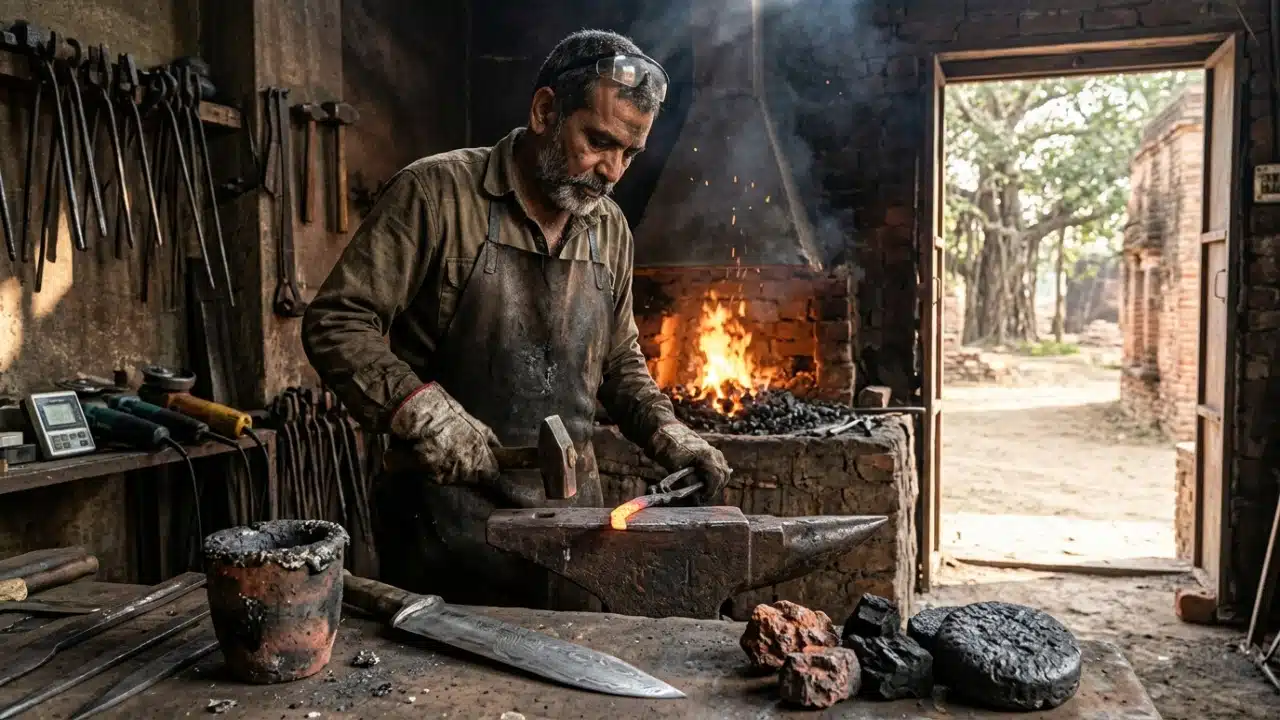
Damascus steel history begins, then, not in the city whose name it carries, but in the forge traditions of the Indian subcontinent, where a combination of geological accident, centuries of craft refinement, and trade routes that moved the finished ingots to buyers across the Islamic world and eventually into the hands of European crusaders created a global reputation for a material that its makers understood in practice without ever understanding in theory.
The Wavy Pattern and What It Means
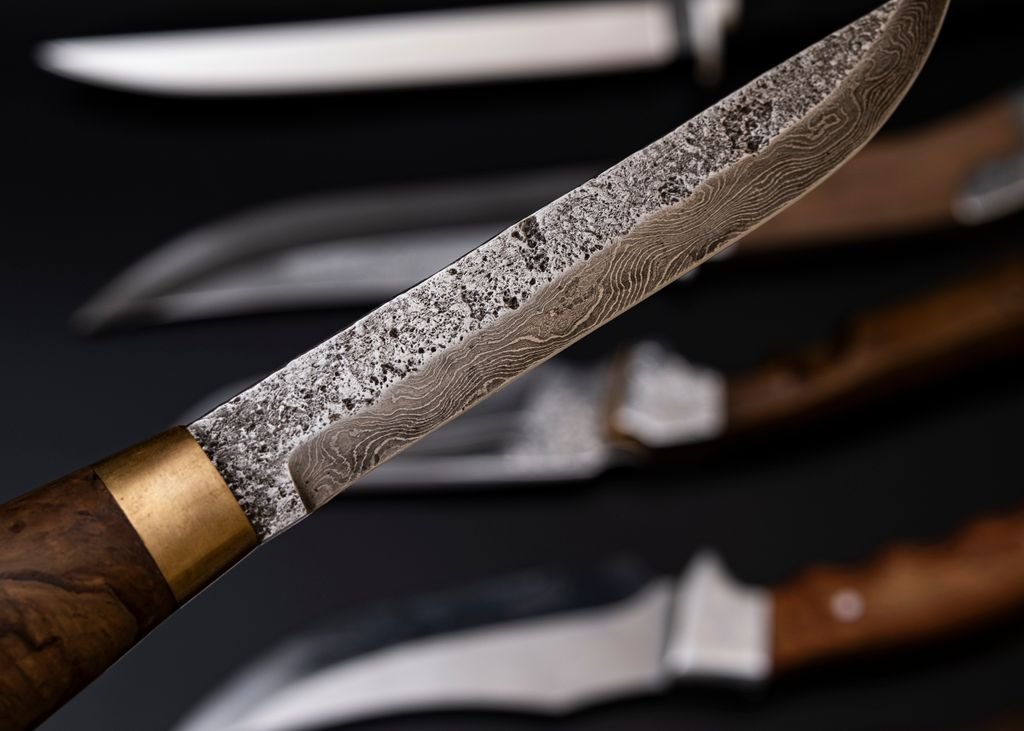
The visual signature of Damascus steel history is the surface pattern that gave the material one of its alternative names: watered steel. The surface of an authentic Damascus blade shows flowing, wavy lines running through the metal, sometimes described as a wood grain pattern, sometimes as the reflection of water in candlelight. Medieval accounts describe it as resembling the wavy lines drawn on sand by water, and the Arabic name for the pattern is the source of the word damask in multiple European languages.
This pattern is not decorative. It is structural, and it is the visual evidence of what is happening inside the metal at the microscopic level.
Wootz steel has a carbon content of approximately 1.5 percent, significantly higher than most conventional steels. At this carbon level, during the cooling process after smelting, carbon migrates through the iron matrix and forms bands of cementite, iron carbide, alternating with bands of softer ferrite and pearlite. The cementite bands are extremely hard and hold a sharp edge with exceptional persistence. The softer bands between them provide the flexibility that prevents the blade from shattering on impact.
When a blade is forged from Wootz and the smith uses the correct temperature regime during working, this banding becomes visible on the surface as the characteristic damask pattern. The pattern is not applied. It is revealed by the forging process, emerging from the internal structure of the metal as the smith works it.
Different pattern characteristics reflect different forging techniques. Some blades show ladder patterns, others rose patterns, others the classic watered flow. Each represents a different approach to thermal cycling and manipulation during the forging process. The specific temperatures, the number of heating and cooling cycles, and the working method- all of these influenced which pattern emerged and how pronounced it became.
In Damascus steel history, the pattern was simultaneously a quality indicator and an aesthetic signature. A blade with a pronounced, regular, flowing pattern was evidence of a smith who had mastered the temperature control required to reveal the steel’s internal structure. The beauty and the performance were the same thing expressed in different registers.
The Carbon Nanotubes Nobody Expected to Find
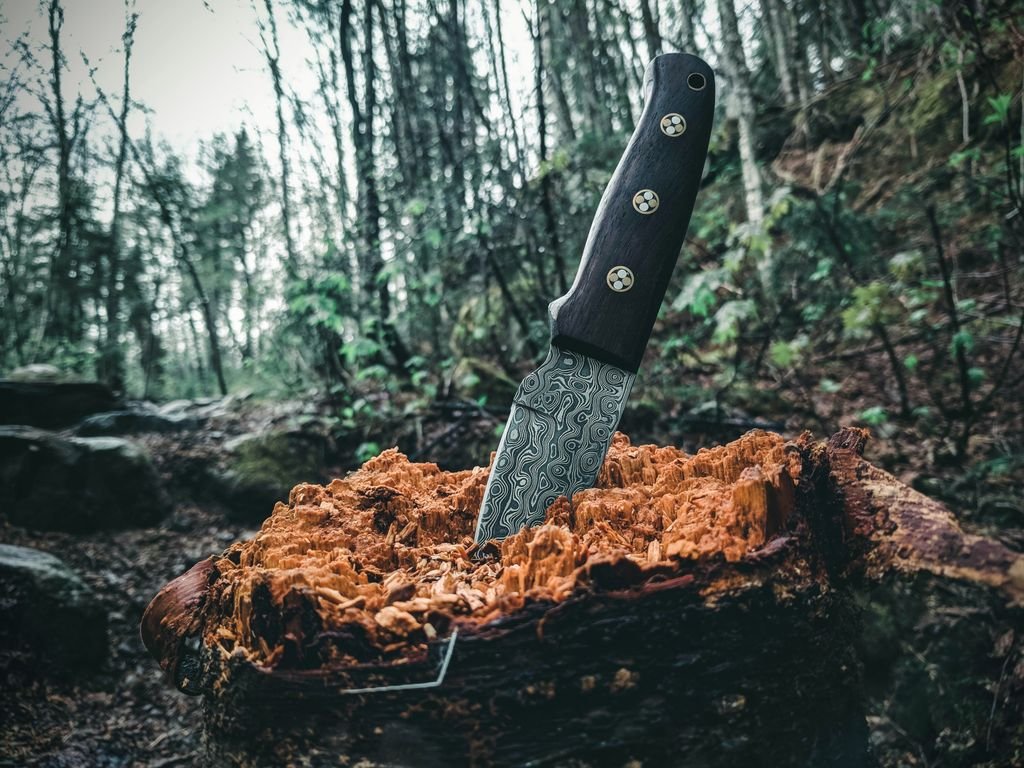
In 2006, a research team led by Peter Paufler at the Technical University of Dresden published a short paper in Nature that changed how Damascus steel history was understood at the molecular level.
Using high-resolution transmission electron microscopy to examine authentic historical Damascus blades, they identified carbon nanotubes and carbon nanowires within the steel matrix. These structures, tubes of carbon just nanometers in diameter with extraordinary mechanical properties, are a subject of intensive research in modern materials science. In 2006, they were less than two decades away from their formal scientific description. Finding them in a medieval sword was not expected.
The nanotubes had formed during the smelting and forging process. The specific combination of high carbon content, trace element impurities including vanadium, and the thermal cycling involved in wootz production created conditions in which carbon atoms organized themselves into nanotube structures within the cooling metal. The smiths who made the blades had no knowledge of this. The nanotubes were an emergent property of a process that was designed for entirely practical reasons, a side effect of the chemistry that nobody understood was happening.
What contribution the nanotubes made to the steel’s mechanical properties is still being quantified. Modern materials science confirms that carbon nanotubes in a metal matrix can significantly increase hardness, wear resistance, and fracture toughness. Whether the specific nanotube density found in Damascus blades accounts for a measurable portion of their legendary performance is an active area of research.
The finding that ancient craftsmen accidentally produced nanostructured materials two thousand years before nanotechnology existed as a concept is one of Damascus steel history’s most startling discoveries, and it illustrates precisely why full replication has been so difficult. You cannot deliberately recreate something that was created accidentally through processes that are only partially understood.
How the Knowledge Disappeared
Damascus steel history’s most consequential chapter is not the story of how the technique was developed. It is the story of how it was lost, and that story involves several intersecting causes that arrived simultaneously in the eighteenth century.
The first and most fundamental cause was geological. The specific ore deposits in South India that provided the natural trace element profile essential to wootz production became exhausted or inaccessible. History.com’s analysis of Damascus steel history confirms that the Middle Eastern trade with India was disrupted by European colonial powers, and that the English ruling over India suppressed the ancient practice so iron ores could be used for other purposes.
This is not a metaphor. The British East India Company’s commercial interests required that Indian iron production serve colonial industrial needs, not the premium indigenous metalworking traditions that had produced wootz. When the ore deposits that provided the right chemistry were no longer accessible to the smiths who knew how to process them, and when the institutional support for that knowledge was actively undermined, the chain of transmission broke.
The second cause was the market. The premium blade weapons market that had justified the extraordinary effort and expense of wootz production collapsed with the spread of firearms. A wootz sword that could cut through an opponent’s inferior blade and resist breaking under combat stress was worth a premium price in a world where swords decided battles. In a world where muskets and rifles were becoming dominant, the most perfect sword ever made was still a sword.
The third cause was secrecy. Damascus steel, history’s most direct parallel to other lost ancient technologies,iss this: the knowledge was never written down in a recoverable form. While general manuals of metalworking technique existed in the medieval Islamic world, the specific details of wootz production were treated as trade secrets within craft guilds and family traditions. When the practitioners were gone, they took the specifics with them.
The Closest Anyone Has Come
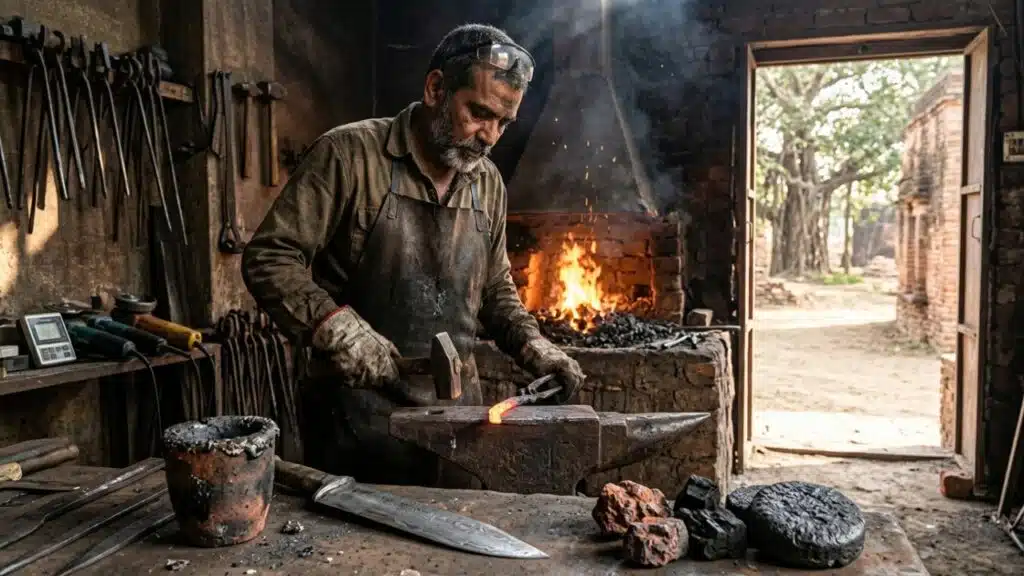
Damascus steel history’s modern chapter begins in the 1980s, when serious scientific interest in replication accelerated following the first electron microscope analyses of authentic historical blades.
Iowa State University metallurgist John Verhoeven and experienced bladesmith Alfred Pendray published the closest attempt to authentic wootz recreation in 1998, after more than a decade of experimental work. Their method involved starting with wootz ingots whose chemical composition matched historical analyses, using forging temperature sequences derived from empirical experimentation, and applying specific thermal cycling patterns to encourage the cementite banding that produces the characteristic surface pattern.
Verhoeven wrote that it was only through a partnership between science and art that the veil had been lifted from this mystery, acknowledging that the combination of materials science analysis and practical blacksmith expertise that Pendray provided was necessary for the collaboration to produce results. Their recreated blades displayed the characteristic pattern and achieved mechanical properties comparable to historical examples by conventional measurement.
But critical questions remained. Verhoeven and Pendray had to supplement their starting material with specific trace elements because they could not source ore with the natural chemical profile of the original Indian deposits. This is not a minor workaround. It is an acknowledgment that the geological raw material that made wootz possible no longer exists in accessible form.
A September 2025 study in the International Journal of Conservation Science examined reconstruction attempts systematically and confirmed that due to differences in raw material and manufacturing techniques, current replications have not fully matched historical Damascus steel. The study attempted to recreate Damascus steel knives from historical documents and found that while surface patterns and basic hardness metrics could be matched, the full mechanical property profile of authentic historical examples remained elusive.
Dierk Raabe at the Max Planck Institute for Iron Research took a different approach, using laser additive manufacturing, essentially precision 3D printing with metal, to build steel layer by layer in patterns that replicate the internal structure of Damascus steel. This approach produces layered steel with similar properties using far less energy than traditional forging, and Raabe’s results represent a genuinely modern parallel technology to the ancient craft rather than a recreation of the original process.
The Name Is Also Wrong
One detail in Damascus steel history that rarely appears in popular accounts is worth stating clearly because it reframes the entire story.
The steel was not made in Damascus. It was not invented by Damascus smiths. The technique was not developed in the Middle East. The name comes from the trade route, not the origin.
Damascus was the market. The steel was Indian. The name accumulated over centuries of European association between the steel’s quality and the city through which European buyers obtained it, and eventually the city’s name became the material’s name regardless of where the material was actually born.
This matters for Damascus steel history because it affects the question of where to look for surviving knowledge. European and Middle Eastern sources describe the properties and the appearance of the steel from a consumer perspective. The production knowledge was in India, held by smiths whose techniques were transmitted orally within craft traditions, and whose institutional context was destroyed by colonial commercial pressure before any systematic documentation of those traditions was undertaken.
The recipe for Damascus steel, history’s most celebrated material,l may have survived in fragmentary form in Indian regional craft traditions that were never consulted by the Western metallurgists who spent the twentieth century attempting reconstruction. This is a research avenue that has not been fully explored, partly because the academic framework of Damascus steel history was established before the Indian origin of the technique was fully recognized and incorporated into the question being asked.
Conclusion: The Metal That Keeps Its Secrets
Damascus steel history is not a mystery of supernatural craft or alien technology. It is a story of real materials science at a level of sophistication that outpaced formal understanding by nearly two thousand years, practiced by craftsmen who knew empirically what worked without knowing theoretically why, and transmitted through apprenticeship traditions that were erased before documentation could preserve them.
The carbon nanotubes are real. The trace element profile is identified. The carbide banding mechanism is understood. The thermal cycling requirements have been partially reconstructed. Modern materials scientists can produce steel with a similar visual appearance and broadly comparable properties.
What they cannot produce is the full authentic material, with its complete nanotube network, its specific cementite distribution, and the precise mechanical property profile that made the original blades worth transporting from India through Persia to Damascus and across the Mediterranean to the Crusader states, where European knights saw something in the Saracens’ blades that they could not match.
Damascus steel history tells us that some knowledge is lost not because the science was beyond human understanding, but because the social and political conditions that sustained a craft tradition were destroyed before anyone thought to write down what the masters knew. The blades survive in museums. The ore deposits are exhausted. The smiths are gone.
What was made cannot be unmade. What was known cannot be unlearned. But Damascus steel history also confirms that knowing and recreating are two different things, and the distance between them is still being measured.
Discover a Hidden Maya City
Deep in Mexico’s jungle, LiDAR has revealed a massive lost city of 30,000 people—reshaping everything we know about Maya civilisation.
In 2024, a team of archaeologists made a discovery that could change everything: they found a lost city beneath the pyramids.
Click below to watch the full story:
https://www.youtube.com/@EchoesofAntiquity-egypt/videos
Sources
- International Journal of Conservation Science (September 2025) — “Research Regarding the Durability and Mechanical Properties of the Legendary Damascus Steel.” DOI: 10.36868/IJCS.2025.03.15 — researchgate.net
- International Journal of Conservation Science (June 2024) — “Learning from the Past: The Reconstruction of the Original Damascus Steel. Experimental Study.” DOI: 10.36868/IJCS.2023.03.07 — ijcs.ro and researchgate.net
- Nature (2006) — Peter Paufler et al., Technical University of Dresden, “Carbon nanotubes in an ancient Damascus sabre.” Nature 444, 286. (Carbon nanotube discovery in authentic blades) — cited via nanoinnovation2025.eu and history.com
- History.com — “Damascus Steel: Why Did The Ancient Super-Metal Vanish?” (Verhoeven, Raabe, vanadium trace elements, colonial disruption) — history.com
- Hoodie History — “The Lost Metal: The Mystery of Damascus Steel” (wootz etymology, trace element analysis, honest assessment of replication limits) — hoodiehistory.com
- Really Lore and Order — “Lost Recipe for Legendary Damascus Steel” (ongoing research summary, cementite kinetics) — realloreandorder.com
- Nano Innovation 2025 / Rome — “The Damascus Steel: Carbon Nanotubes as an Ancient History” (Paufler nanotube discovery context, trade secret problem) — nanoinnovation2025.eu
- Breakthrough Blacksmithing — “Forging Damascus Steel: A Timeless Craft Revived” (Raabe additive manufacturing, modern replication approaches) — breakthroughblacksmithing.wordpress.com
- John D. Verhoeven and Alfred H. Pendray (1998) — “The Mystery of Damascus Blades.” Scientific American 278, 74–79 (foundational replication study) — cited via history.com
- Wikipedia — “Damascus steel” (wootz origin, carbide banding, 18th-century disappearance, modern replications) — en.wikipedia.org
- arXiv — “Structural characterization of ancient Japanese swords from MAAS using neutron strain scanning” (comparative context for ancient metallurgy analysis methods) — arxiv.org