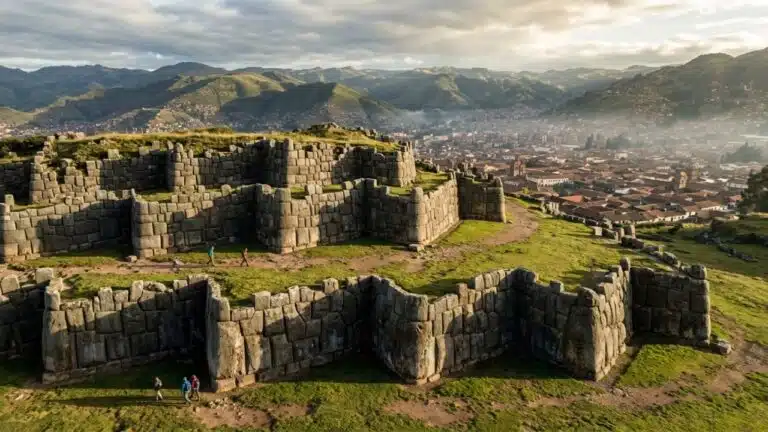
When Did the Roman Empire Rise and Fall? 7 Key Dates
The Empire That Ended Twice
The Roman Empire rise and fall is usually taught as one clean arc: a republic becomes an empire, the empire grows, and the empire collapses in 476. That tidy version hides the strangest part. Rome did not end once. It ended twice, nearly a thousand years apart.
The western half dissolved in 476 CE so quietly that most people living in Italy that year could not have named the day. The eastern half, ruled from Constantinople, kept Roman law and the Roman name alive until 1453. Anyone asking when the Roman Empire rose and fell has to decide which Rome they mean.
Short answer: The Roman Empire began in 27 BCE, when Augustus became its first emperor. The Western Roman Empire fell in 476 CE, when Odoacer deposed Romulus Augustulus. The Eastern Roman Empire, often called the Byzantine Empire, survived until 1453 CE, when the Ottomans captured Constantinople.
Key Takeaways
- The Roman Empire rise and fall covers about 1,480 years, from 27 BCE to 1453 CE.
- The Eastern Roman Empire outlived the Western Roman Empire by nearly a thousand years.
- Most historians describe the Roman Empire rise and fall in the West as a slow process, not a single battle.
- Politics, war, migration, plague, and climate all played a part, and scholars still debate their weight.
- The Late Antique Little Ice Age began in 536, sixty years after 476, so it belongs to the Eastern story.
The Roman Empire: Rise and Fall in 7 Key Dates
| Date | Event | Why it matters |
|---|---|---|
| 31 BCE | Battle of Actium | Octavian defeats Antony and Cleopatra and ends the civil wars |
| 27 BCE | Augustus becomes first emperor | The Roman Empire begins |
| 117 CE | Death of Trajan | Greatest territorial extent, roughly five million square kilometers |
| 235 to 284 CE | Crisis of the Third Century | Civil war, invasion and plague nearly break the state |
| 395 CE | Death of Theodosius I | East and West are divided permanently |
| 476 CE | Odoacer deposes Romulus Augustulus | End of the Western Roman Empire |
| 1453 CE | Ottomans take Constantinople | End of the Eastern Roman Empire |
When Did the Roman Empire Rise?
Rome was a city long before it was an empire. Tradition dates the Republic to 509 BCE, and for nearly five centuries Rome governed its growing territory through elected magistrates and a Senate.
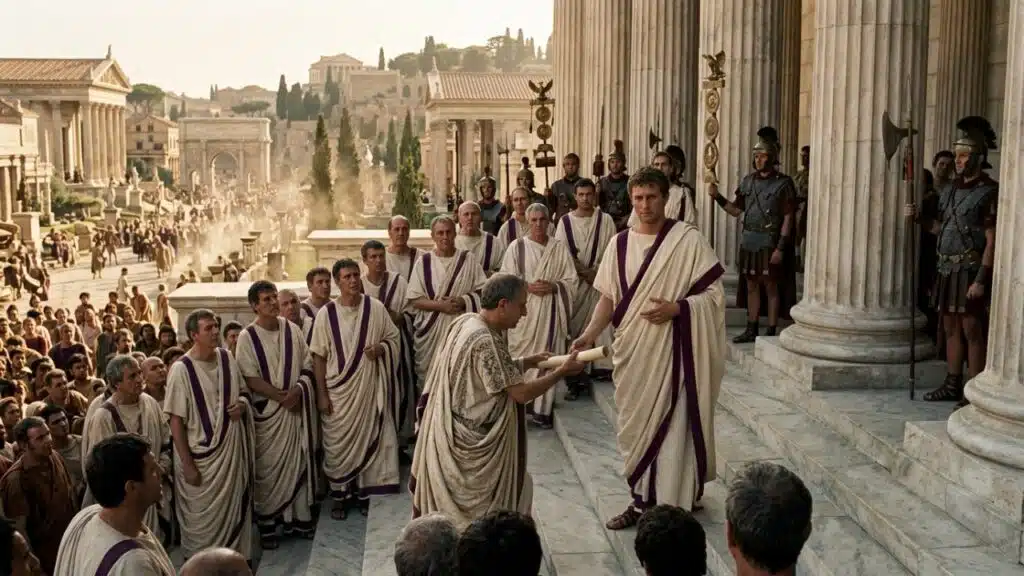
The empire proper begins with a civil war. In 31 BCE, at Actium, Octavian defeated Mark Antony and Cleopatra, the queen whose lost tomb archaeologists are still hunting. Four years later, in 27 BCE, the Senate granted him the title Augustus, and the Republic became a monarchy in everything but name.
Then the empire kept growing. It reached its greatest extent in 117 CE, when Trajan died, stretching from Britain to Mesopotamia. Its engineers poured the Roman concrete that still holds harbors together today. That peak is the hinge of the Roman Empire rise and fall. Every date after 117 is, in some sense, a story about holding on.
When Did the Roman Empire Start Falling?
Historians do not agree on when the Roman Empire rise and fall tipped from growth into decline, but the first great warning is the Antonine Plague, which struck from about 165 to 180 CE. Then came the Crisis of the Third Century, from 235 to 284, when a long line of emperors seized power and lost it amid civil war and invasion.
Diocletian ended the crisis in 284 and split the administration. Constantine dedicated Constantinople in 330. When Theodosius I died in 395, his sons divided the empire for good. In 391, a Christian mob had destroyed the Serapeum in Alexandria, one more episode in the long decline of the Library of Alexandria.
In 410, Alaric’s Visigoths sacked Rome itself, the first time in roughly 800 years that a foreign army had taken the city. The Roman Empire rise and fall was never a straight line downward, but after 410 the direction was hard to miss.
When Did the Western Roman Empire Fall?
The standard answer is 476. In that year, Odoacer, a Germanic general in Roman service, deposed the young emperor Romulus Augustulus and ruled Italy as king.
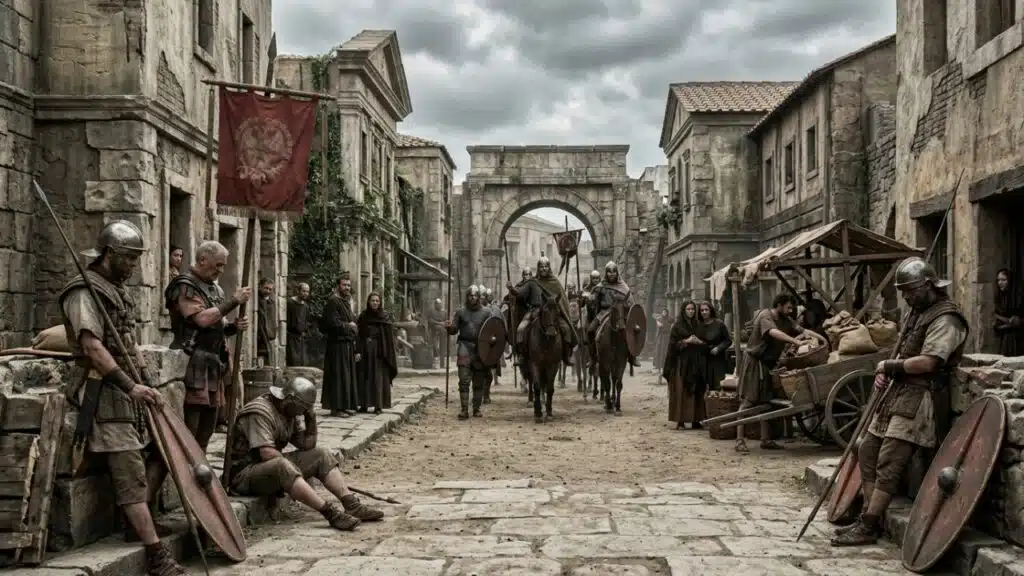
Notice what did not happen. There was no great final battle for Rome. By 476, the West had already lost Britain, most of Gaul, Spain and North Africa. Many historians describe the end as a fragmentation, in which Germanic soldiers and allied kingdoms gradually replaced central Roman authority. Roman landowners, laws, and bishops carried on under new rulers.
That is why the date 476 is more a convenient marker than a true ending. The Roman Empire rise and fall in the West took more than two centuries to unfold, and few people living through it saw one decisive moment.
Why Did the Roman Empire Fall?
The German historian Alexander Demandt once catalogued around 210 proposed causes. Edward Gibbon, whose six volumes appeared between 1776 and 1789, blamed a loss of civic virtue and the rise of Christianity. Modern accounts of the Roman Empire rise and fall prefer combinations.
| Explanation | Strongest evidence | Status among historians |
|---|---|---|
| Political instability | Dozens of emperors during the Crisis of the Third Century | Widely accepted |
| Military and economic strain | Defending huge frontiers with a limited tax base | Widely accepted |
| Migration and invasion | The sack of Rome in 410 and Odoacer in 476 | Accepted, though its weight is debated |
| Plague and climate | Antonine and Cyprian plagues, plus a 2024 study in Science Advances | Debated, with growing support |
| Moral decline | Gibbon’s argument of 1776 | Mostly set aside as a sole cause |
The newest explanations come from science. In The Fate of Rome (2017), Kyle Harper of the University of Oklahoma argued that climate shifts and pandemics, including the Antonine, Cyprian, and Justinianic plagues, shaped the empire’s fate. A 2024 study in Science Advances, with Harper among its authors, found that cold and dry periods on the Italian peninsula coincided with major plagues.
This is a debated claim, not a settled one. A three-part scholarly response in History Compass (2018) questioned how much weight climate and disease can carry. Most researchers now treat them as stressors that made an already strained empire more fragile.
Did the Late Antique Little Ice Age Cause the Fall of Rome?
Not the fall of 476, and the timing explains why. A 2016 study in Nature Geoscience, led by Ulf Büntgen, identified a long cold phase from 536 to about 660 CE that followed volcanic eruptions in 536, 540, and 547. It overlapped with the Justinianic Plague, which reached Constantinople between 541 and 543.
Coverage in Archaeology Magazine in April 2025 revived the idea that this cooling worsened Rome’s problems. But 536 is sixty years after 476. The cold snap belongs to a later chapter of the Roman Empire rise and fall, the transformation of the Eastern Roman Empire, not the end of the West.
Did the Roman Empire Really End in 476?
Only in the West. The Eastern Roman Empire, which later writers labeled Byzantine, kept calling itself Roman for another thousand years. Its people were Romans, its emperors were Roman emperors, and its capital was the greatest city in Christendom.
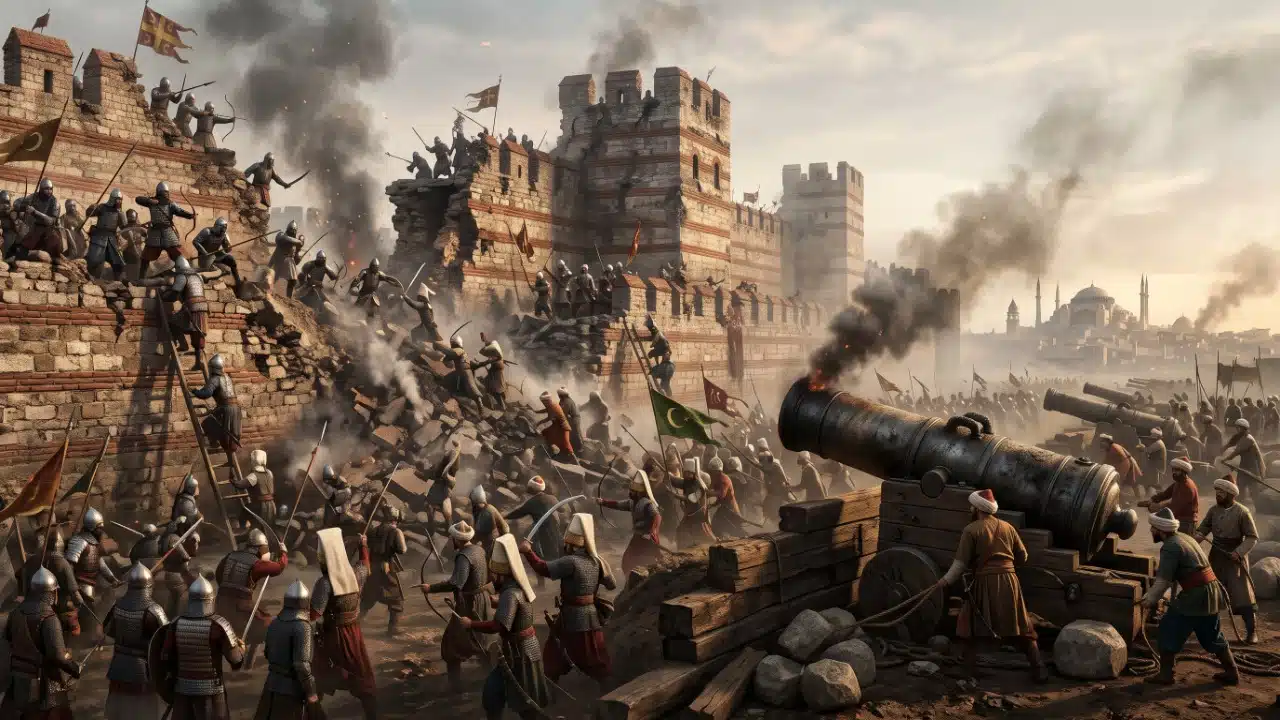
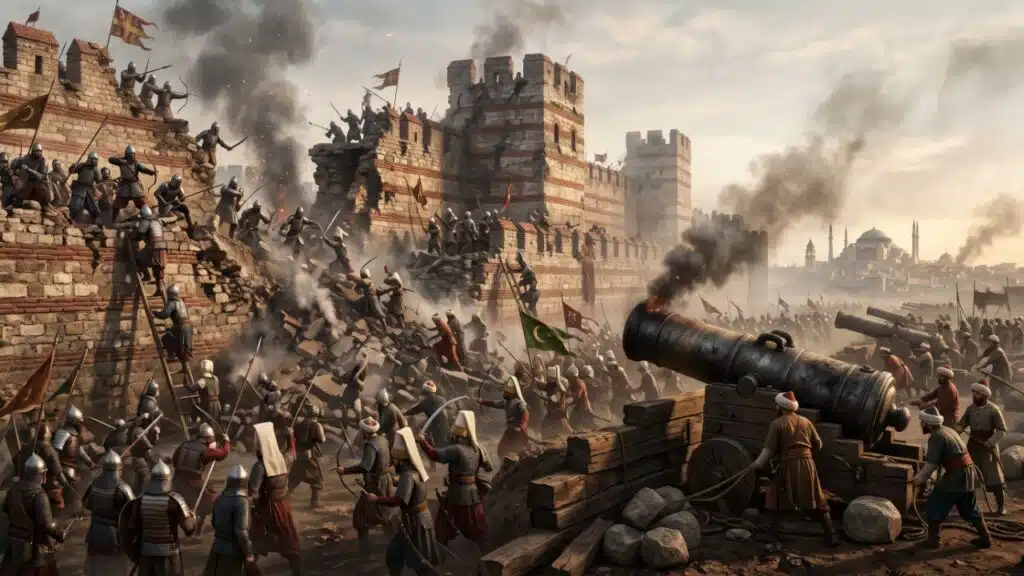
It survived plague under Justinian, Persian wars, and Arab sieges. In the 670s and again in 717 and 718, the Byzantine navy broke Arab fleets at Constantinople with a weapon whose secret was later lost: the Greek fire formula. The end came in 1453, when Sultan Mehmed II took the city, and Constantine XI died defending its walls.
The Eastern chapter of the Roman Empire rise and fall is the one most textbooks skip, and it is longer than the Western chapter by nearly a factor of two.
Roman Empire Rise and Fall: Quick Answers
When did the Roman Empire fall?
The Western Roman Empire fell in 476 CE, when Odoacer deposed Romulus Augustulus. The Eastern Roman Empire fell in 1453 CE, when the Ottomans captured Constantinople.
When did the Roman Empire start?
The Roman Empire started in 27 BCE, when the Senate gave Octavian the title Augustus. By tradition, Rome had been a republic since 509 BCE.
How long did the Roman Empire last?
About 500 years in the West, from 27 BCE to 476 CE. About 1,480 years if you count the Eastern Roman Empire, which lasted until 1453 CE.
Who was the last Roman emperor?
Romulus Augustulus was the last Western emperor, deposed in 476. Constantine XI Palaiologos was the last Eastern emperor and died defending Constantinople in 1453.
Why did the Roman Empire fall?
No single cause explains the Roman Empire rise and fall. Political instability, military and economic strain, migration, plague, and climate stress combined. Historians still debate how much weight each deserves.
Did the Roman Empire fall suddenly?
No. The Western Roman Empire declined over more than two centuries, from the Crisis of the Third Century to 476, and many Roman institutions survived under new rulers.
Conclusion: The Roman Empire Rise and Fall in One Sentence
The RomanEmpire’se rise and fall can be reduced to a date range, 27 BCE to 1453 CE, but that range hides two empires, two endings and a thousand years between them.
The West faded slowly, then was declared over in 476 by a general whom history barely remembers. The East held on through plague, volcanic winters and sieges until a cannon age ended it. Between them, they left Roman law, Roman roads, and a language of power that outlived both capitals.
The honest answer to when the Roman Empire rose and fell is that it rose in one generation and fell over twenty. Rome did not collapse in a day. It was lost in the long accumulation of ordinary decisions, and found again, in part, in every institution that borrowed its name.
Discover a Hidden Maya City
Deep in Mexico’s jungle, LiDAR has revealed a massive lost city of 30,000 people—reshaping everything we know about Maya civilisation.
In 2024, a team of archaeologists made a discovery that could change everything: they found a lost city beneath the pyramids.
Click below to watch the full story:
https://www.youtube.com/@EchoesofAntiquity-egypt/videos
Sources
- National Geographic: “Is This the Real Reason the Roman Empire Collapsed?” (Kyle Harper, climate and epidemics). nationalgeographic.com
- Nature Geoscience (2016): Ulf Büntgen et al., “Cooling and societal change during the Late Antique Little Ice Age from 536 to around 660 AD.” DOI: 10.1038/ngeo2652. nature.com
- Scientific American: “The Roman Empire’s Worst Plagues Were Linked to Climate Change” (Science Advances study co-authored by Kyle Harper). scientificamerican.com
- Archaeology Magazine (April 26, 2025): “A sixth-century little ice age may have contributed to the collapse of the Roman Empire.” archaeologymag.com
- Smithsonian Magazine: Kyle Harper, “How Climate Change and Plague Helped Bring Down the Roman Empire.” smithsonianmag.com
- MDPI Climate (2018): “Climate and the Decline and Fall of the Western Roman Empire: A Bibliometric View.” mdpi.com
- GEOMAR Helmholtz Centre for Ocean Research Kiel: “Two Volcanoes trigger Crises of the Late Antiquity.” geomar.de
- Wikipedia: “Late Antique Little Ice Age” (eruption dates, 2024 plague and climate research). en.wikipedia.org
- Smith College, Climate in Arts and History: “Rise and Fall of the Western Roman Empire (285 to 476 CE).” science.smith.edu
- Books and journals for verification: Kyle Harper, The Fate of Rome: Climate, Disease, and the End of an Empire (Princeton University Press, 2017); Edward Gibbon, The History of the Decline and Fall of the Roman Empire (1776 to 1789); Alexander Demandt, Der Fall Roms (1984); John Haldon et al., response to Harper’s The Fate of Rome, History Compass (2018).