
Cleopatra Lost Tomb: 7 Clues That Could End the Search
A Queen Who Planned Her Own Disappearance
She was thirty-nine years old when she died. She had ruled Egypt for twenty-one years, allied herself with the two most powerful men in the Roman world, spoken nine languages, commanded fleets, managed a treasury, and outlasted nearly every political enemy who had tried to remove her. She had done, in other words, everything possible in one lifetime.
And then, in August of 30 BCE, with Octavian’s army at the gates of Alexandria and every exit sealed, Cleopatra VII organized one final act of sovereignty. She chose the manner and timing of her own death. And she may have chosen, with equal deliberateness, to ensure that what happened to her body afterward was nobody’s business but her own.
The Cleopatra lost tomb is not simply a matter of archaeological misfortune. It is a mystery shaped partly by geology, partly by a tsunami that destroyed an ancient city, and partly, according to the researcher who has spent twenty years pursuing it, by the deliberate strategy of a woman who had every reason to hide.
Two thousand years later, the search for the Cleopatra lost tomb stands at its most technologically advanced and most geographically specific moment in history. And the sea is beginning to give back what it took.
Quick Answer: Cleopatra Lost Tomb
Where is Cleopatra buried?
The location of the Cleopatra lost tomb remains unknown. Ancient sources, including Plutarch,h state that Cleopatra and Mark Antony were buried together in her mausoleum in Alexandria, which was still under construction at the time of their deaths in 30 BCE. A catastrophic earthquake and tsunami on July 21, 365 CE submerged large portions of Alexandria’s royal quarter under twenty feet of water, likely destroying or concealing the tomb’s physical remains. Two primary theories divide current researchers: the tomb is somewhere in the submerged royal quarter of Alexandria, or it is located at Taposiris Magna, thirty miles west of the city.
What is Taposiris Magna and why do archaeologists search for Cleopatra there?
Taposiris Magna is an ancient Ptolemaic temple complex on the Mediterranean coast approximately forty kilometers west of Alexandria. Archaeologist Kathleen Martinez has led excavations there since 2005, discovering over 600 human remains, 21 catacombs, coins bearing Cleopatra’s face, foundation plates identifying the site as dedicated to the goddess Isis, and, nd in 2022, a 1,300-meter underground tunnel running toward the sea. In September 2025, Martinez and famed Titanic discoverer Robert Ballard identified a massive submerged port connected to Taposiris Magna, with structures rising more than twenty feet from the seafloor at a depth of forty feet.
Did the tsunami of 365 CE destroy Cleopatra’s tomb?
It is one of the most significant factors in the Cleopatra lost tomb mystery. The July 21, 365 CE earthquake off Crete, estimated at magnitude 8.0, generated a tsunami that killed approximately 5,000 people in Alexandria, destroyed the port called Portus Magna, and submerged the entire royal quarter under twenty feet of water. Roman soldier Ammianus Marcellinus witnessed the event and described the sea draining back from the harbor before surging over the city walls. If Cleopatra’s mausoleum was in the royal quarter, as Plutarch indicates, it is now underwater.
What new evidence was found in 2024 about the Cleopatra lost tomb?
In December 2024, Egypt’s Ministry of Tourism and Antiquities announced discoveries at Taposiris Magna, including a small white marble bust depicting a woman wearing a royal crown, which Martinez suggested could represent Cleopatra VII. This followed the September 2025 discovery of the submerged port connected to the site, which Martinez believes may have been used to transport Cleopatra’s body to a hidden burial location after her death.
Clue 1: What the Ancient Writers Actually Said
Every search for the Cleopatra lost tomb begins with the same primary source: Plutarch.
Writing roughly a century after Cleopatra’s death, Plutarch recorded that after Octavian permitted the body of Mark Antony to be embalmed and given to Cleopatra, she buried him magnificently and splendidly, using all the supplies she had set aside for her own burial. After her own death by suicide, Octavian reportedly honored her request to be buried beside Antony.
That mausoleum was still under construction when they died. Cleopatra had been building it on the grounds of the royal quarter of Alexandria, somewhere within the complex of palaces and temples that lined the city’s eastern harbor. Ancient Alexandria’s Royal Quarter consisted of ports, a cape, and islands full of temples, palaces, and military outposts. That is where the Cleopatra lost tomb was supposed to be.
The problem is what happened to Alexandria after it was placed inside it.
Clue 2: The Disaster That Swallowed a City
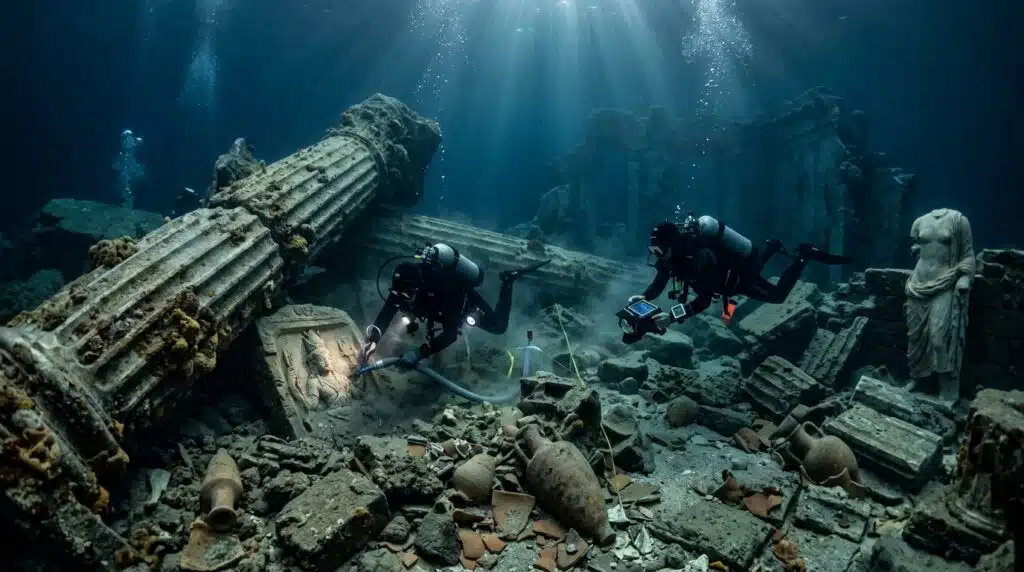
On July 21, 365 CE, roughly four centuries after Cleopatra’s death, Alexandria was destroyed.
A powerful earthquake off the coast of Crete sent a tsunami across the Mediterranean toward Egypt. Scientists now estimate the quake measured approximately magnitude 8.0. The sea drained suddenly from Alexandria’s harbor, ships keeled over, and fish were left flopping in the exposed seabed. People reportedly walked out to look at the empty harbor floor and collect the stranded marine life. Then the water came back.
A massive tsunami surged into the city, flinging water and ships over the sea walls, landing many of them on top of buildings. Approximately 5,000 people died in Alexandria alone. Portus Magna, the city’s main commercial port, was destroyed. The royal quarter, built along the harbor edge on terrain that was already geologically unstable, slid into the sea.
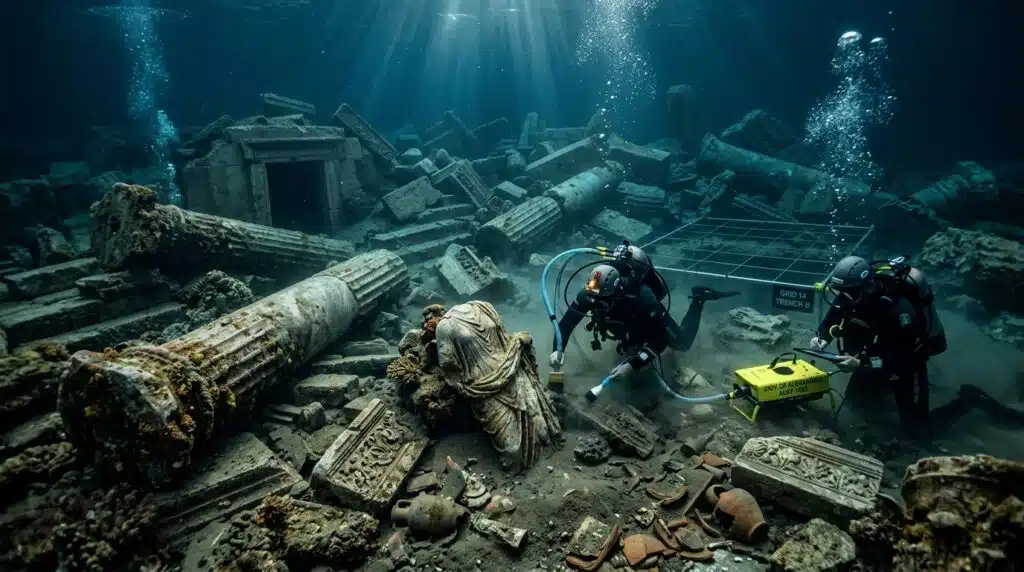
Franck Goddio, the underwater archaeologist who has spent twenty-five years surveying Alexandria’s harbor, discovered the submerged royal quarter in 1992 using electronic surveys and magnetic scans. He identified the locations of ancient Alexandrian military ports, commercial docks, the Royal Harbor, submerged palace structures, and the island of Antirhodos, where an Isis temple was found still largely intact on the seafloor.
The royal quarter is now twenty feet underwater. Everything that was there when Cleopatra’s mausoleum was built has been rearranged by more than a thousand years of seismic activity, gradual coastal subsidence, and accumulated sediment. Goddio believes the Cleopatra lost tomb is likely somewhere in this submerged zone, concealed beneath the harbor sediment, protected by the same water that hid it.
If he is right, finding the Cleopatra lost tomb requires not a trowel but a submarine.
Clue 3: The Woman Who Chose Taposiris Magna
Kathleen Martinez is a criminal lawyer from the Dominican Republic who spent ten years studying Cleopatra’s life before picking up a trowel in 2005. She approaches the Cleopatra lost tomb the way she would approach a criminal investigation, looking for motive, precedent, and physical evidence in equal measure.
Her theory begins with a question nobody had properly asked. Why would Cleopatra, who had every reason to distrust Octavian, have relied on his goodwill to ensure her tomb remained undisturbed in the very city he was about to occupy?
Octavian had just defeated her. He planned to march her through Rome in chains as a war trophy. He had killed her son Caesarion, her child by Julius Caesar. He was not a man from whom she could reasonably expect posthumous respect, whatever diplomatic courtesies he extended in the days before her death.
Martinez argues that Cleopatra understood this, and that she arranged for her body to be taken somewhere Octavian would not look. The queen feared that her enemies would steal her body and carry it back to Rome. She therefore concealed the real tomb in a secret location outside Alexandria.
Taposiris Magna, thirty miles west of the city, dedicated to the goddess Isis with whom Cleopatra had publicly identified throughout her reign, contained a large Ptolemaic temple complex and an extensive underground network of catacombs. It was far enough from Alexandria’s royal quarter to escape Roman attention, sacred enough to warrant royal burial, and connected to Alexandria by the Mediterranean coast road that Cleopatra’s funeral party could have used in secrecy.
Since 2005, Martinez’s team has excavated 21 catacombs, recovered over 600 human remains and 30 mummies, found hundreds of coins bearing Cleopatra’s face, discovered foundation plates identifying the temple as dedicated to Isis, and uncovered burials oriented toward the central temple in a pattern suggesting royalty was interred nearby. In 2022, they found a 1,300-meter underground tunnel carved from solid rock, running forty-three feet below the surface and heading directly toward the sea.
Clue 4: The Sunken Port That Changed Everything
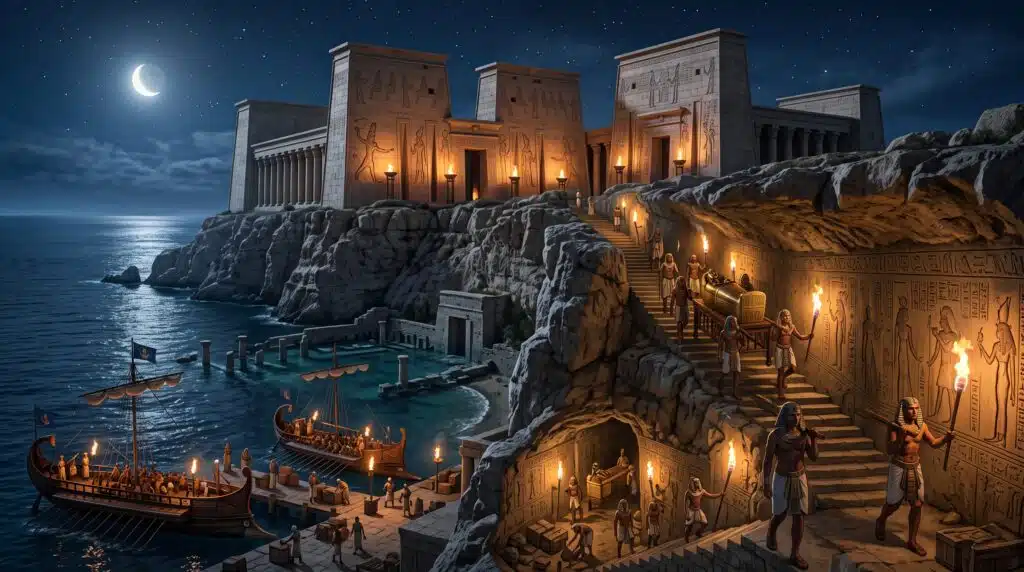
In September 2025, the Cleopatra lost tomb search entered its most dramatic phase in two decades.
Kathleen Martinez, working alongside Robert Ballard, the oceanographer who discovered the wreck of the Titanic, located a massive submerged port forty feet below the Mediterranean Sea near Taposiris Magna. The site contained stone buildings rising more than twenty feet from the seafloor, polished floors, towering columns, cemented blocks, multiple anchors, and scattered Ptolemaic amphorae, all dating to the period of Cleopatra’s reign.
This was not a minor find. It was, in Martinez’s words, a port complex large enough and connected enough to Taposiris Magna to serve as a royal facility, not merely a commercial one. The discovery supported a critical element of her theory: that after Cleopatra’s body was taken from Alexandria, it could have arrived at this port and been moved through the underground tunnel to a burial chamber beneath the temple complex, concealed in a location no Roman patrol would ever have searched.
The discovery of the tomb of Cleopatra will be one of the biggest discoveries of the century, Martinez told CNN. Since the ancient Egyptians speak to us through their tombs, I believe that she should have all this important information that she wanted us to know about her, about her time, about the way she thinks.
Three months of underwater excavation began immediately after the port’s discovery. Nobody had yet dived at the site before, Martinez noted. The first excavation season was, by any measure, the beginning of something.
Clue 5: The Tunnel That Points at the Sea
The 1,300-meter tunnel discovered at Taposiris Magna in 2022 requires its own examination, because it is perhaps the strangest physical feature of the entire Cleopatra lost tomb investigation.
It was found approximately forty-three feet underground, carved from solid rock, partly submerged and flooded with seawater that has entered from the direction of the coast. Inside the tunnel, the team found ceramic jars and pottery from the Ptolemaic period, consistent with the time of Cleopatra’s reign. The tunnel runs from beneath the temple complex toward the sea, in the direction of what is now the submerged port that Martinez and Ballard identified in 2025.
The engineering required to cut a 1,300-meter tunnel through solid limestone at that depth is substantial. This was not a drainage channel or a minor underground passage. It was a deliberate, significant construction, requiring organized labor and clear purpose.
Whether the tunnel was a processional route for royal burials, a ceremonial passageway to a sacred underwater destination, or a practical corridor connecting the temple to the port, its existence confirms that Taposiris Magna had an underground infrastructure of considerable scale. The Cleopatra Lost Tomb, if it is at this site, is buried within a network of chambers and passages that has not yet been fully mapped.
Clue 6: The Coins, the Mummies, and the Marble Bust
The physical evidence recovered from Taposiris Magna over twenty years of excavation builds a circumstantial case that is worth examining in full.
Coins bearing Cleopatra’s face have been found in significant quantities at the site. Foundation plates made of gold, silver, and bronze, ceremonially deposited at the corners of the temple structure, identify the dedication to Isis. The orientation of numerous burials within the necropolis points directly toward the temple’s central axis, a pattern in Egyptian burial practice associated with royalty being interred at or near the temple itself.
In December 2024, Egypt’s Ministry of Tourism and Antiquities announced the discovery of a small white marble bust at the southern outer wall of the Taposiris Magna temple. The figure wears a royal crown. Martinez suggested it could be a representation of Cleopatra VII herself, making it one of the most direct potential visual links between the queen and this site ever recovered.
More than 30 mummies have been found at the site, along with over 600 sets of human remains. Some of the mummies show gold foil applied to the teeth, a practice associated with individuals of high social status. The necropolis at Taposiris Magna appears to contain people of significantly elevated rank, buried in deliberate proximity to the temple and its tunnel system.
None of this proves the Cleopatra lost tomb is here. But each discovery adds a layer of plausibility that the site’s critics have found increasingly difficult to dismiss.
Clue 7: The Political Logic of Disappearing
The final clue in the Cleopatra lost tomb mystery is not archaeological. It is strategic.
Cleopatra was a politician of extraordinary sophistication. She had survived the murder of her father’s ministers, the exile imposed by her brother, the shifting allegiances of Roman generals, and the internal politics of a dynasty that had been killing its own members for three hundred years. She was not a person who left important things to chance.
When Octavian surrounded Alexandria in 30 BCE, Cleopatra would have known with absolute clarity what Roman triumphal tradition required of a defeated foreign queen. She would have been marched in chains through Rome, displayed before the jeering public, and almost certainly executed or left to die in humiliation. She chose suicide rather than submit to that.
It is not a large additional step to suggest that she applied the same thinking to her burial. A body in Roman hands was a political object. A body that could not be found was something else entirely.
I believe she would have done anything to stop her body being in the hands of the Romans, Martinez has stated publicly. The queen who refused to be a trophy in Octavian’s triumph may have arranged, with the same systematic thoroughness she applied to everything else in her life, to be simply unfindable.
The Cleopatra lost tomb may not be lost by accident. It may be lost by design.
Conclusion: Two Thousand Years and Getting Closer
The Cleopatra lost tomb has survived two thousand years of earthquakes, tsunamis, Roman occupations, Arab conquests, modern construction, and the slow encroachment of a Mediterranean Sea that has never been particularly interested in returning what it took.
It has also survived two thousand years of searching. Greek writers looked. Byzantine pilgrims looked. Medieval scholars looked. Every generation of Egyptologists since the discipline was invented has formed a theory and gone looking.
Nobody has found it.
What has changed in the last decade is the technology available to look and the precision with which that technology can be applied. Sonar mapping that can resolve structures on the seafloor at a centimeter scale. Ground-penetrating radar that reveals tunnels before a single shovel breaks the surface. Underwater archaeological techniques developed by the teams that found the Titanic and mapped the sunken cities of the ancient Mediterranean.
The Cleopatra Lost Tomb, if it survives in any form, is in one of two places. It is twenty feet underwater in the former royal quarter of Alexandria, buried under harbor sediment and protected by the same tsunami that concealed it. Or it is somewhere within the underground network of Taposiris Magna, at the end of a tunnel that runs toward a sunken port nobody had ever dived before September 2025.
Martinez has already excavated 21 catacombs. She projects at least 20 to 25 more.
The queen has been hiding for two millennia. She chose her hiding place with the same intelligence she applied to everything else. But she could not have anticipated sonar, or lidar, or a Dominican lawyer who decided that finding her was worth twenty years of her life.
The Cleopatra lost tomb is still out there. And the search has never been this close.
Sources
- National Geographic — “A team went searching for Cleopatra’s lost tomb and made an exciting discovery” (September 23, 2025) — nationalgeographic.com
- History.com — “Why Cleopatra’s Tomb Has Never Been Found” (Updated May 14, 2026) — history.com
- Archaeology Magazine — “Lost port discovery brings Cleopatra’s elusive tomb a step closer” (September 2025) — archaeologymag.com
- CBS News — “Quest for Queen Cleopatra’s lost tomb reveals a sunken ancient Egyptian harbor” (September 23, 2025) — cbsnews.com
- CNN — “Sunken ancient Egyptian port may play a role in search for Cleopatra’s tomb” (September 26, 2025) — cnn.com
- AL-Monitor — “In search for Cleopatra’s tomb, Egypt claims discoveries” (December 11, 2024) — al-monitor.com
- Futura Sciences — “Cleopatra’s royal tomb may be near this sunken city — it’s only a matter of time” (October 6, 2025) — futura-sciences.com
- Smithsonian Magazine — “Raising Alexandria” — smithsonianmag.com
- History.com — “Tsunami hits Alexandria, Egypt, July 21, 365 CE” — history.com
- The Science Survey — “The Final Mystery of Cleopatra: Will 2025 Be the Year Her Tomb Is Found?” (July 3, 2025) — thesciencesurvey.com
- All That History (Substack) — “The Underwater Port That Could Finally Solve the Mystery of Cleopatra’s Tomb” (February 7, 2026) — allthathistory.substack.com
- Macedonia Times — “Cleopatra’s underwater palace: the potential resting place of the last Macedonian Pharaoh” — macedoniatimes.news
- Plutarch — “Life of Antony” (primary ancient source for Cleopatra’s burial arrangements, via multiple scholarly editions)
Discover a Hidden Maya City
Deep in Mexico’s jungle, LiDAR has revealed a massive lost city of 30,000 people—reshaping everything we know about Maya civilisation.
In 2024, a team of archaeologists made a discovery that could change everything: they found a lost city beneath the pyramids.