

King Tut Curse: 7 Shocking Truths Science Uncovered
The Flashlight, the Darkness, and What Came After
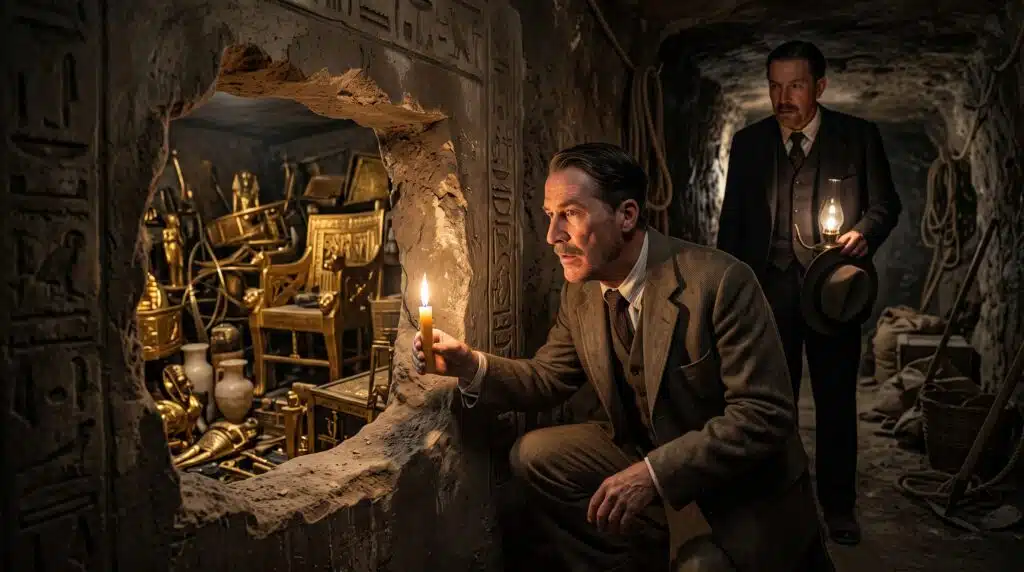
November 26, 1922. Howard Carter pressed a candle through a hole he had just chiseled into a sealed wall in the Valley of the Kings. Three thousand years of trapped air rushed past his face. Behind him, the man who had financed sixteen years of searching, George Herbert, the fifth Earl of Carnarvon, asked the question that has echoed across a century of archaeology.
Can you see anything?
Carter looked into the darkness and saw gold. Everywhere, the glint of gold. Statues, chariots, beds, chests, thrones, and at the center of it all, the untouched burial of a boy king who had been waiting, perfectly sealed, since 1323 BCE.
He replied with a sentence that has never been improved upon in the literature of discovery. Yes, wonderful things.
Five months later, Lord Carnarvon was dead. Within a decade, a string of deaths connected to the excavation had ignited one of the most enduring legends in modern history. The king tut curse, the mummy’s curse, the curse of the pharaohs, call it what you will, it had already entered every newspaper in the world and would never fully leave.
What the newspapers did not print was the statistical study, the fungal science, the medical records, and the detailed press history that together tell a very different story about what the king tut curse actually was, where it came from, and who manufactured it.
Quick Answer: King Tut Curse
Is the King Tut curse real?
No. The king tut curse is not supported by scientific or statistical evidence. A 2002 study published in the British Medical Journal by Professor Mark Nelson of Monash University tracked 44 Western individuals present in Egypt when Tutankhamun’s tomb and sarcophagus were opened. The mean age at death for the 25 people exposed to the supposed curse was 70 years, compared to 75 for the unexposed group, a difference the study found statistically insignificant with a p-value of 0.87. No curse inscription was ever found inside the tomb.
What killed Lord Carnarvon after King Tut’s tomb was opened?
Lord Carnarvon died on April 5, 1923, five months after the tomb’s opening. The cause was mundane: he accidentally reopened an infected mosquito bite on his cheek while shaving. The wound developed into blood poisoning that progressed to pneumonia. Carnarvon had been in chronically poor health for years before visiting Egypt, having sustained serious injuries in an automobile accident in 1903. He died not of any king tut curse but of an infection in an era before antibiotics existed.
Was there a curse inscription found in King Tut’s tomb?
No. Despite widespread newspaper claims in 1923 that a curse had been found inscribed on the tomb’s walls, no such inscription was ever discovered. The king tut curse as described in the popular press was fabricated. Howard Carter himself dismissed the curse as nonsense throughout his life.
Who invented the King Tut curse story?
The king tut curse narrative was constructed primarily by the mass media in 1923, amplified by two prominent voices: novelist Marie Corelli, who sent a warning letter to the New York World magazine claiming that a rare book she possessed warned of dire punishment for tomb intruders, and Sir Arthur Conan Doyle, creator of Sherlock Holmes and a devoted spiritualist, who told American reporters that an evil elemental spirit conjured by ancient priests could have killed Carnarvon.
Truth One: The Curse Was Never in the Tomb
The most important fact about the king tut curse is one that most accounts of it never state clearly at the beginning: there was no curse inscription in Tutankhamun’s tomb.
Newspaper reports in April 1923 claimed that Carter’s team had found a warning carved into the tomb walls. Readers across the world absorbed this claim as established fact. It was repeated in publications, in parlor conversations, and eventually in books. It became part of the permanent mythology surrounding the king tut curse.
It was entirely fabricated.
No curse had actually been found in the tomb, but deaths in succeeding years of various members of Carter’s team and real or supposed visitors to the site kept the story alive, especially in cases of death by violence or in odd circumstances. Howard Carter, the man who spent more time inside the tomb than any other person alive, dismissed the king tut curse throughout his life as complete nonsense. He continued his excavation work for years, living until 1939, seventeen years after the discovery that supposedly unleashed a deadly supernatural force.
If there was a king tut curse, it appears to have significantly misidentified its primary target.
Truth Two: A Novelist and a Spiritualist Built the Legend

The king tut curse did not emerge from archaeology. It emerged from the intersection of tragedy, mass media, and two celebrity voices who had no business speaking about Egyptian history but whose names guaranteed publication.
Carnarvon died on April 5, 1923. The actual cause, a mosquito bite that became infected and developed into blood poisoning, was clear enough to the physicians who treated him. But the newspapers were already primed. The tomb discovery had been the biggest story of 1922, and The Times of London had sealed an exclusive deal with Carnarvon, shutting out every other major paper from direct access to the excavation. Journalists who had been locked out were looking for any angle they could find.
They found two.
Marie Corelli was one of the most widely read authors in the English-speaking world. She had outsold H.G. Wells, Arthur Conan Doyle, and Rudyard Kipling combined. On March 24, 1923, before Carnarvon even died, she sent a letter to the New York World magazine warning of dire consequences for tomb intruders. She claimed to be quoting from a rare book she possessed, describing divers secret poisons enclosed in boxes in such wise that they who touch them shall not know how they come to suffer. Scholars who examined her source found it was a collection of Arabic folklore with no connection to ancient Egyptian religious practice. Nobody cared. Corelli was famous, and the warning fit the narrative the press needed.
Then Arthur Conan Doyle, creator of Sherlock Holmes and a devoted member of the spiritualist movement that was sweeping fashionable British society in the 1920s, told reporters in New York that an evil elemental, a spirit guardian conjured by ancient priests, could have been responsible for Carnarvon’s death. The Glasgow Herald reported his comments on April 6, 1923, the day after Carnarvon died.
The king tut curse was born. It had no ancient Egyptian origin. It had a novelist, a spiritualist, and a global press system with something to sell.
Truth Three: The BMJ Study That Ended the Statistical Case
For decades, the king tut curse was kept alive by a list of deaths. Carnarvon died in April 1923. George Jay Gould, an American financier who visited the tomb, fell ill shortly after and died in May 1923. Carnarvon’s half-brother Aubrey Herbert died in September 1923. The deaths accumulated in newspaper archives, and nobody had done the arithmetic on whether they were actually unusual.
In 2002, Professor Mark Nelson of Monash University did the arithmetic.
His study, published in the British Medical Journal, tracked 44 Western individuals whom Carter had identified as present in Egypt when the tomb and the sarcophagus were opened between February 1923 and November 1926. Of those 44, 25 were potentially exposed to the king tut curse in the sense that they were directly present at the openings. The remaining 19 were in Egypt but not present at the specific moments.
Nelson compared their survival rates. The 25 exposed individuals had a mean age at death of 70 years. The unexposed group averaged 75. The difference was statistically insignificant, with a p-value of 0.87, meaning there was an 87 percent probability that this difference occurred purely by chance. There was no sign that those exposed to the king tut curse were more likely to die within ten years of exposure.
Eight people connected to the tomb died within a dozen years. Forty-six others, including Howard Carter and Lady Evelyn Herbert, died of natural causes much later. The people who survived the king tut curse far outnumbered those who did not, and the ones who died did so at ages and from causes entirely consistent with the medical realities of the 1920s, a decade before antibiotics, when an infected mosquito bite in a pre-modern healthcare environment was a genuinely dangerous thing.
Truth Four: The Fungus Theory — Real Hazard, Wrong Victim
The king tut curse acquired a scientific dimension in the decades after Nelson’s statistical study, and this version of the story is more interesting because it is partially true.
Laboratory analysis of ancient mummies and tomb environments has confirmed the presence of potentially dangerous biological agents. Some ancient mummies have been shown to carry mold species including Aspergillus niger and Aspergillus flavus, both of which can cause serious respiratory illness, particularly in people with compromised immune systems. Tomb walls at various sites have been found to contain Pseudomonas and Staphylococcus bacteria, both capable of attacking the lungs. Sealed tombs that contained food offerings as part of burial practice, a common Egyptian custom, could theoretically have provided substrate for microbial growth across thousands of years.
A 2003 correspondence to The Lancet argued that Carnarvon’s death was consistent with Aspergillus sinusitis. Researchers noted that Lord Carnarvon could readily have inhaled contaminated grain dust as the sealed tomb was broken into, and that spores of Aspergillus can remain dormant in the lungs of infected individuals for extended periods before becoming active. The Times of London reported on March 17, 1923 that Carnarvon was suffering from pain as the inflammation affected the nasal passages and eyes, symptoms consistent with invasive Aspergillus sinusitis spreading toward the orbit.
This is a plausible mechanism. But it faces a problem that researchers have consistently flagged. Carnarvon had been in chronic poor health for years before he ever approached the tomb. His automobile accident in 1903 had left him with permanent respiratory weakness, which was precisely why he had been wintering in the dry Egyptian climate in the first place. His immune system was not the immune system of a healthy man encountering ancient fungi.
Most critically, the experts who have examined the king tut curse most carefully note that there is no documented case of any archaeologist or tourist suffering negative health consequences from tomb exposure at Egyptian sites. National Geographic’s science reporting has confirmed that despite the presence of molds, bacteria, and other biological agents in many tombs, most archaeological sites have proved safe for science and tourism alike. The fungal theory explains a possible mechanism. It does not establish that mechanism as the actual cause of Carnarvon’s death rather than the infected mosquito bite his own physicians identified.
Truth Five: Carter Himself Never Believed Any of It
The man who should have been most vulnerable to the king tut curse, if it existed, was the man who found the tomb, spent years inside it, and handled its contents more extensively than anyone else alive.
Howard Carter entered the tomb in November 1922. He spent the next decade methodically clearing and cataloguing approximately 5,000 individual artifacts from the burial chambers. He worked inside the tomb season after season. He touched the mummy of Tutankhamun. He handled the gold, the jewelry, the ceremonial objects, and the innermost personal possessions of the pharaoh.
He died in 1939, seventeen years after the discovery, of Hodgkin’s disease at approximately 64 years old. He was not struck down. He was not haunted. He finished his work, wrote his books, and died of a disease that had nothing to do with ancient Egypt.
Carter’s response to the king tut curse throughout his life was consistent and dismissive. He had no patience for it. The curse narrative was, in his view, a fabrication built by a press that could not access the genuine story and therefore manufactured a more sensational one.
One account suggests that the canary Carter kept at his house was seized by a cobra on the day the tomb was opened, a detail that became part of the curse mythology. Carter’s response was presumably that snakes eat birds in Egypt with some regularity, and that this particular incident required no supernatural explanation.
Truth Six: The Real Curse Was Written on Paper
The most enduring and least examined aspect of the king tut curse is not what ancient Egyptian priests may or may not have intended. It is what the modern press did with a tragedy in 1923.
The exclusivity deal that Carnarvon had struck with The Times of London left every other major newspaper in the world locked out of direct coverage of the most significant archaeological discovery of the century. Journalists who had traveled to Egypt found themselves unable to report on what was happening inside the tomb. The frustration was professional and financial.
When Carnarvon died, those journalists finally had a story they could publish without deferring to The Times. It was a human tragedy far more compelling than the disappointingly slow-moving events at the tomb itself, as historian Joyce Tyldesley noted. The king tut curse gave the locked-out press its revenge, and they used it without restraint.
The curse grew, death by death, headline by headline, across the 1920s. Each new death connected to anyone who had ever visited the tomb, however tangentially, was enrolled into the narrative. The story was too commercially powerful to examine critically. The readers it created were too numerous to disappoint.
Arthur Weigall, a Daily Mail correspondent who had been cut off from tomb access and began filling his stories with anything available, is one of the figures historians have identified as an early amplifier of the king tut curse narrative. His rivalry with the Times-affiliated coverage gave his curse reporting an edge that pure journalistic curiosity might not have produced.
The king tut curse was, in its most accurate description, the first great viral misinformation campaign of the mass media age.
Truth Seven: No Curse Was Ever Found in Any Egyptian Royal Tomb
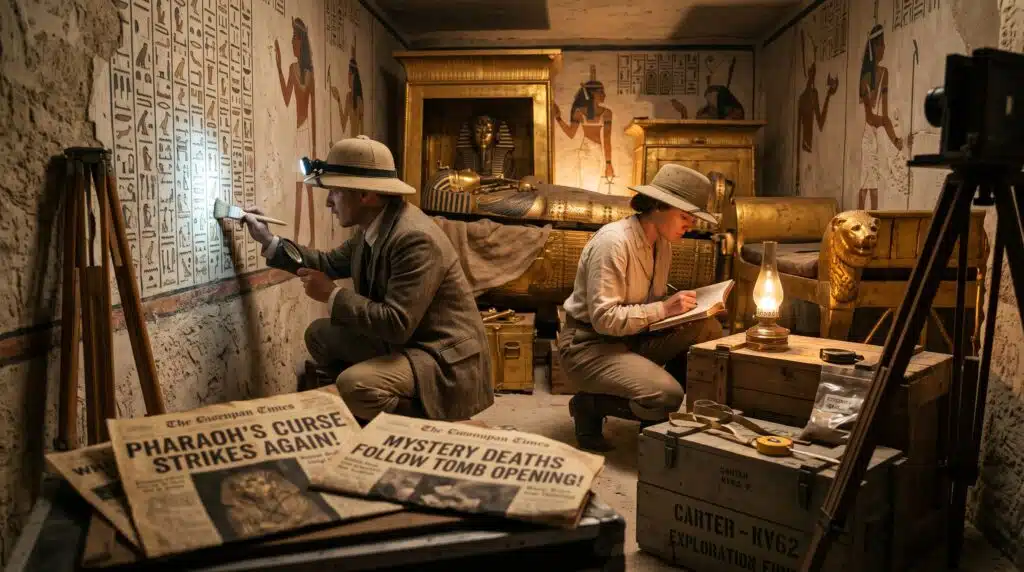
The king tut curse belongs to a broader tradition of what archaeologists call the curse of the pharaohs, a general belief that Egyptian burial sites were supernaturally protected by warnings carved into their walls.
The evidence for this tradition is considerably thinner than popular culture suggests. While protective texts and warnings do appear in certain Egyptian funerary contexts, they are not the universal feature of royal tombs that the king tut curse mythology implies. The famous inscription sometimes cited as Tutankhamun’s curse, warning that death will come on swift wings to one who disturbs the peace of the pharaoh, was never found in his tomb. Its origins are disputed, and it may have been invented entirely by the press in 1923.
Some earlier tombs do contain texts that warn against disturbing the burial, but these are typically administrative prohibitions, requests directed at priests and necropolis officials to maintain the sanctity of the site, rather than magical curses directed at future intruders. The distinction matters. A request not to disturb a burial is a legal and religious instruction. It is not a death sentence delivered across three thousand years to an English aristocrat with a mosquito bite.
The king tut curse as a supernatural mechanism has never been supported by a single piece of Egyptological evidence from within the tomb itself. The tomb’s actual contents, thousands of artifacts, inscriptions, texts, and ritual objects, contain nothing that functions as the curse the world spent a century believing in.
Conclusion: What the King Tut Curse Actually Was
The king tut curse killed nobody. It was not inscribed in the tomb. It was not released when the sealed doors opened. It did not follow Howard Carter through seventeen more years of life, through seasons of methodical work in the chamber of a dead pharaoh.
What the king tut curse was, and what it remains, is a story that the human mind needed in 1923 and has never fully been willing to give up. A great discovery deserved a great danger. A sealed tomb that had survived three thousand years deserved consequences for its violation. A boy king who had been silenced for three millennia deserved, in the imagination of a world that had just lived through the First World War and was still processing the incomprehensibility of mass death, some form of power over the living.
The BMJ found no statistical difference between those who entered the tomb and those who did not. Carnarvon died of an infected mosquito bite. Carter lived another seventeen years. No curse inscription was ever found.
And yet the king tut curse outlasted every person who was present at the tomb’s opening, every archaeologist who debunked it, every study that dismantled its statistical foundation.
Because the truth, in 1923 as now, has always been less interesting than a story that reminds us the dead are not entirely powerless.
Sources
- British Medical Journal (2002) — Mark R. Nelson, “The mummy’s curse: historical cohort study.” BMJ 325(7378):1482-1484. DOI: 10.1136/bmj.325.7378.1482 — pmc.ncbi.nlm.nih.gov
- National Geographic — “Egypt’s ‘King Tut Curse’ Caused by Tomb Toxins?” — nationalgeographic.com
- History.com — “Is the curse of King Tut real?” (Updated March 2, 2025) — history.com
- World History Encyclopedia — “The Mummy’s Curse: Tutankhamun’s Tomb and the Modern-Day Media” — worldhistory.org
- Aeon Essays — “Why does the mummy’s curse refuse to die?” — aeon.co
- Big Think — “The mummy’s curse might be real — but it’s caused by a fungus” (May 2, 2023) — bigthink.com
- History Today — “Tutankhamun’s Curse?” (June 20, 2022) — historytoday.com
- The Collector — “What Really Killed the Men Who Opened King Tut’s Tomb” (January 14, 2026) — thecollector.com
- All About History — “The Facts Behind the Curse of Tutankhamun: Fake News from Beyond the Grave” (June 7, 2023) — historyanswers.co.uk
- All That’s Interesting — “King Tut’s Curse: Why The Pharaoh’s Tomb Is Said To Be Cursed” (November 24, 2025) — allthatsinteresting.com
- University of Manchester — “90th anniversary of the curse of Tutankhamen: how a modern myth was born” (April 4, 2013) — manchester.ac.uk
- MagellanTV — “The Curious Curse of King Tutankhamun” (July 27, 2025) — magellantv.com
- JSTOR Daily — “The Pharaoh’s Curse or the Pharaoh’s Cure?” — daily.jstor.org
- SpaceDaily — “When Tutankhamun’s sealed tomb was opened after more than 3,000 years…” (August 2026) — spacedaily.com
Discover a Hidden Maya City
Deep in Mexico’s jungle, LiDAR has revealed a massive lost city of 30,000 people—reshaping everything we know about Maya civilisation.
In 2024, a team of archaeologists made a discovery that could change everything: they found a lost city beneath the pyramids.