
7 Shocking Stoicism CBT Roots Behind Modern Stress
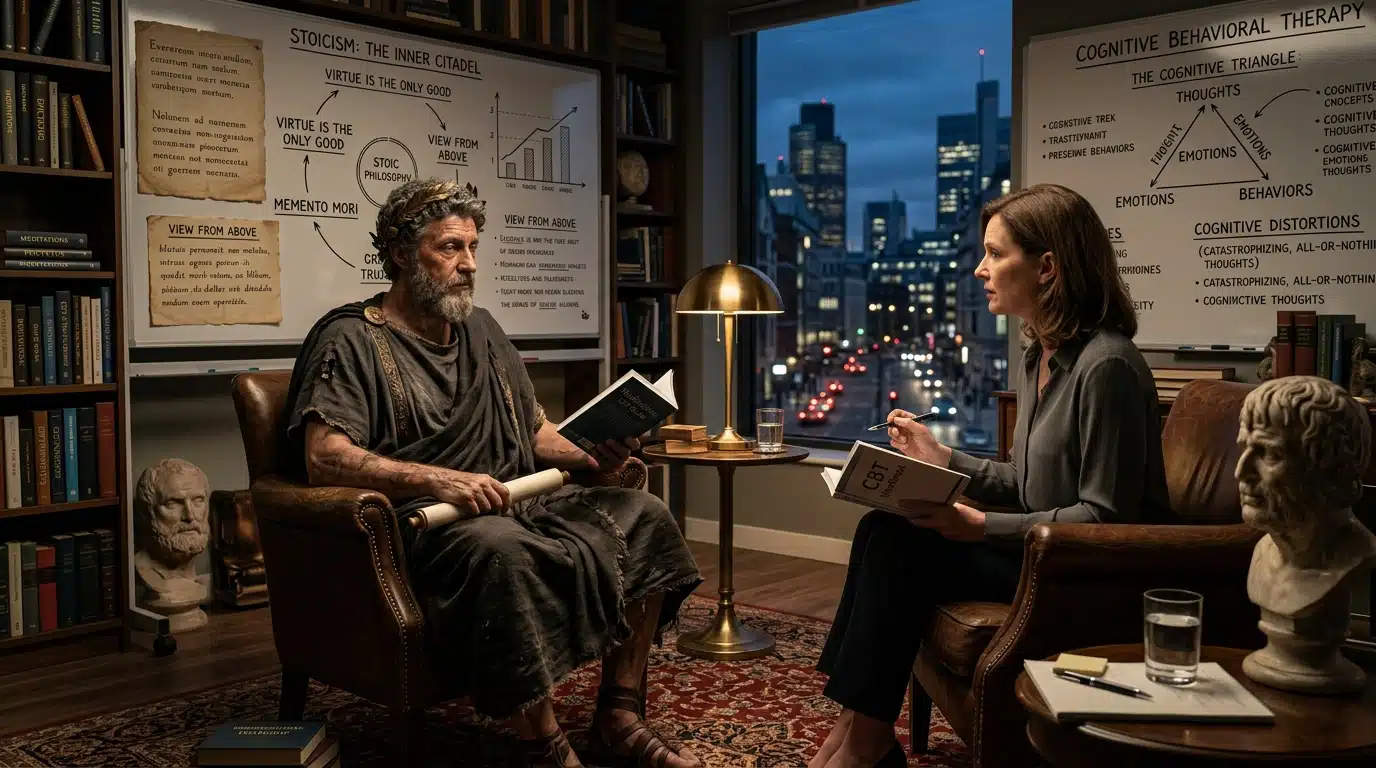
Stoicism CBT Roots may sound like an unlikely connection, but modern psychology and ancient philosophy share far more than most people realize. More than 2,000 years before therapists began treating anxiety with cognitive techniques, Stoic thinkers in ancient Athens and later the Roman Empire were already developing mental strategies to manage fear, stress, anger, and emotional suffering.
And the strange part?
Many of those techniques now sit at the heart of Cognitive Behavioral Therapy (CBT)—one of the world’s most trusted modern psychological treatments.
This isn’t internet self-help mythology either. Historians of philosophy and psychologists openly acknowledge that Stoicism heavily influenced the development of modern cognitive therapies.
Which means one of the oldest philosophies in human history may also be one of the most psychologically advanced.

1. Stoics Believed Thoughts Create Suffering
At the center of both Stoicism and CBT lies one revolutionary idea:
People are disturbed not by events, but by their interpretation of them.
That quote comes from Epictetus, a former slave turned Stoic teacher whose writings would later influence modern psychologists centuries later.
This idea forms the foundation of CBT.
Modern therapists teach that anxiety and depression are often intensified by distorted thinking patterns:
- Catastrophizing
- Overgeneralization
- Negative assumptions
- Emotional reasoning
The Stoics recognized the same psychological trap long before neuroscience existed.
They believed external events are often neutral. What creates emotional suffering is the story the mind attaches to them. Stoicism CBT Roots
2. Marcus Aurelius Engaged in Cognitive Reframing
Marcus Aurelius’s works provide one of the most obvious Stoicism CBT roots.
Marcus continuously schooled his mind to objectively evaluate stressful situations, even though he ruled Rome during times of war, pestilence, and political unrest.
Psychologists now refer to phenomenon as cognitive reframing.
Marcus would stop and intellectually reframe the circumstance rather than responding emotionally:
An insult turned into a patience test.
Failure was just momentary.
Fear turned into inflated fantasies.
He frequently reminded himself in his private notebook, Meditations:
“You are in control of your thoughts, not external circumstances.”
The ideas of contemporary CBT are nearly exactly reflected in that statement alone.

3. Rather than teaching emotional repression, stoicism taught emotional detachment.
One of the most common misconceptions regarding stoicism is that it promotes emotionlessness.
It doesn’t.
Stoics recognized that feelings were normal. The intention was to keep emotions from dictating judgment, not to eradicate them.
The reasoning for modern CBT is the same.
Patients are not advised to “stop feeling” by therapists. Rather, they assist individuals in identifying emotional responses without presuming that every concept associated with them is true.
This distinction is crucial.
Stoicism emphasizes awareness over rash decisions.
And that way of thinking feels shockingly contemporary in today’s environment of perpetual stress and digital overload.Stoicism CBT Roots
4. Visualization of Negativity Decreased Fear
Premeditation of calamities, or premeditatio malorum, was one of the most peculiar Stoic practices.
Stoics would consciously envision the worst:
- Status loss
- Getting sick
- Having to deal with embarrassment
- Death itself
This sounds quite depressing at first.
However, it had a significant psychological function.
The brain was less overpowered by uncertainty when fear was faced head-on.
Similar techniques are used in contemporary psychology through exposure treatment, which gradually lessens anxiety reactions through controlled exposure to fears.
The Stoics made a significant discovery:
Avoided terror intensifies.
When faced with fear, it becomes controllable.
Stoicism CBT Roots
5. The Stoics Focused Only on What They Could Control
Perhaps the most famous Stoic principle is the dichotomy of control.
Some things are within human control:
- Thoughts
- Choices
- Actions
- Attitudes
Other things are not:
- Reputation
- Weather
- Politics
- Other people’s opinions
The Stoics believed emotional suffering increases when people obsess over uncontrollable events.
Modern CBT teaches nearly the same principle by helping patients redirect focus toward actionable behaviors instead of endless mental spirals.
This is one reason Stoicism has become so popular again today.
Modern life overwhelms people with uncertainty.
Stoicism cuts through that noise with one simple question:
“Can I control this?”
If not, stop surrendering emotional energy to it.Stoicism CBT Roots
6. The Founders of Modern CBT Studied Stoicism Directly
The relationship between CBT and stoicism is not coincidental.
The creator of Rational Emotive Behavior Therapy (REBT), a significant forerunner of cognitive behavioral therapy (CBT), psychologist Albert Ellis explicitly acknowledged Stoic philosophy as an inspiration for his work.
Ellis felt that illogical beliefs caused emotional distress and often cited Epictetus.
In a similar vein, one of the main pioneers of CBT, psychologist Aaron Beck, created methods based on recognizing and combating erroneous thought patterns.
There is no denying the overlap with stoic thought.
Stoicism was not entirely replicated in modern therapy.
However, it did inherit some of its mental structure. Stoicism CBT Roots

7. Why Stoicism Feels More Relevant Than Ever
The rise of Stoicism today says something important about modern society.
People are exhausted mentally.
Social media creates constant comparison. News cycles amplify fear. Modern work culture produces chronic stress and anxiety.
And suddenly, a 2,000-year-old philosophy feels strangely useful again.
Because Stoicism doesn’t promise happiness through comfort.
It promises resilience through perspective.
That difference matters.
The Stoics believed peace comes not from controlling the world,but from controlling internal reaction to it.
And modern psychology increasingly agrees.
Ancient Philosophy, Modern Psychology
The most fascinating part of the Stoicism CBT Roots connection is that it proves ancient humans understood the mind far better than we often assume.
The Romans lacked brain scans, neuroscience, and clinical psychology.
Yet somehow, Stoic philosophers identified core mental patterns that modern therapy would later confirm scientifically.
That doesn’t make Stoicism a replacement for therapy.
But it does reveal something timeless:
Human beings have always struggled with fear, uncertainty, anger, and negative thinking.
And across 2,000 years of history, one idea survived because it worked:
You cannot always control what happens to you.
But you can train how you respond to it.
Discover a Hidden Maya City
Deep in Mexico’s jungle, LiDAR has revealed a massive lost city of 30,000 people—reshaping everything we know about Maya civilization.
In 2024, a team of archaeologists made a discovery that could change everything: they found a lost city beneath the pyramids.
Click Below To Watch Full Story
https://www.youtube.com/@EchoesofAntiquity-egypt/videos