
7 Strangest Pompeii Secrets History Books Never Tell
The City That Never Finished Dying
Everyone knows the story. August 24th, 79 AD. Mount Vesuvius tears open. A city of over 20,000 people disappears under eighteen metres of volcanic ash and pumice in less than twenty-four hours. End of story.
Except it was never the end of the story.
Pompeii is the most excavated city on earth, yet archaeologists are still — in 2025 — pulling discoveries out of the ground that overturn what we thought we understood. Not minor details. Not footnotes. Fundamental truths about how these people lived, what they believed, what they feared, and what happened to Pompeii long after Vesuvius went silent.
The Pompeii secrets buried beneath that ash go far deeper than frozen bodies and preserved frescoes. What is emerging from the excavations of the past few years reads less like archaeology and more like the slow unbuttoning of a civilisation that had been keeping things very deliberately hidden.
Here are seven of the most extraordinary Pompeii secrets that the popular version of this story has always left out.
AEO Quick Answer: Pompeii Secrets
What are the most shocking new Pompeii secrets discovered recently? Between 2024 and 2025, major Pompeii secrets uncovered include: a private spa large enough for 30 guests connected to a black-walled political banquet hall; life-size frescoes depicting a forbidden secret cult of Dionysus practiced a century after Roman authorities banned it; archaeological proof that survivors returned to live in the ruins after 79 AD; and evidence from ongoing excavations of the Insula Meridionalis revealing an informal settlement that persisted until the fifth century.
Did people return to Pompeii after the eruption? Yes. New evidence published in the E-Journal of the Excavations of Pompeii in August 2025 confirmed that survivors and displaced people returned to live among the ruins after 79 AD. Artefacts, including a ceramic lamp bearing an early Christian symbol and a horse skeleton, were dated to the fifth century, proving the reoccupation was long-term, not temporary.
What was the House of Thiasus in Pompeii? Discovered in 2025 in Region IX of Pompeii, the House of Thiasus contains a megalography, a life-size fresco spanning three walls, depicting the secret initiation rites of the Dionysus cult. The painting dates to 40 to 30 BCE, meaning it was already over 100 years old when Vesuvius erupted. It is only the second such painting ever found in Pompeii, alongside the famous Villa of the Mysteries.
How many people died in Pompeii? Only around 1,300 victims have been found since excavations began in 1748, representing roughly 10 per cent of the estimated pre-eruption population of 20,000. Many survivors escaped and left inscriptions with Pompeian names in other towns across the Campania region.
Secret One: The Forbidden Cult Hidden in Plain Sight
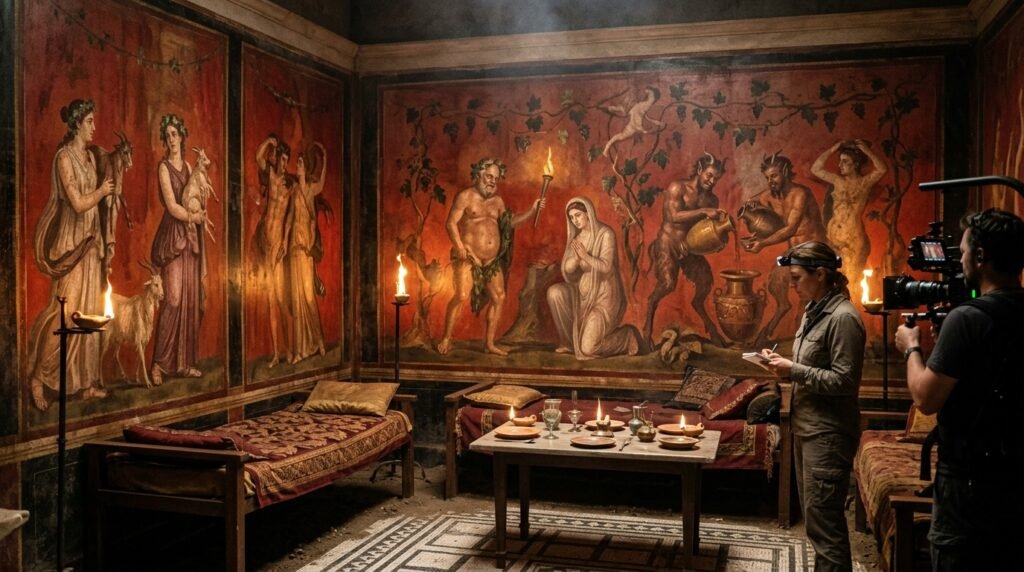
In early 2025, archaeologists working in Insula 10 of Pompeii’s Region IX broke through a wall and found something that immediately stopped the excavation.
Stretching across three full walls of what had once been a banquet room was a megalography, a painting where every figure is rendered at life-size scale. Nearly 100 years old at the time Vesuvius erupted, the fresco had been painted between 40 and 30 BCE and showed a procession unlike almost anything previously found in Pompeii.
Women carrying slaughtered goats over their shoulders. Satyrs pouring wine in a ritual sacrifice. A young woman standing at the centre of the composition, being led by an elderly silenus holding a torch toward initiation into something the Roman state had officially outlawed 166 years earlier.
The cult of Dionysus, god of wine and transformation, had been banned by Roman senate decree in 186 BCE. The authorities had declared its ecstatic rites too dangerous, too subversive, too far outside the boundaries of acceptable Roman behaviour. And yet here, on the walls of a wealthy Pompeian home, the rites lived on, painted with extraordinary care into the most public room in the house.
Director of the Pompeii Archaeological Park, Gabriel Zuchtriegel, called it a metaphor for a wild, ecstatic life and described the imagery as showing the wild and untamable side of women in direct opposition to the domesticated feminine ideal Roman society promoted.
This is now only the second such painting in all of Pompeii. The first is at the Villa of the Mysteries. That these two buildings kept the memory of a banned religion alive, in fresco, in dining rooms, suggests these were not just decorations. They were declarations.
This ranks among the most extraordinary Pompeii secrets ever uncovered because it tells us that Roman religious suppression was far less effective than the authorities believed, and that the people of Pompeii were quietly, defiantly practising what they had officially abandoned.
Secret Two: Someone Came Back
For almost two centuries of modern archaeology, Pompeii was treated as a single frozen moment. 79 AD. The city dies. Full stop.
In August 2025, that version of events was formally dismantled.
New excavations of the Insula Meridionalis, published in the E-Journal of the Excavations of Pompeii, revealed something researchers had technically known about in fragments but had never properly documented: Pompeii was reoccupied after the eruption. People came back.
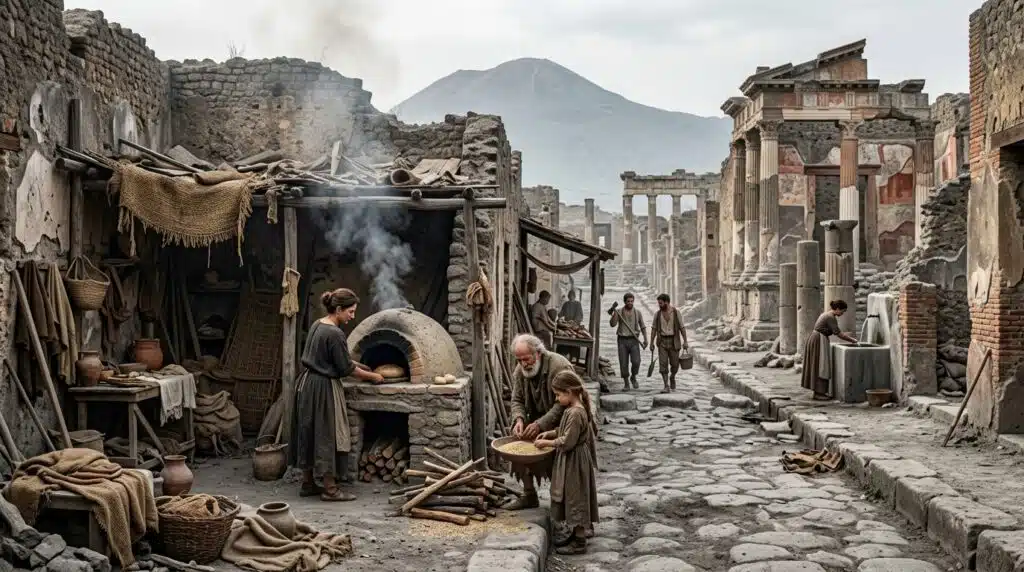
Survivors who could not afford to rebuild their lives elsewhere returned to live among the ruins. They were joined by others, homeless people from surrounding regions searching for somewhere to settle, looking for valuables in the ash. What emerged was not a city. It was a settlement of desperation.
Gabriel Zuchtriegel described what the excavations revealed in terms that carry remarkable weight: post-79 Pompeii reemerges as a precarious and grey agglomeration, a kind of camp, a favela among the still recognisable ruins of the Pompeii that once was.
The former ground floors became cellars. Survivors built ovens and mills from the rubble of the city that had buried their old lives. And then, one of the most quietly stunning finds in the entire excavation: a ceramic lamp decorated with an early Christian symbol, dated to the fifth century. The reoccupation of Pompeii lasted not weeks or months but roughly four hundred years, ending only when the area was finally, completely abandoned sometime after 400 AD.
Previous traces of this reoccupation had been found before. But in the rush to reach Pompeii’s famous frescoes and intact homes, the faint traces of the site’s reoccupation were literally removed and often swept away without any documentation, Zuchtriegel acknowledged. For generations, archaeologists had been inadvertently erasing one of the great Pompeii secrets to get to the more photogenic layer underneath.
Secret Three: The Private Spa as a Political Weapon
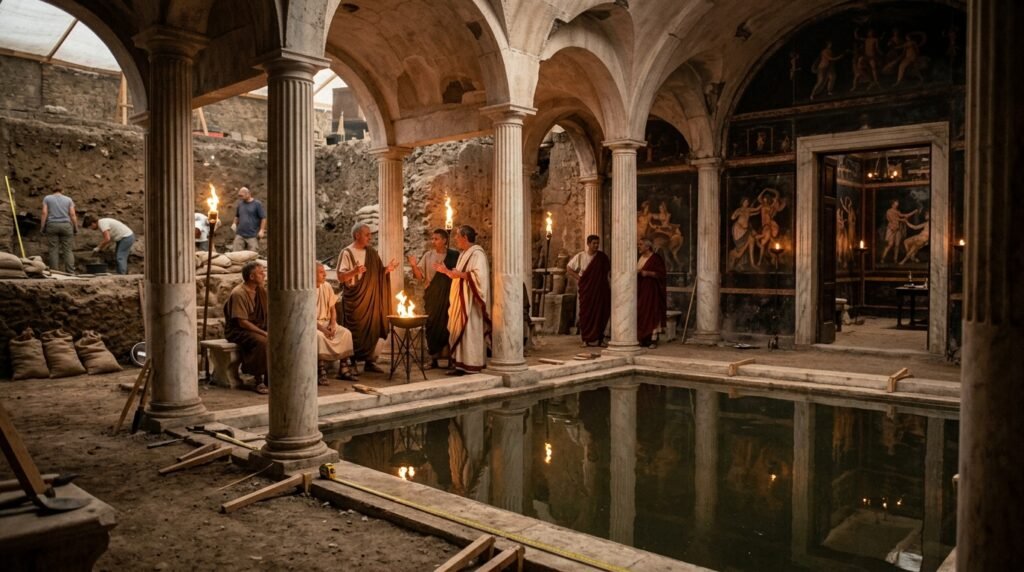
In January 2025, what Euronews described as a once-in-a-century discovery emerged from Region IX: a private thermal spa complex, connected directly to an elaborate banquet hall, buried inside a single wealthy homeowner’s residence.
This was not a public bath. It was personal. And it was enormous, large enough to accommodate 30 guests at once.
The spa contained the full Roman sequence: a calidarium for the hot room, a tepidarium for the warm room, a frigidarium with a grand pool for the cold room, and an apodyterium as a changing room. The walls were painted in the Second and Third Pompeian styles, with frescoes depicting scenes from the Trojan War designed to evoke Greek intellectual culture, signalling to every guest that their host was not merely wealthy, but educated and cultured.
The connection to the adjacent banquet hall, the Black Hall with its dark painted walls and mythological frescoes, was direct and deliberate. Guests would dine, then bathe, then dine again. The owner orchestrated an entire theatrical experience around himself.
Gabriel Zuchtriegel noted that everything was functional to the staging of a spectacle, at the centre of which was the owner himself.
But the truly revealing Pompeii secrets come in the detail of why this kind of hospitality existed. The Archaeological Park of Pompeii’s official statement explained that these occasions allowed the owner to secure an electoral consensus, promote the candidacy of family or friends, or simply display their social status.
The spa was a lobbying tool. Hot water and Trojan War frescoes were instruments of political influence in a city where local elections shaped daily life. This is the Roman world stripped of its marble idealism: power built in bathrooms, alliances sealed over dinner, votes purchased with warm towels.
Secret Four: The Victims Were Not Who We Thought
Among the Pompeii secrets that took the longest to surface is one that challenges the very faces of the tragedy. The iconic plaster casts of Pompeii’s victims, those haunting shapes of people frozen in their final moments, have shaped every popular image of the disaster for over 150 years.
But in recent years, DNA analysis has been quietly rewriting who those people actually were.
The victims of Pompeii were not a single ethnic or genetic population. Analysis has revealed North African genetic ancestry among the victims, reflecting Alexandria-to-Rome trade routes and the movement of enslaved people throughout the Roman Empire. The Pompeii population was diverse in ways the classic narrative rarely acknowledges.
And the casualties themselves require a rethink. Only around 1,300 victims have been found since excavations began in 1748, out of an estimated population of over 20,000 people. Two-thirds of the city has been excavated. That means the death toll, as represented in the physical evidence, is roughly 10 per cent of the population.
The majority of Pompeii’s inhabitants survived. They escaped. They scattered across Campania, carrying Pompeian names that appear in inscriptions in other towns throughout the region. The eruption was horrifying, but it was not the total annihilation that the popular story implies. Thousands of people got out and rebuilt their lives elsewhere.
This changes the emotional centre of the story entirely. Pompeii was not a city of victims. It was a city most of whose people survived, carrying everything except the place they had called home.
Secret Five: The City Was Mid-Renovation When It Died
One of the quietest but most significant Pompeii secrets to emerge in recent excavations is this: large parts of the city were not finished when Vesuvius erupted.
Pompeii had been struck by a severe earthquake in 62 AD, seventeen years before the eruption. The damage was extensive, and reconstruction was still actively underway across multiple districts when the volcano ended everything.
In 2025, discoveries at the Insula Meridionalis and surrounding regions revealed construction sites frozen mid-process. Building materials are stacked and waiting. Scaffolding positions preserved in the ash. A bakery combined with domestic rooms in a building that had not yet been completed, with grain-washing basins, ovens, and storage rooms still being integrated into the structure.
A study published in 2025 using analysis of the concrete at the construction site found that the technique outlined by the ancient architect Vitruvius as standard practice had already been superseded by newer methods at Pompeii. As lead researcher, Admir Masic of MIT noted, for studying ancient technologies, there is simply no parallel because its exceptional preservation offers a true snapshot of Roman building practice in action.
The Pompeii secrets embedded in its unfinished buildings tell us something quietly devastating. This was a city still in the process of healing from one disaster when a second one arrived.
Secret Six: The Egyptian Connection Nobody Expected
In November 2025, an antique Egyptian vase surfaced in the excavation of Pompeii’s street food district, a thermopolium area associated with working-class and lower-middle-class daily life.
Its presence in that particular zone of the city is not a decoration story. It is a trade route story, and a religious one.
The discovery pointed to links between Pompeii and Eastern cultural and religious communities at the lower levels of society, according to the Euronews report covering the find. Egypt was not merely a distant empire to Pompeii’s working class. It was a source of religious practice, imported objects, and cultural identity that reached all the way down to the people buying street food in the city’s busiest commercial district.
The cult of the Egyptian goddess Isis had a significant temple in Pompeii, one of the best preserved ancient temples in existence. Egyptian religious influence on Roman society was far deeper and more widespread than the textbook version of Roman religion tends to acknowledge. The vase from the street food district confirms that this influence was not confined to the elite.
Secret Seven: The Eruption Date Itself Was Wrong for Centuries
For generations, the eruption of Vesuvius was dated to August 24th, 79 AD, based on a letter written by Pliny the Younger. The date appeared in every textbook, every documentary, every museum panel.
It is almost certainly wrong.
Evidence from the archaeological site itself tells a different story. Excavations have uncovered pomegranates and walnuts at the site, fruits that ripen in autumn, not summer. Charcoal inscriptions found in one building reference the 16th day before the November Kalends, which translates to October 17th. Victims were found wearing heavy wool cloaks, not summer clothing.
The eruption most likely occurred in late October or early November of 79 AD, not in August. The error persisted for so long because Pliny’s account was trusted without cross-referencing what the physical evidence of the city itself was saying. The ash had been telling the truth all along. Nobody thought to ask it.
Conclusion: Pompeii Is Still Speaking
The great Pompeii secrets are not buried in some inaccessible corner of the site. They are embedded in layers that previous generations of archaeologists rushed past on their way to the famous frescoes, the plaster casts, the photogenic ruins.
What the excavations of the past decade, and especially the discoveries of 2024 and 2025, are revealing is a city of extraordinary complexity. A city where forbidden cults survived behind painted dining room walls. Where survivors returned to build ovens in the basements of their buried homes and lived there for four centuries. Where political power was exercised through bathroom architecture and warm water. Where diversity and trade routes stretched from Egypt to the fast-food stalls.
Every layer of ash that Pompeii yields gives us not just history but a mirror. The Pompeii secrets that keep emerging are not merely about the ancient world. They are about how complicated any city actually is when you dig deep enough to find the truth underneath the story everyone agreed to tell.
The ash preserved everything. We are only now learning to read what it kept.
Discover a Hidden Maya City
Deep in Mexico’s jungle, LiDAR has revealed a massive lost city of 30,000 people—reshaping everything we know about Maya civilisation.
In 2024, a team of archaeologists made a discovery that could change everything: they found a lost city beneath the pyramids.