
8 Minoan Civilization Mystery Facts That Rewrote History
Europe’s First Great Civilization Left No Name Behind
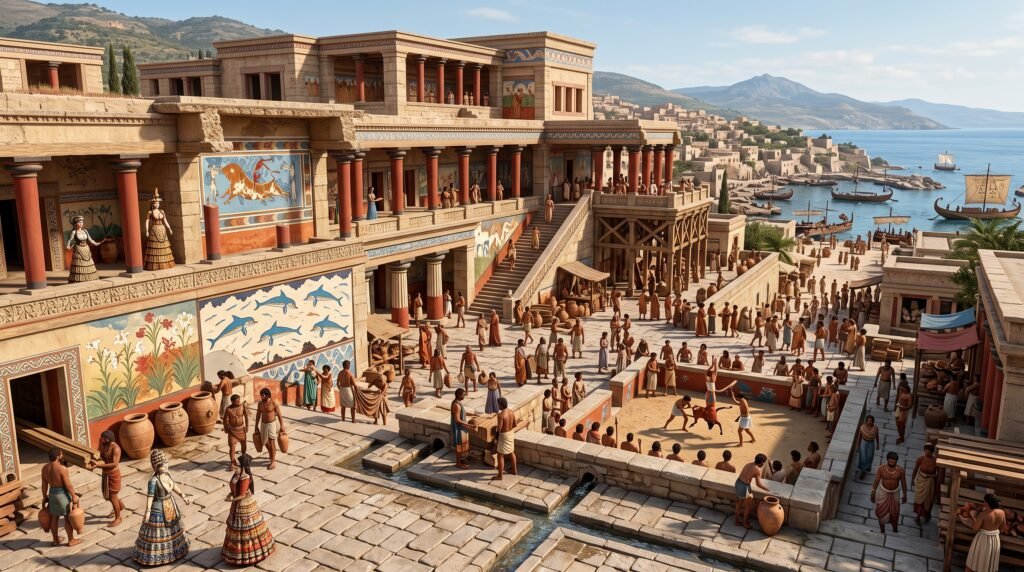
They built palaces with indoor plumbing when most of Europe was still sleeping in wooden huts. They painted their walls with leaping dolphins, athletic acrobats, and flowering meadows. They sailed trading routes that connected Crete to Egypt, to Anatolia, to the Greek islands and beyond. They created two writing systems, neither of which has ever been fully deciphered. And they named themselves something we will never know, because the only people who called them the Minoans were archaeologists who arrived four thousand years after their civilization had already collapsed.
Sir Arthur Evans, the British archaeologist who discovered their palace at Knossos in 1900, named them after the mythological King Minos. The Minoans themselves left no king lists, no battle records, no founding documents in any language we can read. What they left were frescoes, pottery, seal stones, the bones of their buildings, and a silence that has been driving researchers to distraction for over a century.
The Minoan civilization mystery is not simply the question of how they vanished. It is the question of who they actually were, what they believed, what language they spoke, and whether the most dramatic event in Bronze Age Mediterranean history, the eruption of the volcanic island of Thera around 1600 BCE, was the event that ended them or merely the wound that left them vulnerable for a century before something else delivered the final blow.
The answers, in 2025, are more complicated than they have ever been.
Quick Answer: Minoan Civilization Mystery
What is the Minoan civilization mystery? The Minoan civilization mystery encompasses several interconnected questions: what caused the collapse of palace culture across Crete around 1450 BCE, whether the Thera eruption destroyed the Minoans or only weakened them, who the Minoans actually were genetically and culturally, and why their primary writing system, Linear A, remains undeciphered. Evidence from the past decade points toward Mycenaean invasion as the primary collapse trigger, with the Thera eruption as a destabilizing precursor that played out over more than a century.
Did the Thera eruption destroy the Minoan civilization? Not directly. Physical evidence confirms the Minoan civilization survived the Thera eruption and continued thriving for approximately 100 to 150 years afterward. A 2024 University of Nebraska honors thesis synthesizing recent geoarchaeological research concluded that evidence of manmade destruction appears across Crete around 1450 BCE, followed immediately by a cultural shift toward Mycenaean elements, indicating invasion rather than volcanic catastrophe as the final cause of Minoan collapse. A 2025 study published in Quaternary International found that high-altitude wind patterns spread Thera’s ash and aerosols over Minoan agricultural regions, contributing to environmental destabilization without causing immediate civilizational collapse.
When did the Thera eruption occur? The dating of the Thera eruption is itself one of the most contested aspects of the Minoan civilization mystery. Radiocarbon dating of seeds, olive branches, and tree rings places the eruption between 1627 and 1600 BCE. A landmark 2025 study by Bruins and van der Plicht, using advanced radiocarbon techniques on Egyptian artifacts, confirmed the eruption predates the reign of Pharaoh Ahmose I, placing it in the Second Intermediate Period before Egypt’s reunification. This eliminates a previously popular theory that the Egyptian Tempest Stela of Ahmose recorded the eruption’s aftermath.
What happened to the Minoans after the collapse? The Minoans did not disappear as a people. Mycenaean Greeks took control of Knossos around 1450 BCE and continued using the palace, replacing Linear A with their own script, pt Linear B. Minoan artistic traditions, architectural styles, and religious iconography were absorbed into Mycenaean culture and subsequently influenced classical Greek civilization. The Minoan civilization mystery ends not with extinction but with cultural absorption into the civilization that replaced it.
Mystery One: The Writing That Nobody Can Read
The most profound of all Minoan civilization mysteries is not geological or military. It is linguistic.
The Minoans developed two writing systems. Linear A, their primary administrative script, appears on clay tablets, ceremonial axes, and inscribed pottery across the entire period of Minoan civilization. Linear B, which was adopted later and found primarily at Knossos, was deciphered in 1952 by Michael Ventris and John Chadwick, who determined it represented an early form of Greek used by the Mycenaean administration.
Linear A has resisted decipherment to this day. Its decipherment is one of the Holy Grails of ancient scripts, as New World Encyclopedia describes it. We know the script exists. We know it is related to but distinct from Linear B. We know the approximate phonetic values of some symbols based on their Linear B descendants. And we know that if we could read it, the Minoan civilization mystery would transform overnight.
Linear A tablets would tell us the Minoans’ name for themselves, their administrative structure, their trade accounts, their religious texts. Every question about who the Minoans actually were could potentially be answered by a script that has been sitting in the Heraklion Archaeological Museum for over a century, fully visible and completely unreadable.
The language the Minoans spoke was not Greek. It was not any known Semitic language. Its linguistic family remains unidentified, meaning the Minoans spoke something so distinct from every known ancient tongue that we cannot even map it onto the family tree of human language. We do not know what they called themselves. We do not know what they called their gods. We do not know what their Linear A tablets say, even though thousands of them survive.
Mystery Two: The Thera Eruption Was One of the Largest in Human History
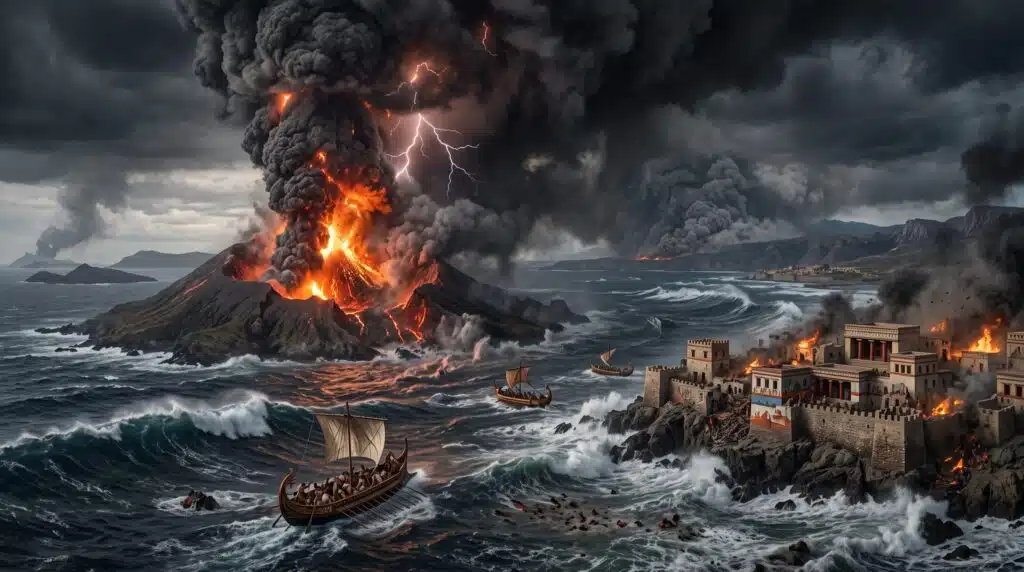
To understand the Minoan civilization mystery properly requires understanding the scale of what happened on Thera around 1600 BCE, because the eruption occupies the center of every debate about why the Minoans ultimately fell.
The Minoan eruption of Thera, on the island now known as Santorini, is classified with a Volcanic Explosivity Index of 7, placing it among the most violent eruptions of the past ten thousand years. The event produced approximately 80 cubic kilometers of dense-rock equivalent material, making it potentially the largest volcanic event of the entire Holocene period, according to research published through Ancient Origins in October 2025. The explosion buried the prosperous Minoan trading settlement of Akrotiri under thick layers of tephra, scattered volcanic ash across eastern Crete, and generated tsunamis that crashed across the Aegean and the eastern Mediterranean.
The settlement at Akrotiri, when excavated beginning in the 1960s, proved to be a Bronze Age Pompeii. Buildings of two and three stories still stood to their original heights. Wall frescoes in vivid blues and yellows and reds depicted antelopes, fishermen, spring landscapes, and in one of the most remarkable images from the ancient world, an entire flotilla of ships in a sea procession that shows the Mediterranean sailing culture of the period in extraordinary detail. No human remains were found at Akrotiri, confirming that residents had evacuated before the worst of the eruption. They took their lives. They left everything else.
The caldera collapse that followed the main eruption created the distinctive crescent shape of modern Santorini, a geological wound visible from space. The tsunamis generated by that collapse reached coastlines across the Aegean within hours.
Mystery Three: The Dating War That Science Finally Settled
For decades, the Minoan civilization mystery included a bitter disagreement between two scientific communities about when exactly the Thera eruption occurred.
Radiocarbon scientists, analyzing organic material from the eruption layer including olive branches buried in pumice and seeds sealed beneath the ash, consistently produced dates in the range of 1627 to 1600 BCE. Archaeological chronologists, working from pottery sequences and stylistic parallels to Egyptian artifacts of known dates, preferred a later date around 1500 BCE. The gap of more than a century created enormous problems for reconstructing Bronze Age Mediterranean history, because events in Greece, Egypt, and the Levant were all cross-referenced against each other.
In October 2025, Bruins and van der Plicht published a landmark study that moved the debate significantly forward. Using advanced radiocarbon dating techniques on Egyptian artifacts, including a mudbrick from the Temple of Ahmose at Abydos now held in the British Museum, they determined conclusively that the Thera eruption predated the reign of Pharaoh Ahmose I, placing it in the Second Intermediate Period before Egypt’s New Kingdom began.
This single finding dismantled a long-standing theory within the Minoan civilization mystery: that the Egyptian Tempest Stela of Ahmose, which describes violent storms and dark skies, recorded the atmospheric aftermath of Thera’s eruption. If the eruption predates Ahmose’s reign entirely, the Tempest Stela was describing something else, and the connection between the eruption and Egyptian historical memory evaporates.
The radiocarbon scientists were right about the timing. And that makes the gap between the eruption and the final collapse of Minoan palace culture even wider than previously understood.
Mystery Four: The Minoans Survived the Eruption for Over a Century
This is the detail that permanently broke the simple version of the Minoan civilization mystery.
For most of the twentieth century, the popular explanation was clean: Thera erupted, the Minoans collapsed. Cause and effect, separated by very little time. The image of a civilization simultaneously struck by ash and tsunamis and falling silent was powerful and satisfying in the way that dramatic single-event explanations always are.
The archaeology destroyed it.
Physical evidence confirms the Minoan civilization continued to thrive for approximately one hundred to one hundred and fifty years after the Thera eruption. The palaces at Knossos, Phaistos, Malia, and Zakro were not abandoned in 1600 BCE. The centuries between roughly 1700 and 1450 BCE represent the apex of Minoan civilization, with trade networks at their widest extent and Minoan artistic influence spreading across the Aegean, appearing on the walls of elite Egyptian tombs and in the material culture of islands far beyond Crete.
The Minoans rebuilt after Thera. They absorbed the damage. They continued trading, creating, administering. Whatever the eruption did to their civilization, it was not enough to end it.
The final collapse of palace culture happened around 1450 BCE, more than a century after the eruption. Something else delivered that blow.
Mystery Five: Wind Patterns That Carried Destruction Across the Aegean
A June 2025 study published in Quaternary International added a new atmospheric dimension to the Minoan civilization mystery that researchers had not fully quantified before.
Dimitrios Ntokos of the National Technical University of Athens modeled the high-altitude wind patterns that would have been active during the Thera eruption, correlating them with the distribution of tephra deposits found across the eastern Mediterranean region. The study found that high-altitude wind patterns played a crucial role in the collapse of the Minoan civilization by spreading volcanic ash and aerosols from the eruption of the Thera volcano, which in turn caused atmospheric effects impacting the region.
The ash and aerosols carried by these wind patterns would have affected solar radiation, lowered temperatures, and disrupted agricultural productivity across Minoan territories for years or possibly decades after the eruption itself. Eastern Crete, which lay directly in the path of the prevailing wind patterns identified in the study, received the heaviest fallout of fine volcanic ash, damaging crops and contaminating water sources.
This atmospheric dimension helps explain why the effects of the Thera eruption were not immediate but cumulative. The Minoans survived the initial blast and the tsunamis. They then spent a century and a half dealing with degraded agricultural yields, disrupted trade routes, and the broader economic and political instability that follows any major environmental shock. By the time the Mycenaeans arrived at the gates of the Minoan palaces around 1450 BCE, they were striking a civilization that had been slowly ground down by a century of environmental pressure. The eruption did not destroy the Minoans. It made them destroyable.
Mystery Six: The Mycenaeans Delivered the Final Blow
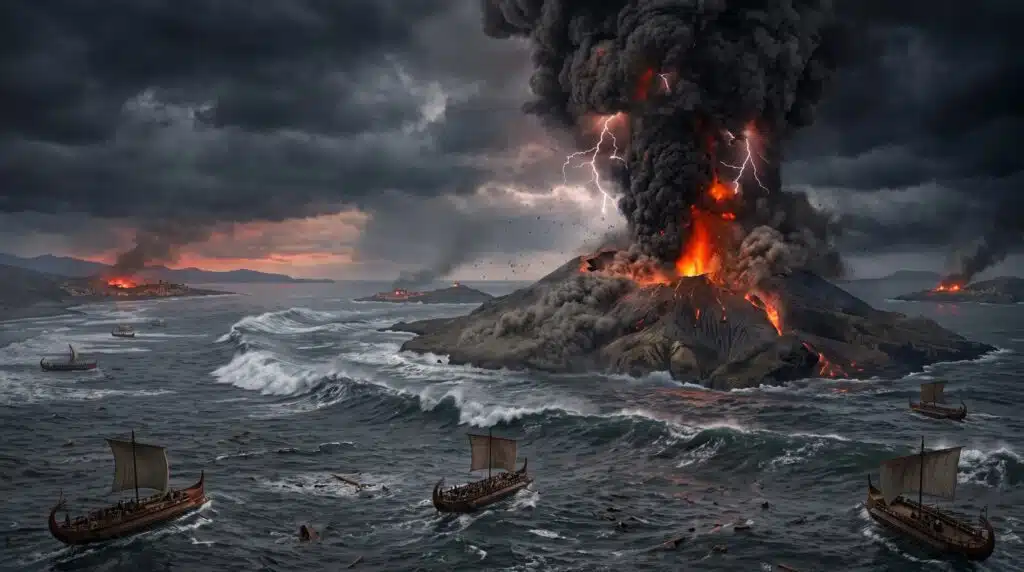
Despite popular ideas that the Bronze Age Minoan society was destroyed by the volcanic eruption of Thera, physical evidence indicates that the Minoans survived that crisis and only fell more than a century later to invading Mycenaeans.
This conclusion, synthesized from recent geoarchaeological research in a 2024 University of Nebraska honors thesis, represents where the scholarly consensus now sits on the central Minoan civilization mystery.
The evidence for Mycenaean invasion at approximately 1450 BCE is substantial and multi-layered. Evidence of manmade destruction has been uncovered across the island of Crete around that date. The Linear A script disappears from administrative records and is replaced by Linear B, which Ventris proved records the Greek language of the Mycenaean people. Pottery styles shift suddenly and decisively toward mainland Greek forms. The palace at Knossos continues operating after 1450 BCE, but it operates under new management, producing Linear B tablets in Greek rather than Linear A tablets in the unidentified Minoan language.
The Mycenaean Greeks did not simply absorb the Minoans. They admired them enough to appropriate their art, their architectural styles, their religious imagery, and their administrative practices. The bull-leaping imagery that is the most iconic visual element of Minoan civilization appears in Mycenaean art after the conquest. The palace complexes that became the centers of Mycenaean power borrowed heavily from the Minoan model. The Greek myths of the Minotaur, of Theseus and the labyrinth, of Daedalus and Icarus, all carry traces of a Bronze Age memory of Crete as a place of power and strangeness.
The civilization that replaced the Minoans carried the Minoans inside it. And that Mycenaean civilization, transformed by centuries of contact with the Near East and Egypt, eventually became classical Greece, which became the foundation of Western thought.
The Minoan civilization mystery, in its broadest dimension, is a story about how the roots of European culture lie in a civilization so ancient that it forgot its own name.
Mystery Seven: Arthur Evans Built What He Expected to Find
Any honest account of the Minoan civilization mystery must engage with the uncomfortable truth at the center of Knossos, the site that more than any other defines what we think we know about the Minoans.
Arthur Evans excavated Knossos beginning in 1900 with extraordinary energy and considerable personal wealth. He found an extensive network of rooms, approximately 1,300 at Knossos alone, along with fragments of frescoes, small statues, storage vessels, administrative tablets, and the elaborate drainage system that became one of the most celebrated features of Minoan civilization. He interpreted what he found through the lens of his time and his assumptions, and where the evidence was fragmentary, he filled in the gaps with reconstructed concrete and painted reproductions of frescoes that were moved to the Heraklion Archaeological Museum while copies took their place in situ.
The palace that visitors to Knossos walk through today is significantly Arthur Evans’s creation. The upper stories were rebuilt in reinforced concrete. The throne room, the central court, and the storage magazines are real. The vivid painted reconstructions on the walls above them are educated interpretations, not preserved originals.
This matters for the Minoan civilization mystery because the interpretive framework Evans applied was his framework, shaped by his understanding of what a Bronze Age palace civilization ought to look like. Later archaeologists have questioned whether the large building complexes Evans called palaces actually functioned as royal residences at all. There appear to be no royal apartments, no clear living quarters for a monarch. The buildings may have been primarily ceremonial and administrative centers, redistribution hubs for agricultural goods, or temple complexes rather than conventional palaces.
The word we use for these buildings shapes how we understand the civilization that built them. And the word was chosen by a Victorian archaeologist whose reconstruction of Knossos, however well-intentioned, has made it harder for every generation since to see the original.
Mystery Eight: The Minoan Civilization Mystery Is Still Being Rewritten
What makes the Minoan civilization mystery genuinely compelling in 2025 is not that it is unsolved. It is that it keeps being actively reshaped by new evidence.
The 2025 Bruins and van der Plicht radiocarbon study overturned the Tempest Stela connection that had been a feature of Mediterranean Bronze Age scholarship for decades. The Quaternary International wind pattern study gave atmospheric scientists a new tool for modeling how the eruption’s effects propagated across the region. And ongoing excavation at sites across Crete continues to produce material that refines or complicates every standing theory about the sequence of events between the Thera eruption and the final abandonment of the palace system.
Linear A remains undeciphered. The language the Minoans spoke remains unidentified. The names they gave themselves, their gods, their cities, and their rulers are gone from the historical record unless they survive encoded in a script that has so far resisted every attempt to break it.
The Minoans painted dolphins on the walls of their palace bathrooms. They depicted women in elaborate frilled skirts and open bodices participating in what appear to be public religious ceremonies. They built drains that worked. They traded across an entire sea before most of their contemporaries understood what long-distance commerce could be.
They were extraordinary. And we do not know what they called themselves.
That gap, between the extraordinary sophistication of what they built and the total silence of who they said they were, is the Minoan civilization mystery in its purest form. And it is a gap that archaeology, radiocarbon science, linguistic analysis, and atmospheric modeling are all still working, in 2025, to close.
Conclusion: The Sea Empire That Named Itself in a Language We Cannot Read
The Minoan civilization mystery began with a British archaeologist digging in Crete in 1900 and ended, for the popular imagination, with a clean story about a volcano and a civilization swallowed by ash. Neither the beginning nor the ending has survived contact with the evidence.
The Minoans were not named by themselves. They were not destroyed by the volcano. They spoke a language nobody has deciphered and wrote it in a script nobody has cracked. They survived the most powerful volcanic eruption of the past ten thousand years and then fell to something far more ordinary: a neighboring civilization that was younger, militarily aggressive, and willing to fight for what the Minoans had built.
The Thera eruption did not kill the Minoan civilization mystery. It created the conditions for it. A century and a half of atmospheric disruption, agricultural stress, and probably social instability left the Minoans unable to resist when the Mycenaeans came. And when the Mycenaeans came, they were so impressed by what they found that they spent centuries wearing its imagery, worshipping versions of its gods, and building its myths into the stories that eventually became Greek mythology.
The most advanced sea empire of the ancient Mediterranean did not vanish. It transformed. Its DNA runs through everything that followed it. Its name just never made the journey.
Sources
- Archaeology Magazine Online — “Thera Eruption Predates Pharaoh Ahmose: Radiocarbon Study Solves Ancient Mystery” (October 23, 2025) — archaeologymag.com
- Ancient Origins — “Timing of Major Bronze Age Events Dramatically Changed by New Research” (October 23, 2025) — ancient-origins.net
- Greek Reporter — “Winds Played Key Role in Minoan Collapse After Thera Eruption, Study Finds” (June 6, 2025) — greekreporter.com
- University of Nebraska-Lincoln Digital Commons — Ashley Arp, “A Grim End for Europe’s First Civilization: The Fall of Minoan Crete.” Honors Thesis, May 2024 — digitalcommons.unl.edu
- World History Encyclopedia — “Minoan Civilization” (Mark Cartwright, March 29, 2018) — worldhistory.org
- Forbes and Fifth, University of Pittsburgh — “The Eruption of Thera” — forbes5.pitt.edu
- The York Historian — “The Collapse of Minoan Civilisation: A Geological, Anthropological, or Meteorological Phenomenon?” (January 24, 2026) — theyorkhistorian.com
- History Collection — “Minoan Civilization Built Europe’s First Palace, Then Disappeared” (July 19, 2026) — historycollection.com
- Olympus Estate — “The Minoan Civilization: Bronze Age Crete and Its Enduring Mysteries” (May 30, 2025) — olympusestate.com
- Linda Hall Library — “Arthur John Evans: Knossos and the Minoans” — lindahall.org
- New World Encyclopedia — “Arthur Evans and Linear A” — newworldencyclopedia.org
- Lamont-Doherty Earth Observatory, Columbia University — “A Volcanic Explosion 520,000 Years Ago Dwarfed One That Devastated the Minoan Civilization” — lamont.columbia.edu
- arXiv — “Enhanced Seismicity Monitoring in the Rapid Scientific Response to the 2025 Santorini Crisis” — arxiv.org (Geological context for ongoing Santorini volcanic activity)
- Bruins, H.J. and van der Plicht, J. (2025) — “The Minoan Thera eruption predates Pharaoh Ahmose: Radiocarbon dating of Egyptian artifacts” — Peer-reviewed primary study cited via archaeologymag.com and ancient-origins.net
Discover a Hidden Maya City
Deep in Mexico’s jungle, LiDAR has revealed a massive lost city of 30,000 people—reshaping everything we know about Maya civilisation.
In 2024, a team of archaeologists made a discovery that could change everything: they found a lost city beneath the pyramids.