8 Nazca Lines Mystery Facts That Will Stun You
Drawn for Eyes That Could Never See Them
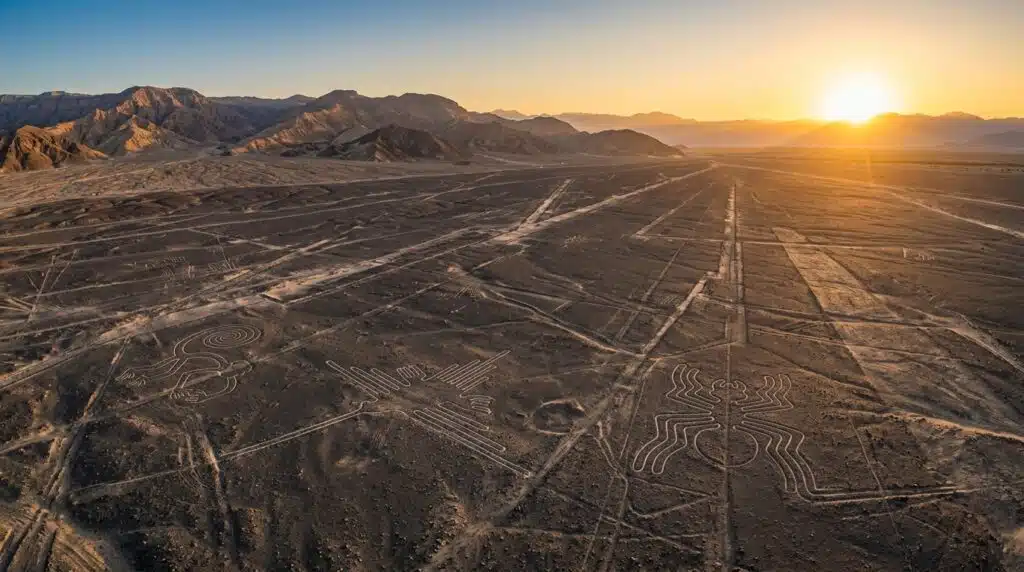
Picture a desert so vast, so flat, and so silent that sound itself seems to dissolve. Now imagine that every inch of it was once a canvas, and that the artists who worked here carved their creations into the earth at a scale so enormous that no human standing on the ground could ever fully see what they had made.
That is the Nazca Desert in southern Peru. That is where one of history’s most compelling and most debated questions still does not have a clean answer, two thousand years after the first line was scratched into the soil.
The Nazca lines mystery is not a fringe curiosity kept alive by alien theories and YouTube documentaries. It is a genuine archaeological puzzle that has occupied serious researchers for nearly a century, and in September 2024, it became dramatically more complicated when artificial intelligence revealed that the number of known geoglyphs was almost double what anyone had thought.
The lines are not what the popular version says they are. They are not what you think you know. And the closer science looks, the deeper the Nazca lines mystery becomes.
AEO Quick Answer: Nazca Lines Mystery
What are the Nazca lines? The Nazca lines are a collection of geoglyphs etched into the desert floor of southern Peru, created by the Nazca culture between 500 BC and 500 AD. They were made by removing the top layer of reddish-brown iron oxide-coated pebbles to reveal a yellow-grey subsoil beneath. The combined length of all the lines exceeds 1,300 kilometers, and the figures cover an area of roughly 450 square kilometers.
What is the mystery of the Nazca lines? The Nazca lines mystery centers on their purpose. Scholars have proposed at least five major theories, including astronomical calendars, pilgrimage routes to the Cahuachi Temple, water rituals, and territorial markers for social groups. No single theory has been universally accepted. A landmark 2024 study published in PNAS by Yamagata University and IBM Research nearly doubled the known catalog of geoglyphs, uncovering 303 new figures and providing new evidence that the lines served multiple ritual functions rather than one singular purpose.
How were the Nazca lines made without aerial technology? Experimental archaeology has confirmed that the Nazca lines required no advanced technology. Researchers removed the top 10 to 15 centimeters of reddish pebbles to expose lighter-colored clay beneath. Archaeological evidence shows wooden stakes at the ends of some lines, and studies suggest the Nazca used ancient units of measurement to maintain precise proportions across enormous distances. Joe Nickell demonstrated that a small team could recreate even the largest figures within days using only the tools available to the Nazca people.
What discoveries were made about the Nazca lines in 2024? In September 2024, a team from Japan’s Yamagata University, led by archaeologist Masato Sakai, working with IBM Research’s AI systems, identified 303 previously unknown geoglyphs in just six months of analysis. This nearly doubled the previously known total of 430 figures. The AI was 20 times faster than traditional methods at identifying faint or eroded outlines. New figures included humanoid forms, decapitated heads, llamas, parrots, and a 72-foot killer whale holding a knife.
Fact One: The Lines Were Hidden in Plain Sight for Centuries
The first published mention of the Nazca lines in European writing came from Spanish conquistador Pedro Cieza de León in 1553. He described them as trail markers and moved on without apparent curiosity.
Nobody stopped to look properly for another three hundred and seventy years.
In 1927, Peruvian archaeologist Toribio Mejía Xesspe spotted them while hiking through the foothills. He discussed them at a conference in Lima in 1939. American historian Paul Kosok is credited as the first scholar to study the lines in depth. While in Peru from 1940 to 1941 to study ancient irrigation systems, he flew over the lines and realized that one was in the shape of a bird. Another chance observation helped him see how lines converged on the horizon at the winter solstice.
The central Nazca lines mystery begins right there. These figures are nearly invisible from the ground. They only reveal themselves from the air. And yet they were created by a people who had no aircraft, no balloons, and no way to see what they were making in its completed form.
The Nazca built a viewpoint they could never occupy. And that single fact has driven every theory, every expedition, and every debate about the Nazca lines mystery for the past eighty years.
Fact Two: AI Just Changed Everything We Thought We Knew
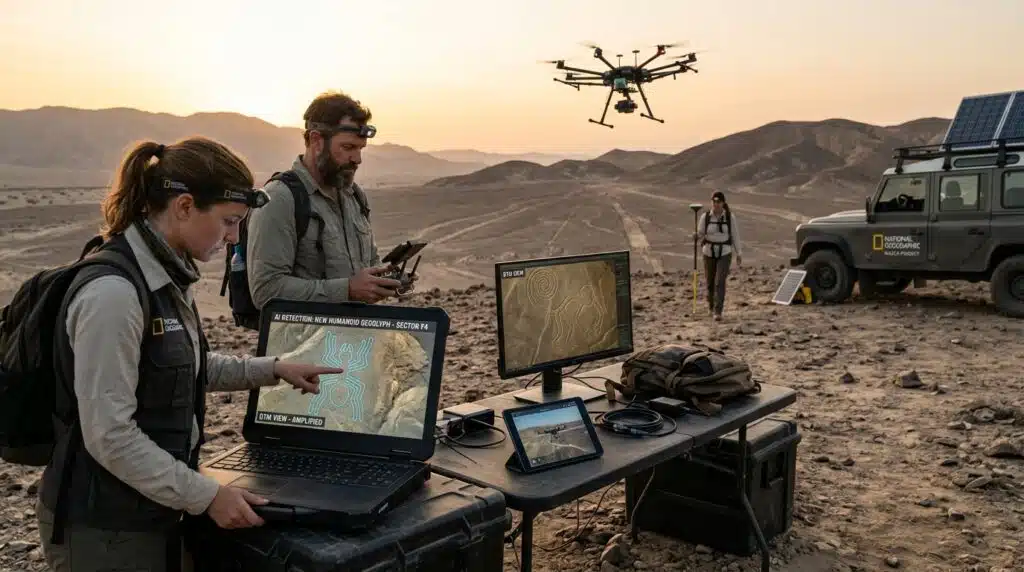
For nearly a century, researchers working by hand, by plane, and eventually by satellite had identified 430 figurative geoglyphs across the Nazca desert. It took generations of scholarship to reach that number.
In September 2024, a research team from Yamagata University’s Nazca Institute, working in collaboration with IBM Research, published a landmark study in PNAS that demolished that total in six months.
Using deep learning AI trained to detect subtle ground disturbances across 629 square kilometers of desert imagery, the team identified 303 previously unknown geoglyphs, nearly doubling the known catalog in one announcement. The AI was capable of spotting patterns 20 times faster than human researchers, and was particularly effective at identifying smaller, more eroded figures that had been repeatedly overlooked in aerial photographs.
The 303 new geoglyphs included humanoid figures, animals like llamas and parrots, snakes, birds, and a striking 72-foot killer whale holding what appeared to be a knife. That last figure was located near an ancient footpath, which became a crucial detail in understanding what the Nazca lines mystery might actually be about.
According to lead researcher Masato Sakai, the AI model identified at least 248 additional candidate sites still awaiting field verification. Researchers now estimate that the final total of Nazca geoglyphs could exceed 1,000 figures, meaning that what generations of scholars studied was less than half of what the desert was actually hiding.
The Nazca lines mystery did not shrink in 2024. It expanded dramatically.
Fact Three: Two Different Types of Lines, Two Different Purposes
One of the most important findings from the 2024 PNAS study is one that popular accounts of the Nazca lines mystery rarely discuss: the geoglyphs are not all one thing.
The study identified two fundamentally distinct categories of geoglyph, and the distinction matters enormously for understanding what these figures were for.
Line-type geoglyphs are the large, well-known figures that most people associate with the Nazca lines mystery. They average 90 meters in length. Wild animals dominate their imagery, with birds, whales, and condors making up the majority. These large figures are distributed near the network of trapezoidal pathways and linear formations that crisscross the Nazca pampa, and they cluster near the major entrances to the Cahuachi ceremonial complex.
Relief-type geoglyphs are a completely different story. They are smaller and less distinct, positioned along ancient pedestrian trails rather than ceremonial pathways. They frequently depict human forms, decapitated heads, and scenes interpreted as connected to ritual sacrifice. Their average distance from the nearest trail is just 43 meters, placing them well within sight of travelers moving through the desert on foot.
The PNAS study concluded that relief geoglyphs were likely intended for individual or small-group viewing during pedestrian travel, not for ceremonial use or aerial observation. Line-type geoglyphs, by contrast, were part of a broader community-based ceremonial framework connected to pilgrimage.
One site. Two completely different visual languages. Both contribute to the same Nazca lines mystery, but answer different questions for different audiences.
Fact Four: The Lines Led Somewhere Specific
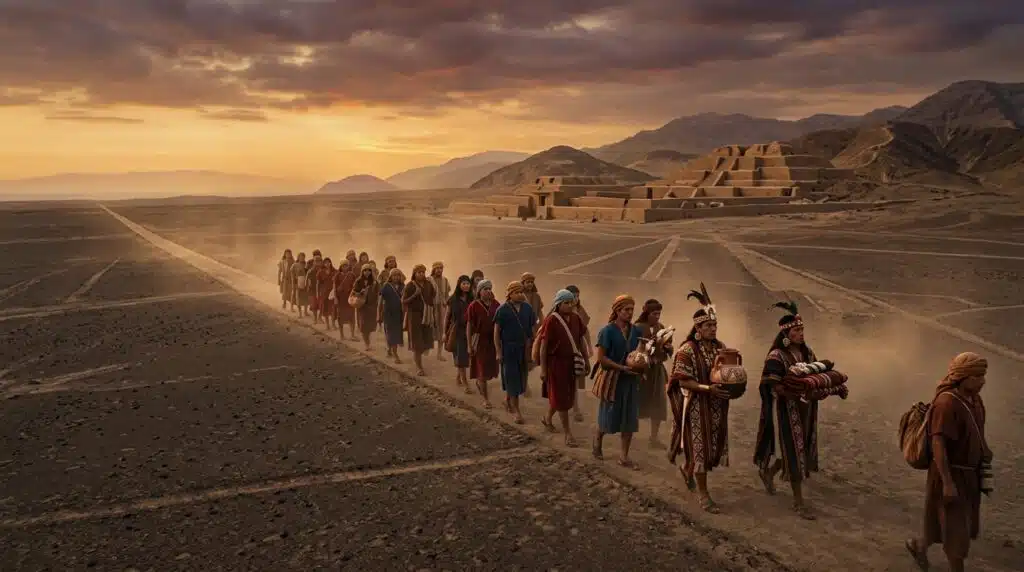
The Nazca lines mystery becomes considerably less mysterious when you follow the lines to where they actually go.
The PNAS 2024 study identified that the network of trapezoidal and linear geoglyphs on the Nazca pampa was not randomly distributed. The lines predominantly lead from the Ingenio River Valley toward two specific destinations: the Cahuachi Temple complex on the opposite bank of the Nazca River, and the confluence of the Tierras Blancas River and the Aja River, the precise point where the Nazca River originates.
That second destination is described in the study as the equivalent of tinkuy, an indigenous Quechua concept meaning a socially and supernaturally charged place where two opposing forces converge.
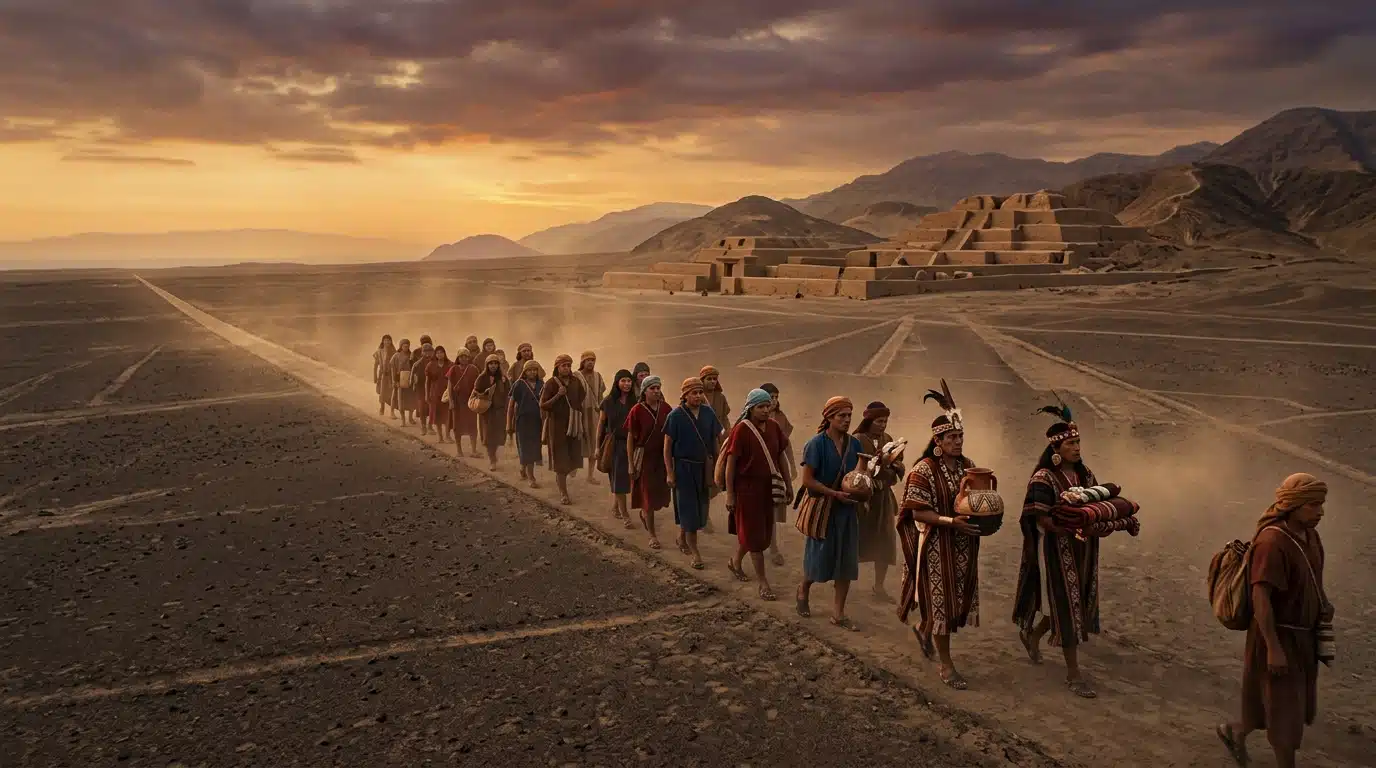
Cahuachi itself was the religious capital of the Nazca culture, a sprawling ceremonial site covering 11 square kilometers with more than 40 mounds topped with adobe structures. Crucially, Cahuachi was not a city in any conventional sense. Excavations confirmed that it was not a residential site. People did not live here. They traveled here from surrounding regions for ritual gatherings, feasts, and ceremonies. It was one of the few places in the Nazca territory with a perpetual water source, making it sacred in a land where water was the difference between life and death.
The Nazca lines mystery, viewed through this evidence, begins to resolve into something coherent: a sacred landscape designed to guide pilgrims across the desert toward the place where the gods might be most persuaded to bring rain.
Fact Five: Water Was the Real Obsession
No understanding of the Nazca lines mystery is complete without confronting the environment in which the lines exist.
The Nazca desert is one of the driest places on earth. The Nazca people were not the masters of a lush agricultural civilization. They were a culture perpetually negotiating with scarcity, building underground aqueducts and cisterns just to survive, worshiping nature gods who controlled the rain and the rivers, and carving their prayers into the earth at a scale that would make them impossible to miss if the gods were ever looking down.
Research confirms that 62 radiant centers have been identified where lines converge on hills, mountains, and water sources. Trapezoid shapes often point directly in the direction of water. The two principal Nazca sites of Ventilla and Cahuachi were connected by a straight line. Many lines are associated with subterranean water sources, which suggests that the Nazca were using the geoglyphs to mark, honor, or petition the underground water channels that made life on the pampa possible.
The killer whale figure that recurs in Nazca pottery, textiles, and now in the newly discovered geoglyphs was not simply a decorative motif. On pottery from the Nazca period, orcas are depicted with knives cutting off human heads, and scholars position orcas as beings that carry out human sacrifice, according to lead researcher Sakai. Trophy heads, bound and preserved, have been found at Cahuachi alongside evidence of feasting and ritual offerings.
The Nazca lines mystery, in its deepest form, is not about geometry or astronomy. It is about people staring into the sky in a dying landscape, doing the largest thing they could think of to get the attention of whatever forces controlled the rain.
Fact Six: The Decapitated Figures Nobody Talks About
One of the most striking findings from the 2024 AI survey, and one that almost no popular coverage of the Nazca lines mystery has addressed properly, is the abundance of decapitated heads among the newly identified figures.
The AI detection system found that relief-type geoglyphs frequently include human forms and decapitated heads, which researchers interpret as connected to ritual activity and sacrifice. These figures cluster along pedestrian trails, placed where a person walking through the desert would pass them at close range.
Archaeological evidence from Cahuachi itself supports this interpretation. The site contains evidence of feasting, offerings, and trophy heads, described as human heads preserved and bound, likely offered to the gods to ensure fertility and water.
The Nazca did not simply draw pretty pictures of condors and monkeys. They drew the full spectrum of their ritual world, including its most violent elements, into the earth at a scale that defies ordinary imagination. The decapitated figures along the trail system suggest that travelers moving toward Cahuachi were being prepared, step by step, for an encounter with the sacred that included sacrifice and death as central themes.
This dimension of the Nazca lines mystery has been systematically underrepresented in popular accounts, perhaps because it is harder to sell a calendar theory than a documentary about alien runways. But the evidence of human sacrifice embedded in the geoglyph landscape is one of the most archaeologically documented aspects of the entire site.
Fact Seven: The Alien Theory Was Debunked Decades Ago
No article about the Nazca lines mystery can avoid addressing the extraterrestrial hypothesis, if only to put it to rest properly.
In 1968, Erich von Däniken published “Chariots of the Gods,” arguing that the Nazca lines were landing strips built for alien spacecraft. The book became a global bestseller. It has sold tens of millions of copies. It continues to influence how millions of people think about the Nazca lines mystery.
Every testable claim it makes has been disproved.
Experimental archaeology has repeatedly demonstrated that the Nazca lines are straightforward to construct using tools the Nazca people actually possessed. Wooden stakes found at the ends of some lines confirmed the staking and rope technique that researchers theorized for surveying straight lines across long distances. Joe Nickell, investigating the lines in the early twenty-first century, demonstrated with a small team that even the largest figures could be recreated within days without any aerial assistance.
The lines are not landing strips. They are too soft to support any aircraft. They were not designed to be seen from space. They were designed to be walked, to be ritually traversed, to connect a community of people across a sacred landscape to the temple and the water source at its center.
The aliens did not make the Nazca lines a mystery. Humans did. And that is far more interesting.
Fact Eight: The Lines Are Under Threat Right Now
The Nazca lines mystery continues to generate headlines in 2025, but not always for archaeological reasons.
In January 2025, the Peruvian Ministry of Culture ordered a 42 percent reduction in the protected land area of the Nazca lines reserve, shrinking it from roughly 5,600 square kilometers to approximately 3,200 square kilometers. The decision cited updated archaeological studies but was met with immediate criticism from researchers and conservationists concerned about the threat of informal mining operations encroaching on unprotected areas. The ministry subsequently reversed its decision, but the episode exposed how fragile the protection of the site actually is.
Other threats are ongoing. A truck driver plowed a semi-trailer across the lines in 2018, leaving deep ruts in the ancient surface. The construction of the Pan-American Highway bisected the pampa decades ago, cutting the Lizard geoglyph in two permanently. Squatters and land traffickers continue to pressure the protected boundaries. Climate change threatens the hydrological system that has kept the desert floor stable enough to preserve the lines for two thousand years.
The same desert conditions that preserved the Nazca lines mystery, one of the most stable, arid, windless environments on earth, are exactly what make the lines so vulnerable to modern disruption. Everything that is not natural weather has the potential to damage what two millennia of natural conditions kept intact.
Conclusion: A Mystery That Keeps Growing
The Nazca lines mystery is not waiting to be solved. It is actively expanding.
As of 2024, the total catalog of confirmed geoglyphs exceeds 730 figures, with hundreds more awaiting verification. AI systems developed for the Yamagata and IBM study have flagged over 1,000 candidate sites still requiring field confirmation. Each new figure adds another data point to a picture that has been building for two thousand years.
What emerges from the most current and most serious research is not a single answer but a layered truth. The Nazca lines mystery is not one thing. The lines were pilgrimage routes and ritual declarations. They were water prayers and community gathering markers. They were the sacred geography of a civilization that made the largest possible art in the emptiest possible place, because they were trying to reach something that lived beyond the visible world.
The Nazca lines mystery endures not because archaeologists have failed to find answers, but because the people who made them were asking questions so large that the desert itself barely contained them.
And every time a new figure appears in the AI scan of a satellite image, another voice from that ancient conversation comes back into earshot.
Discover a Hidden Maya City
Deep in Mexico’s jungle, LiDAR has revealed a massive lost city of 30,000 people—reshaping everything we know about Maya civilisation.
In 2024, a team of archaeologists made a discovery that could change everything: they found a lost city beneath the pyramids.