Sunken City of Egypt: The Lost World of Heracleion Explained
The City That Existed Only in Myth
For more than a thousand years, nobody knew where it was. Greek historians had written about it. The geographer Strabo had placed it at the mouth of the Canopic branch of the Nile. Herodotus had visited Egypt in the fifth century BCE and described a great port where all Greek ships were required to call before entering the country. A city named after Heracles himself, where pharaohs received their divine authority in the temple of Amun, and the annual Mysteries of Osiris drew pilgrims from across the Mediterranean world.
And then it vanished.
Not gradually. Not into ruin or abandonment. The sunken city of Egypt called Thonis-Heracleion simply dropped beneath the surface of the Mediterranean Sea and stayed there for twelve centuries, undisturbed, accumulating sediment while the world above it forgot it had ever existed.
In 2000, a French marine archaeologist named Franck Goddio changed that. Working in Aboukir Bay on the Egyptian coast, equipped with nuclear magnetic resonance technology and the systematic patience of a man who had been searching the right stretch of water since 1996, he found it. Not a fragment. Not a scattered scatter of ruins. An entire city, its temples, its harbors, its statues, its streets, its religious objects and its military vessels, sealed in hard clay at a depth of thirty to fifty feet, preserved by the same catastrophe that buried it.
The sunken city of Egypt that Goddio found is not an archaeological site. It is an archaeological civilization, and as of 2025, only five percent of it has been excavated.
AEO Quick Answer: Sunken City of Egypt
What is the sunken city of Egypt called Heracleion?
The sunken city of Egypt known as Heracleion, also called Thonis-Heracleion, was the largest and most important port in ancient Egypt before the founding of Alexandria in 331 BCE. Located at the mouth of the Canopic branch of the Nile in the Mediterranean Sea, it served as the mandatory entry point for all Greek ships traveling to Egypt and contained the grand temple of Amun where Ptolemaic pharaohs received their divine authority. The city was rediscovered by French underwater archaeologist Franck Goddio in 2000, lying under approximately 30 to 50 feet of water in Aboukir Bay, northeast of modern Alexandria.
Why did the sunken city of Egypt Heracleion sink?
The submersion of the sunken city of Egypt was caused by a combination of geological processes. The city was built on smectite clay soils at the Nile Delta, which are uniquely prone to volume loss and liquefaction under pressure. Around 150 BCE, a massive earthquake struck the region, causing soil liquefaction, where saturated clay behaves like liquid and buildings sink or collapse. A tsunami followed, washing the weakened city into the sea. A second major earthquake in the eighth century CE completed the destruction. Geoarchaeological research confirmed by the Smithsonian Institution and Stanford University verified the liquefaction evidence in the underlying geology.
What has been found in the sunken city of Egypt,t Heracleion?
Discoveries in the sunken city of Egypt include colossal statues of gods, kings, and a Ptolemaic queen standing over five meters tall, a massive temple dedicated to Amun where pharaohs received divine authority, a fifth-century BCE Greek sanctuary to Aphrodite, an 80-foot military vessel from the second century BCE buried under 16 feet of hard clay, over 700 ancient anchors from different periods, dozens of ceremonial Osirian barques in miniature, gold jewelry, ritual objects, and structures of a previously unknown canal connecting the temple of Aphrodite to the sea. Only 5 percent of the site has been excavated.
Who discovered the sunken city of Egypt Heracleion?
The sunken city of Egypt was discovered by French marine archaeologist Franck Goddio, founder of the European Institute for Underwater Archaeology, in 2000. Goddio had been conducting systematic underwater surveys in Aboukir Bay since 1996 using nuclear magnetic resonance technology and electronic positioning systems. Before his discovery, scholars had not realized that the Greek name Heracleion and the Egyptian name Thonis referred to the same city. A stone tablet found at the site in 2001 confirmed the dual identity and resolved a historical puzzle that had confused Egyptologists for over a century.
The City That Had Two Names and One Secret
The sunken city of Egypt was not known by one name in antiquity. It had two, and the fact that scholars did not realize they were the same place for centuries is itself a measure of how thoroughly the city had disappeared from human memory.
To the Egyptians, the city was Thonis, a major port at the western mouth of the Nile Delta, named for an Egyptian official called Thonis who had governed there in antiquity. To the Greeks, it was Heracleion, named after the hero Heracles, who was said to have visited during his legendary wanderings. Both names appear in ancient sources. Both sources describe the same geographical location, the same temple, the same port. But without any physical evidence of the city itself, scholars were unable to confirm whether Thonis and Heracleion were the same settlement or two separate places in proximity.
In 2001, the year after Goddio found the city underwater, his team recovered a stele, a carved stone inscription, from the seafloor. It bore both names. Thonis. Heracleion. The same city. The same temple. The same place described in both languages by two civilizations who had shared it for centuries without ever using the same word for it.
That single stone answered a question that had confused Egyptologists for over a century and confirmed that the sunken city of Egypt once known by two names was now, finally, located.
The Port That Controlled All Trade Into Egypt
Before Alexandria existed, before the Ptolemaic dynasty remade the Egyptian coastline, the sunken city of Egypt called Thonis-Heracleion was the most powerful port in the entire country.
Every ship traveling from the Greek world to Egypt was legally required to stop at Heracleion first. This was not a suggestion. It was a requirement of Egyptian law during the Saite dynasty, the period running from 664 to 525 BCE, when Egypt’s rulers maintained sophisticated commercial relationships with the Greek world while maintaining strict control over who entered and traded within Egyptian territory. Customs duties were collected, cargoes were inspected, and the Greek merchants who were permitted to settle in the city did so within controlled districts, maintaining their own sanctuaries and trading practices within a framework the Egyptians set.
The strategic consequence was that Heracleion became fabulously wealthy. It sat at the junction of the Mediterranean trading world and the Egyptian interior, controlling the flow of grain, linen, papyrus, luxury goods, and the enormous religious economy generated by the annual Mysteries of Osiris. Every amphora of Greek olive oil that entered Egypt, every Egyptian gold object that left for the Aegean, passed through Heracleion’s customs officers and into its harbor master’s records.
The 2024 to 2025 excavation season at the sunken city of Egypt added material confirmation of this international commercial character. Goddio’s team uncovered evidence of Greek settlement and trade from as early as the fifth century BCE, including wooden structures supported by posts and beams from that period. The existence of a Greek sanctuary dedicated to Aphrodite within the Egyptian port confirmed that Greek merchants were not merely tolerated in the sunken city of Egypt. They were accommodated at a religious level, permitted their own cult spaces within what was primarily an Egyptian sacred landscape.
The Temple Where Pharaohs Became Gods
At the center of the sunken city of Egypt stood a structure that defined the city’s religious purpose even more than its commercial function: the grand temple of Amun.
Amun was the supreme god of the Egyptian pantheon during the Late Period, the divine king whose will organized the cosmos and whose favor was essential to legitimate royal authority. The temple of Amun at Heracleion was not merely one shrine among many. It was the place where the pharaohs of the Ptolemaic dynasty came to receive their authority as rulers of Egypt. Each new pharaoh traveled to the sunken city of Egypt and underwent a ritual of divine investiture at this temple before their rule was considered legitimate in the eyes of the Egyptian religious establishment.
When Goddio’s team began recovering the temple’s remains from the seafloor, the scale of what they found made the site’s historical importance viscerally clear. Huge blocks of stone from the collapsed structure, colossal statues of gods that had once presided over the temple precinct, ritual objects from the Mysteries of Osiris celebrated there annually, and the massive architectural fabric of what had once been one of the most sacred buildings in Egypt all lay spread across the seafloor in the exact configuration in which they had fallen when the ground beneath them liquefied and the building collapsed.
The Hilti Foundation reported in August 2025 that Goddio’s team had recovered new artifacts directly around the temple of Amun in that season’s excavation, continuing to add detail to a picture of the city’s religious and ceremonial life that becomes clearer with each annual mission. The quality and quantity of religious objects found near the temple confirm that Heracleion was not a minor provincial center. The sunken city of Egypt was a primary seat of Egyptian religious authority for several centuries.
The Ship Buried Under Hard Clay
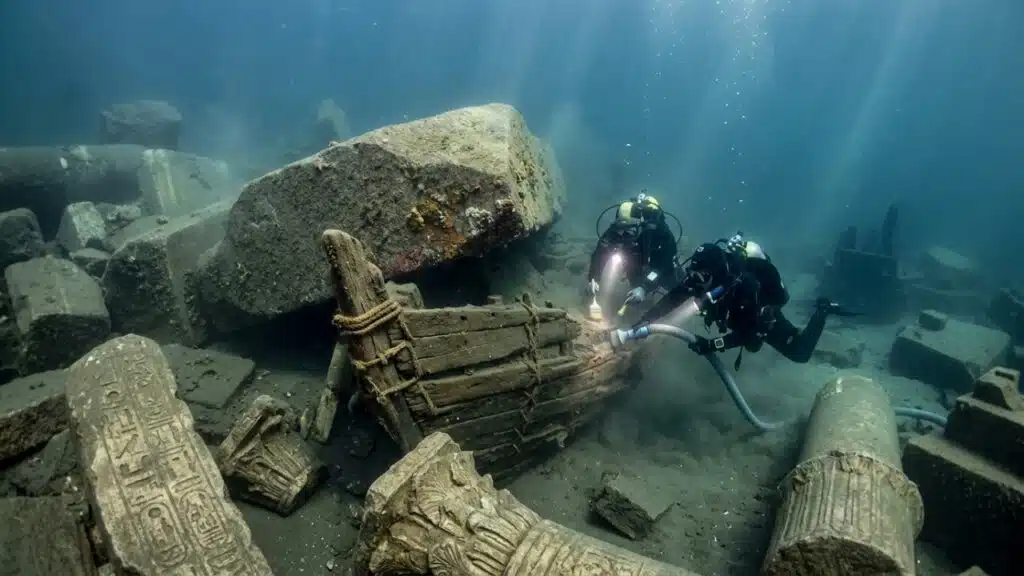
One of the most extraordinary individual discoveries from the sunken city of Egypt came from what lay beneath the temple itself rather than within it.
When Goddio’s team was excavating the collapsed blocks of the temple of Amun, they discovered that a massive stone block from the destroyed building had fallen directly onto a vessel moored alongside it, pinning the ship to the harbor floor and burying it under approximately sixteen feet of hard clay. The ship was an 80-foot military vessel dated to the second century BCE, built using the ancient sewn-plank technique, where planks were bound together with ropes rather than nails, a construction method that Egyptian and Mediterranean shipwrights had refined over thousands of years.
The vessel was found intact in a state of extraordinary preservation precisely because the collapsed temple block had sealed it. The same catastrophe that destroyed the city created the preservation conditions that kept the ship’s remains in recoverable condition two thousand years later. Franck Goddio noted in his statement about the discovery that finding intact remains of such ancient fast ships is very rare.
The military vessel at the sunken city of Egypt confirmed something that archaeology had suspected but not physically verified: Heracleion in the second century BCE was not just a commercial and religious center. It maintained military infrastructure, harbor defenses, and fast vessels capable of patrol and enforcement. This was a city with state power, not merely trade wealth.
The Night the Ground Became Liquid
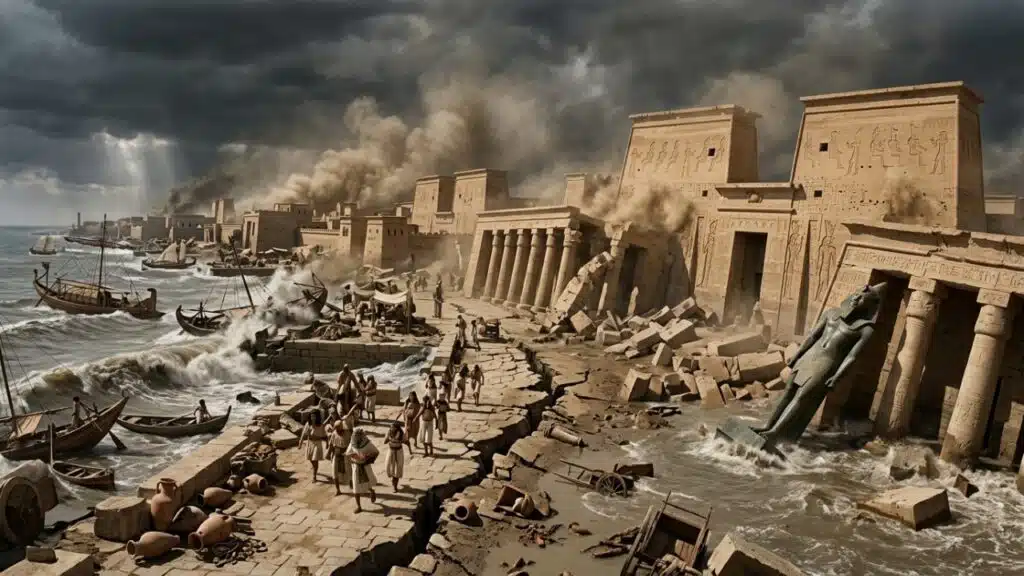
The question of how the sunken city of Egypt actually sank has been investigated with the same systematic rigor that Goddio applied to finding it, and the geological answer is as dramatic as anything recovered from the seafloor.
Thonis-Heracleion was built on the wrong kind of ground. The Nile Delta soils in the Aboukir Bay region are composed primarily of smectite clay, a geological material fundamentally different from the more stable clays found in other regions. Smectite clays undergo significant volume changes and rapid loss of structural cohesion when subjected to stress or changes in water content. Unlike solid rock or compacted sand, the ground beneath Heracleion was always, at a geological level, waiting for the wrong kind of pressure.
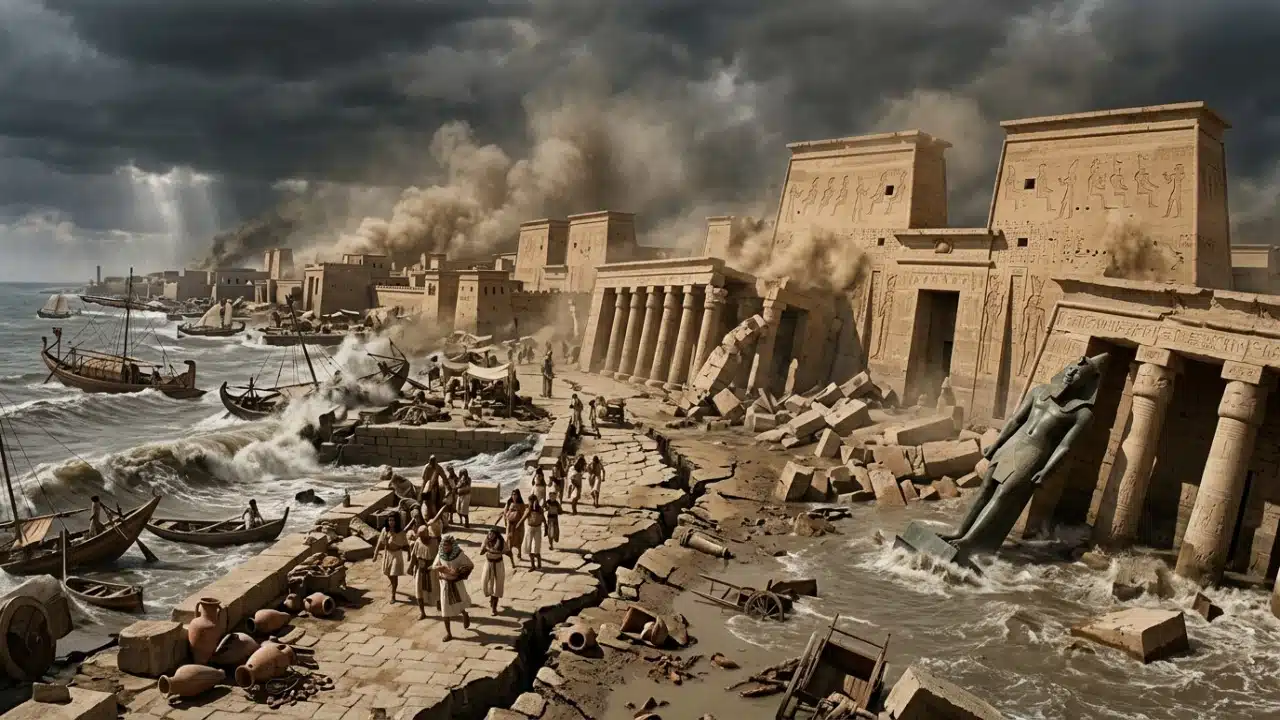
Around 150 BCE, that pressure arrived. A massive earthquake struck the region. The shaking caused the saturated smectite clay beneath the city to undergo soil liquefaction, a process in which saturated soil loses its structural integrity entirely and begins to behave like liquid. Buildings that had stood for centuries on what appeared to be solid ground suddenly had no ground beneath them. They sank, tilted, and collapsed as the earth itself gave way. A tsunami followed the earthquake, pushing seawater over the weakened city and completing the destruction that the liquefaction had begun.
Research by the IEAS, M working with the Smithsonian Institution and Stanford University, ty confirmed these geological processes through geoarchaeological analysis of the underlying sediment. The hard clay that divers excavate today at the sunken city of Egypt is the re-consolidated remnant of the liquefied soil that swallowed the city in the second century BCE. The city did not flood. It sank. And then the ground around it solidified again, sealing the ruins in a case of compressed clay that preserved them for twelve hundred years.
A second major earthquake in the eighth century CE completed the destruction of whatever structures had survived the first collapse. By then, the sunken city of Egypt had already been under the sea for nearly a thousand years, and the world above had long since forgotten it was there.
The Mysteries of Osiris Beneath the Waves
One of the most religiously significant aspects of the sunken city of Egypt has emerged gradually from the ritual objects recovered by Goddio’s excavations: Heracleion was the primary location for the annual Mysteries of Osiris.
The Mysteries of Osiris were the most important religious festival in the Egyptian calendar during the Late and Ptolemaic periods. Held each year during the month of Khoiak, the festival commemorated the death and resurrection of Osiris, the god of the afterlife whose myth underpinned Egyptian beliefs about death, renewal, and the eternal cycle of existence. The ritual involved the ceremonial burial and resurrection of small figurines of Osiris, the Osirian barques, which were carried in procession and then symbolically returned to the earth and the water.
Goddio’s team has recovered dozens of these miniature ceremonial barques from the seafloor of the sunken city of Egypt, along with ritual objects directly associated with the Mysteries. The evidence confirms that Heracleion was not merely a backdrop for the festival but the active ritual center where the most sacred elements of the ceremony took place.
The discovery that an entire cycle of Egypt’s most important religious festival was centered on the sunken city of Egypt transforms how historians understand Heracleion’s place in the ancient world. This was not a commercial city that happened to have temples. It was a sacred city that happened to control trade. The religious economy it generated through the annual Mysteries drew pilgrims, priests, and offerings from across the Mediterranean world, and the combination of sacred authority and commercial control made it, in the centuries before Alexandria, the most strategically important city on the Egyptian coast.
Only 5% excavated
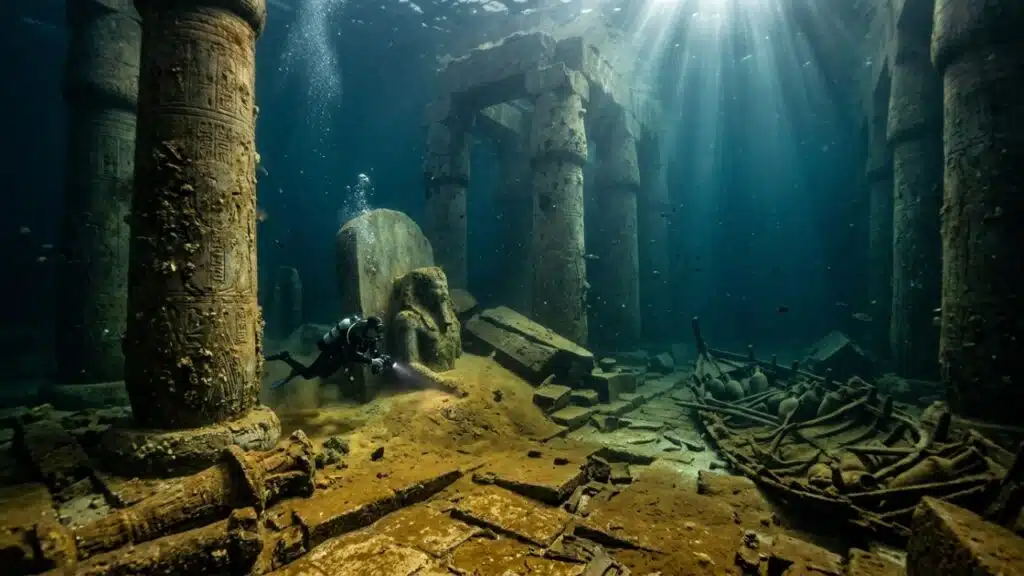
The most important number associated with the sunken city of Egypt is not the depth at which it lies, not the size of the statues recovered from its harbor, not the age of the military vessel pinned beneath the temple block.
It is five percent.
Franck Goddio estimates that only five percent of the ancient city of Thonis-Heracleion has been excavated since he found it in 2000. Twenty-five years of annual excavation missions, each yielding discoveries of extraordinary quality and significance, have covered one twentieth of the site. The remaining ninety-five percent of the sunken city of Egypt lies sealed in the hard clay of Aboukir Bay, waiting.
The 2024 to 2025 excavation season, described in reports from both the Hilti Foundation and academic publications as among the most prolific in the site’s excavation history, focused on the southern canal area and the surroundings of the temple of Amun. It produced new artifacts from around the main temple and provided additional confirmation of the city’s extraordinary state of preservation.
What lies in the areas not yet touched is, by definition, unknown. The military vessel buried under the temple block was found by accident when excavating the collapsed stone. The Aphrodite sanctuary was discovered during work focused on a different part of the site. Every excavation season at the sunken city of Egypt has produced at least one discovery that nobody expected because nobody knew it was there.
The city that vanished into mythology and stayed beneath the sea for twelve centuries is giving back its secrets at a rate determined not by what it contains but by the annual capacity of an underwater excavation team working at thirty to fifty feet of depth in Egyptian coastal waters.
At the current pace, the sunken city of Egypt will be revealing its discoveries well into the twenty-second century.
Conclusion: The City That Time Preserved
The sunken city of Egypt called Thonis-Heracleion is the most perfectly preserved ancient urban site on earth, sealed in its catastrophe before the world could reach it, protected by the same water that drowned it, and yielding its contents now to archaeologists equipped with technology its builders could not have imagined.
It was the gateway to Egypt for a thousand years. It was the place where pharaohs became gods and where the greatest religious festival in the Egyptian calendar found its spiritual heart. It controlled the most important trade route in the ancient Mediterranean and generated wealth that made it indispensable to two empires simultaneously.
And then the ground beneath it became liquid, and in the space of what ancient texts describe as a single catastrophic event, the sunken city of Egypt fell below the surface of the sea and stayed there.
What Franck Goddio found in Aboukir Bay in 2000 was not a ruin. It was a world in suspension, waiting for the tools and the knowledge and the will to lift it, object by object, statue by statue, ship by ship, back into the light.
Ninety-five percent of it is still waiting.
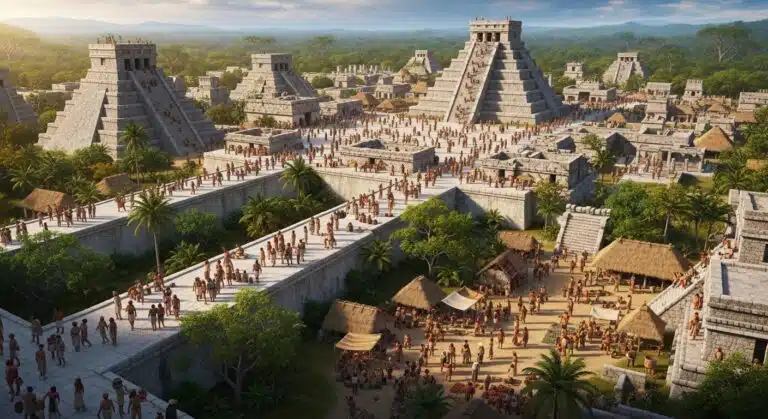
Discover a Hidden Maya City
Deep in Mexico’s jungle, LiDAR has revealed a massive lost city of 30,000 people—reshaping everything we know about Maya civilisation.
In 2024, a team of archaeologists made a discovery that could change everything: they found a lost city beneath the pyramids.
Click below to watch the full story:
https://www.youtube.com/@EchoesofAntiquity-egypt/videos
Sources
- Hilti Foundation / IEASM — “Sunken Secrets: New Discoveries by Goddio at Thonis-Heracleion” (August 13, 2025) — hiltifoundation.org
- Franck Goddio Official Site — “Thonis-Heracleion: Sunken Civilizations” — franckgoddio.org
- Franck Goddio Official Site — “Why Did the Cities Disappear? Soil Liquefaction Research with Smithsonian and Stanford” — franckgoddio.org
- Smithsonian Magazine — “Divers Discover Ancient Military Vessel in Submerged Egyptian City” (July 2021) — smithsonianmag.com
- Art News — “Archaeologists Make New Discoveries at Ancient Temple in Sunken City off Egypt’s Coast” (September 2023) — artnews.com
- History.com — “5 Ancient Cities That Are Now Underwater: Thonis-Heracleion” (Updated June 2025) — history.com
- Greek Reporter — “Underwater City of Heracleion, Egypt, and Its Links to Ancient Greece” (February 2024) — greekreporter.com
- Ancient Origins — “Finding the Lost City of Heracleion: Encountering Myth Under the Waves” — ancient-origins.net
- CRV Science — “Stratigraphy of a Sunken City on the Nile: Thonis-Heracleion” (November 2025) — crvscience.com
- Coffee or Die — “Multiple Disasters Sank This Ancient Egyptian Port City” — coffeeordie.com
- Bastet Travel — “Heracleion: The Lost City of Thonis-Heracleion Beneath the Sea” (May 2026) — bastettravel.com
- Wikipedia — “Heracleion” — en.wikipedia.org
- Wikipedia — “Franck Goddio” — en.wikipedia.org
- Nutters World — “New Discoveries at Ancient Sunken City of Thonis-Heracleion” (May 2025) — nuttersworld.com