

El Dorado City of Gold: The Deadly Obsession That Killed Thousands
A Ritual That Became a Ruin
Somewhere in the Andes, at roughly 9,000 feet above sea level, a lake sits inside an ancient volcanic crater. Its water is dark. The air around it is thin and cold. The Muisca people of what is now Colombia called it Guatavita, and they considered it sacred in a way that had nothing to do with material wealth.
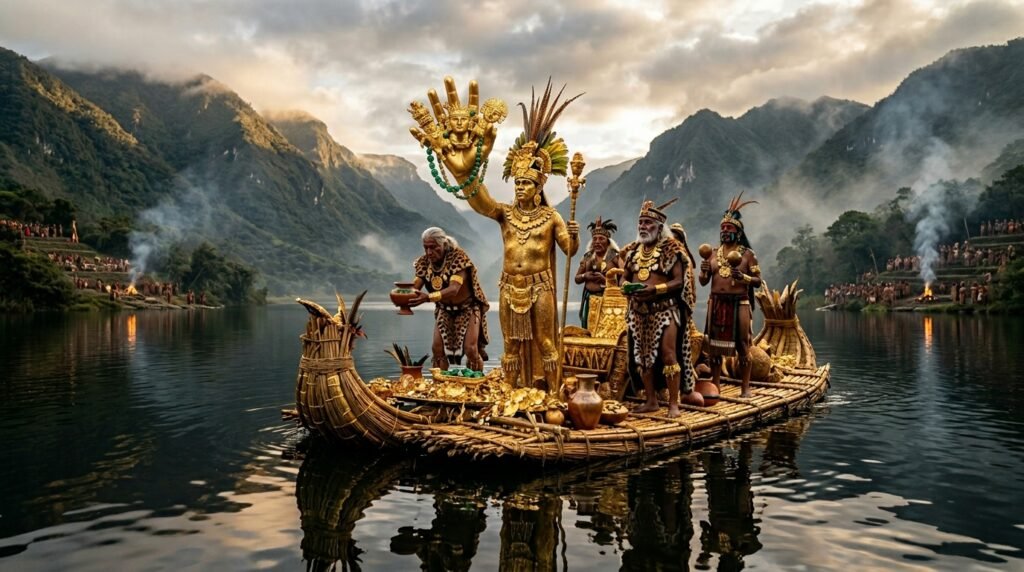
Once, when a new king rose to power, priests would coat his naked body in resin and then cover him, head to toe, in fine gold dust. He would step onto a raft surrounded by attendants carrying gold offerings. The raft would move to the center of the lake. The king would dive in. The gold washed from his body into the water. His attendants threw jewels and golden objects into the darkness below.
It was a prayer. An act of devotion. A king surrendering gold to the gods who gave it meaning.
The Spanish conquistadors saw it differently.
They called the golden king El Dorado, meaning “the gilded one,” and then spent the next two centuries destroying themselves trying to find the city of gold they were certain he was hiding somewhere in the jungle.
The legend of the El Dorado city of gold is not a story about a lost place. It is a story about what happens when one culture’s sacred ritual enters the imagination of another culture’s greed, and what that greed costs everyone involved.
Quick Answer: El Dorado City of Gold
Did the El Dorado city of gold ever exist? No. The El Dorado city of gold never existed as a physical location. The legend began as a misinterpretation of a real Muisca coronation ceremony involving a king covered in gold dust at Lake Guatavita in present-day Colombia. Over time, the story evolved from a golden man to a golden city, then to a golden kingdom, and finally to an entire golden empire, growing more elaborate with each retelling.
Where did the El Dorado city of gold legend come from? The origin of the El Dorado city of gold legend traces to the Muisca people of the Colombian Andes, whose new rulers underwent a coronation ritual at Lake Guatavita. The first written Spanish record of El Dorado appears in historian Gonzalo Fernández de Oviedo’s writings around 1541, describing “a great lord or monarch who constantly goes about covered in gold as fine as ground salt.”
What is the Muisca raft, and how does it connect to El Dorado? The Muisca raft is a gold alloy artifact measuring 19.5 cm long, discovered in 1969 in a cave near Pasca, Colombia, and dated to between 1295 and 1410 AD. It depicts the coronation ceremony at Lake Guatavita, showing a chief standing on a raft surrounded by attendants and priests. It is now the centerpiece of the Gold Museum in Bogotá and is considered strong evidence that the ritual behind the El Dorado city of gold legend was real, even if the city itself never was.
Who died searching for El Dorado? Dozens of expeditions ended in mass death. Gonzalo Jiménez de Quesada’s 1536 expedition of 900 men left only 156 alive. Gonzalo Pizarro’s 1541 expedition of several hundred conquistadors and 4,000 native servants ended in catastrophe. Sir Walter Raleigh lost his son on his 1617 expedition, lost his trusted commander to suicide, and was beheaded by King James I in 1618. The El Dorado city of gold became one of history’s most deadly myths.
The Spanish Misread
Before tracing the destruction the El Dorado city of gold legend left behind, it is worth understanding what the Muisca were actually doing at Lake Guatavita, because the gap between what it was and what the Spanish believed it to be is where all the tragedy begins.
The Muisca inhabited the Altiplano Cundiboyacense, a high plateau in modern Colombia, from roughly 600 CE to 1600 CE. They were skilled goldsmiths who made frequent use of golden objects in their religious ceremonies and manufactured ornaments and jewelry for trade with neighboring tribes. But here is the detail that every El Dorado story tends to skip: the Muisca territory was not gold-producing. The Muisca had an economy built on salt, which they traded with neighboring tribes. Their territory was not El Dorado, the Golden, but El Salado, the Salty.
The gold they threw into Lake Guatavita was not their surplus. It was their sacrifice. In Muisca mythology, the mother goddess Bachué was said to have emerged from a lake before peopling the earth and then returned to the water in the form of a serpent. Guatavita was one of several sacred lakes found within the Muisca territory, and gold, emeralds, and other objects were deposited at the lakeside as sacrificial offerings.
To throw gold into the lake was to return something precious to the divine. It was an act of faith, not waste. The Muisca were not advertising wealth. They were demonstrating reverence.
When the Spanish arrived and interrogated captured chiefs about the ritual, they heard exactly what they wanted to hear. A king covered in gold. Treasures thrown into the water. A sacred lake holding centuries of offerings at its bottom. They filtered all of it through the lens of European gold hunger, stripped away every spiritual dimension, and concluded that somewhere nearby there must be an inexhaustible mine, a city, a kingdom, built from the metal these people were casually tossing into lakes.
The El Dorado city of gold was born not from indigenous imagination but from Spanish misreading of a ceremony they never fully understood.
The Myth Grows Legs: How a King Became a Kingdom
The word El Dorado first circulated among Spanish settlers in Quito in the early 1540s. By then, Francisco Pizarro had already destroyed the Inca Empire, and the message sent across the continent was clear: there was gold in South America in quantities the European world could barely imagine.
The first recorded written account of El Dorado appears in the writings of conquistador Gonzalo Fernández de Oviedo, describing “a great lord or monarch who constantly goes about covered in gold as fine as ground salt… for it is his opinion that to wear any other adornment is less beautifying… but to powder one’s self with gold is an extraordinary thing, unusual and new and more costly.”
That description is of a man. A ceremony. A ritual practice.
But by the time different Spanish sources began writing about the same legend, something remarkable had already happened. Gonzalo Pizarro described El Dorado as a lake. A third contemporary source, the chronicler Pedro de Cieza de León, describing the very same expedition, writes of El Dorado as a valley.
Within two decades of the first written mention, the El Dorado city of gold had already become whatever each person needed it to be. A man. A lake. A valley. A kingdom. A city. The legend was shapeshifting in real time, growing more elaborate and more geographically vague with every expedition that failed to find it, because a legend that cannot be disproved by failure is a legend that never dies.
The legends surrounding El Dorado changed over time, as it went from being a man, to a city, to a kingdom, and then finally to an empire.
Each transformation moved it further from the Lake Guatavita ceremony that had started it all, and further into the realm of pure fantasy, which made it simultaneously more powerful and more dangerous as a motivator for exploration.
The Men Who Died Chasing It
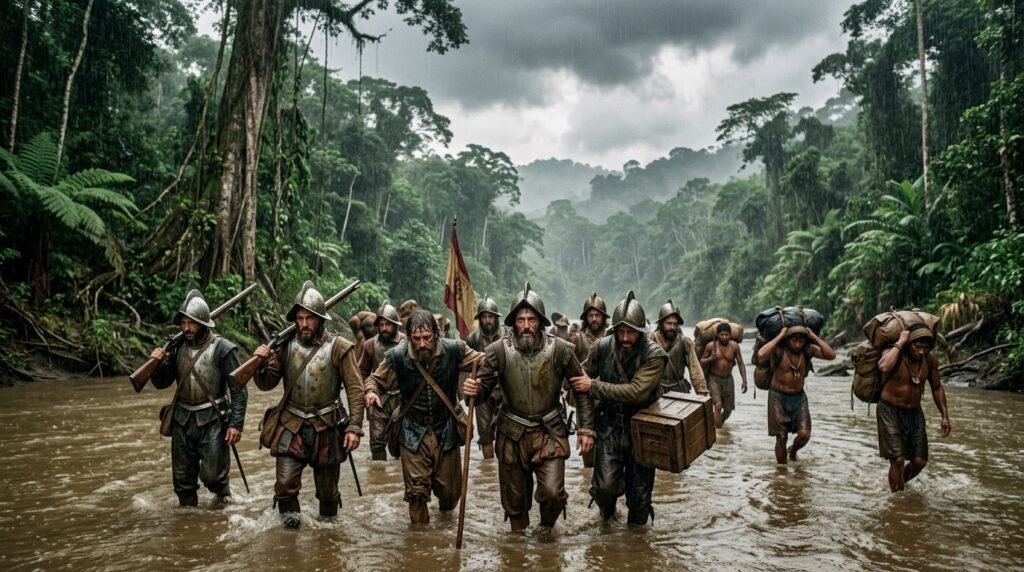
The El Dorado city of gold was not merely a story. It was a sentence. Every expedition it inspired came at a price measured in human lives, and the toll was staggering.
In 1536, Gonzalo Jiménez de Quesada departed from Santa Marta on Colombia’s coast with 900 men, cutting through jungle and mountains toward what he believed was Muisca territory and the source of the legend. Only 156 survived the initial foray. They did find the Muisca. They conquered them, looted their temples and palaces of gold, and were intensely disappointed to discover that these people were not awash in treasure as they had been led to believe. The real El Dorado, they concluded, must be somewhere else. The search continued.
In February 1541, Gonzalo Pizarro set out from Quito with several hundred conquistadors and 4,000 native servants. The expedition proved fatal to the majority of the 4,000 accompanying men, who died from starvation, disease, and attacks from natives. What the expedition did produce, unexpectedly, was Francisco de Orellana’s journey down the entire length of the Amazon River, the first European to do so, as he broke off from the main party in search of food and never returned.
The El Dorado city of gold had sent a man down the Amazon without intending to.
Then came Lope de Aguirre, whose pursuit of the El Dorado city of gold in 1560 ended not in discovery but in documented madness. Aguirre began executing his own men during the expedition, declared himself the wrath of God, murdered his own daughter to prevent her capture, and was finally killed in Venezuela in 1561. He had found nothing. He had destroyed everything around him in the process.
Walter Raleigh: The Man in the Legend Executed
Of all the lives the El Dorado city of gold consumed, none tells the story more completely than that of Sir Walter Raleigh.
Raleigh was one of the most celebrated men in Elizabethan England. Courtier, soldier, poet, explorer. In 1594, he came into possession of a Spanish account describing a great golden city at the headwaters of the Caroní River in what is now Venezuela, and the El Dorado city of gold lodged itself in his imagination in a way it never left.
His first expedition in 1595 took him 400 miles up the Orinoco River into the Guiana highlands. He found no city. He returned to England and published an account of the voyage, titled “The Discovery of the Rich and Beautiful Empire of Guiana,” that stretched what he had actually found well beyond the evidence. He needed the legend to remain credible if he was ever to secure funding for a second attempt.
During his second trip in 1617, Raleigh sent his son, Watt Raleigh, with an expedition up the Orinoco River. But Walter Raleigh, then an old man, stayed behind at a base camp on the island of Trinidad. The expedition was a disaster, and Watt Raleigh was killed in a battle with the Spaniards.
Kemys informed Raleigh of his son’s death and begged for forgiveness, but did not receive it, and at once committed suicide.
Raleigh returned to England without gold, without his son, and without his most trusted commander. Upon Raleigh’s return to England, the Spanish ambassador demanded that he be put to death. Raleigh was arrested and imprisoned for a third time before his life was ended by the headsman’s axe on October 29, 1618. He was about 65 years old.
The El Dorado city of gold had taken everything from him. His son. His advisor. His freedom. His head.
The Lake They Tried to Empty
While explorers were dying in the jungles of South America, a parallel obsession was consuming the lake at the center of everything: Guatavita itself.
In 1545, conquistadors Lázaro Fonte and Hernán Pérez de Quesada made the first serious attempt to drain Lake Guatavita. They worked for three months, with workers forming a bucket chain, but were unable to drain the lake sufficiently to reach any treasures deep within. They did find gold along its shores, fueling their suspicion that the lake contained a treasure of riches. That small finding was enough to keep the obsession alive for centuries.
In 1580, Antonio de Sepúlveda cut a massive notch in the crater rim to lower the water level. His effort killed several laborers. He found some gold objects, which were sent to King Philip II of Spain. The central depths of the lake remained untouched.
The most ambitious and destructive attempt came later, when a British contractor named Harvey Knowles established a company whose name left no ambiguity about its purpose: The Company for the Exploitation of the Lagoon of Guatavita. By 1898, this company had drilled a 400-meter tunnel from the middle of the lake, using a steam pump to drain it. They did recover artifacts, eventually auctioned at Sotheby’s in London, sand ome were donated to the British Museum. The mud at the bottom hardened before anything significant could be retrieved.
Colombia placed Lake Guatavita under legal protection in 1965. The lake cannot be touched. Whatever remains at its bottom will stay there.
In a sense, the Muisca king who dove into that water and gave his gold to the gods may have made the most effective protection plan anyone could have designed. The lake is protected now precisely because of the legend of the El Dorado city of gold, and the artifacts at its bottom remain offerings, undisturbed, as they were always meant to be.
The Proof That Was There All Along
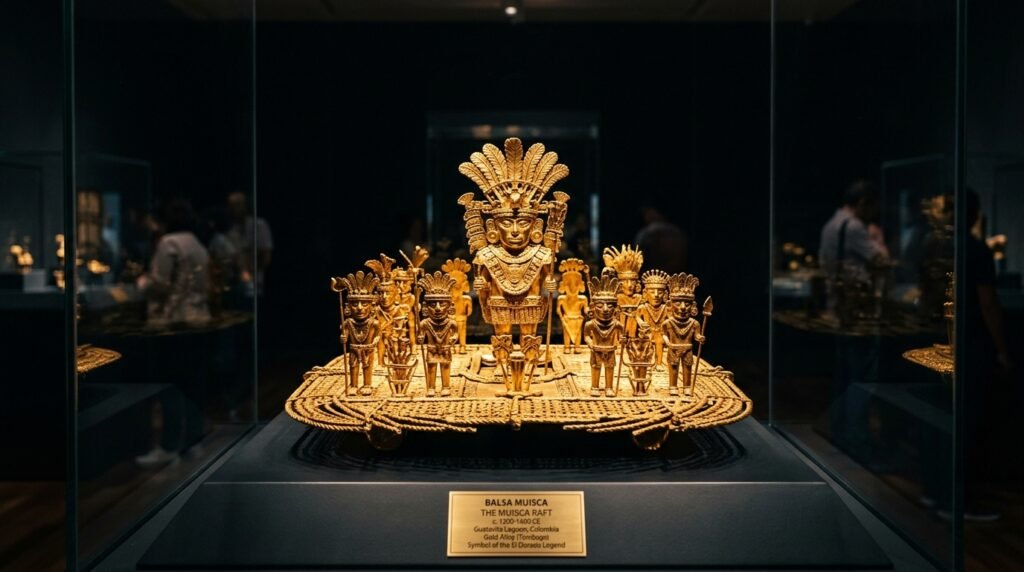
In 1969, three farmers in the Colombian countryside near Pasca found a ceramic pot hidden in a small cave. Inside was a gold object small enough to hold in both hands.
The Muisca raft measures only 4.02 inches wide, 3.98 inches high, and 7.68 inches deep. The sculpture features ten figures on a bamboo raft. The central and largest figure is the chief. He is surrounded by two medium-sized priests in the front, and then seven small attendants throughout. The chief wears dangling adornments on his headdress and a huge nose ring. At the bow of the raft are two priests holding jaguar masks in front of their faces.
The raft depicts, in extraordinary detail, exactly the ceremony that the Spanish had described in their reports 400 years earlier. A king on a raft. Attendants carrying offerings. The procession toward the center of a sacred lake.
In 1969, researchers discovered the small gold artifact that brought the El Dorado legend to life. The Muisca raft is a gold model, about 10 centimeters long, depicting the golden ceremony in remarkable detail. It confirms many details from Spanish accounts and proves the ceremony was real, not just European fantasy.
The artifact was created between 1295 and 1410 AD using the lost-wax casting technique, from a gold-copper alloy called tumbaga. Very few golden Muisca items survive because they were melted for bulk gold to ship home by the Spanish conquistadors. This one survived because someone hid it in a cave, far from the roads the conquistadors traveled, and the earth kept it safe for five and a half centuries.
The proof of the El Dorado city of gold legend’s real origin was not in the jungle. It was not at the bottom of a lake. It was in a ceramic pot in a cave, waiting for someone to stop looking for cities of gold long enough to find the truth.
Conclusion: The City That Was Never There
The El Dorado city of gold does not exist and never did. The gold was real. The ceremony was real. The sacrifice and devotion behind it were real. The misinterpretation was catastrophic, and the obsession it produced was deadly on a scale that makes it one of the most consequential legends in the history of exploration.
Hundreds of thousands of people lost their lives in the jungles of South America chasing a city that was never built. Entire indigenous civilizations were disrupted, looted, and enslaved by men who were certain that gold on this scale could only mean one thing. The Muisca knew what gold meant: connection to the sacred, an offering to the divine, something valuable precisely because it was given away.
The El Dorado city of gold teaches something about the nature of obsession that has not grown less relevant in the centuries since Raleigh put his head on the block. We see what we want to see in the evidence before us. We mistake other people’s sacred acts for invitations to our own greed. We keep searching for cities that were never there, past the point where reason would have told us to stop, until the legend itself extracts its price.
The Muisca raft sits in Bogotá’s Gold Museum, barely larger than a book. It has never left Colombia. It measures 10.2 centimeters wide. It weighs 287 grams.
It is worth more than any city of gold ever was.
Discover a Hidden Maya City
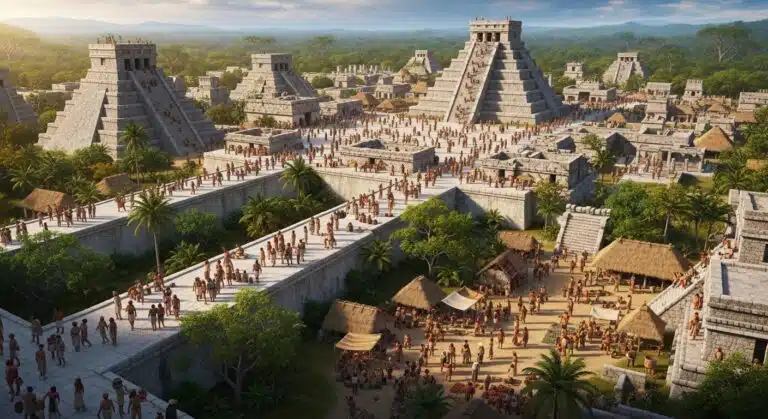
Deep in Mexico’s jungle, LiDAR has revealed a massive lost city of 30,000 people—reshaping everything we know about Maya civilisation.
In 2024, a team of archaeologists made a discovery that could change everything: they found a lost city beneath the pyramids.




Nice