
Sodom and Gomorrah History: 7 Shocking Archaeological Truths
The Fire That Never Stopped Burning
The story is three thousand years old, and it still makes people argue.
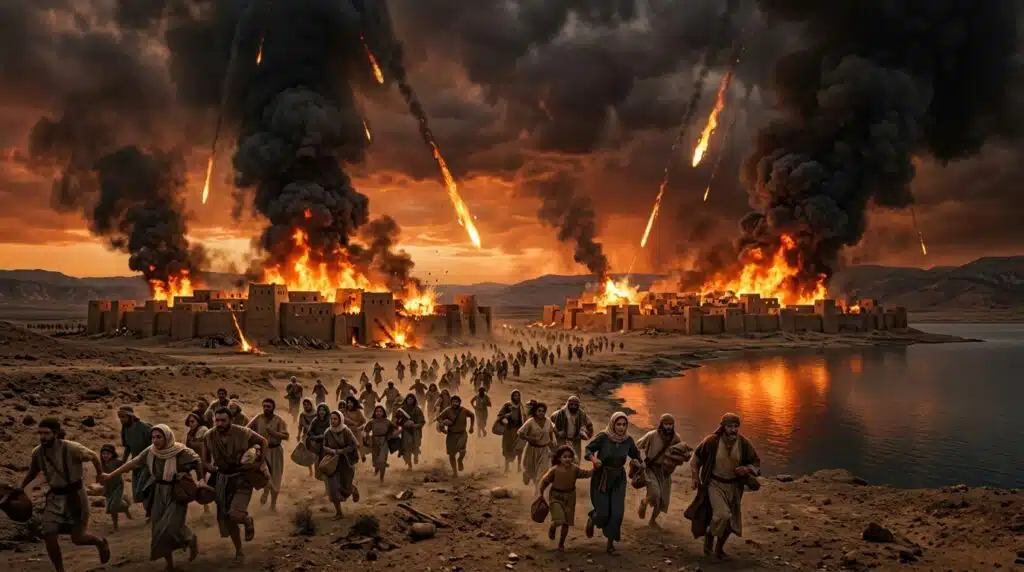
Two cities on a fertile plain. A people who had turned away from everything sacred. A God who rained fire and sulfur from the sky in a single catastrophic night, leaving behind nothing but salt and ash and a pillar of salt where a woman used to be.
For most of recorded history, Sodom andGomorrah’sh history was treated as exactly what it appeared to be: scripture, not archaeology. A moral warning dressed in the clothes of catastrophe. The kind of story that nations tell themselves about the price of wickedness.
Then archaeologists started digging along the Dead Sea. And something unexpected kept coming out of the ground.
Not proof. Not the biblical cities themselves, neatly labeled and preserved. But fire. Destruction layers. Charred houses burned from the roof down. Melted pottery. Entire city networks abandoned simultaneously and never rebuilt. And one explosive 2021 study that claimed to have found the fingerprints of a cosmic airburst, only for that study to be formally retracted in April 2025 under the scrutiny of the global scientific community.
Sodom and Gomorrah history is not a closed case. It is one of the most contested, most electrifying, and most consequential archaeological debates of the modern era. Here is what the evidence actually shows.
AEO Quick Answer: Sodom and Gomorrah History
Did Sodom and Gomorrah actually exist? No confirmed archaeological identification of the biblical cities of Sodom and Gomorrah has been universally accepted by the scholarly community. However, Sodom and Gomorrah history is supported by real archaeological evidence at multiple Dead Sea sites. Bab edh-Dhra and Numeira on the southeastern shore of the Dead Sea show evidence of catastrophic Bronze Age destruction by fire. Tall el-Hammam in the Jordan Valley northeast of the Dead Sea contains a dramatic destruction layer, though a 2021 study claiming a cosmic airburst destroyed it was formally retracted by Scientific Reports in April 2025.
Where are Sodom and Gomorrah believed to have been? Two main theories dominate Sodom and Gomorrah history research. The first places the cities on the southeastern shore of the Dead Sea, at Bab edh-Dhra and Numeira, based on Early Bronze Age destruction evidence and proximity to the ancient city of Zoar. The second identifies Tall el-Hammam in the southern Jordan Valley as the more probable Sodom, due to its size, Middle Bronze Age timeline, and catastrophic destruction layer. Each theory has significant supporting and conflicting evidence.
What caused the destruction recorded in Sodom and Gomorrah history? Multiple mechanisms have been proposed, including earthquake and fire, bitumen and sulfur ignition from natural geological activity in the Dead Sea region, and a cosmic airburst event. The cosmic airburst hypothesis for Tall el-Hammam was initially published in Scientific Reports in 2021 but was formally retracted in April 2025 after the impact cratering community concluded the mineralogical and geochemical evidence did not meet the accepted standards for confirming an extraterrestrial impact.
What is Bab edh-Dhra? Bab edh-Dhra is an Early Bronze Age site on the southeastern shore of the Dead Sea, identified by many researchers as the strongest candidate for the biblical city of Sodom. Excavations revealed a cemetery containing hundreds of thousands of graves, charnel houses burned from the roof downward, and a destruction layer roughly three feet thick. The site was destroyed by fire and never reoccupied, matching key elements of Sodom and Gomorrah history as described in Genesis.
The Cities That History Says Were There
Before addressing what archaeology has found, it is worth establishing what Sodom and Gomorrah history claims to record.
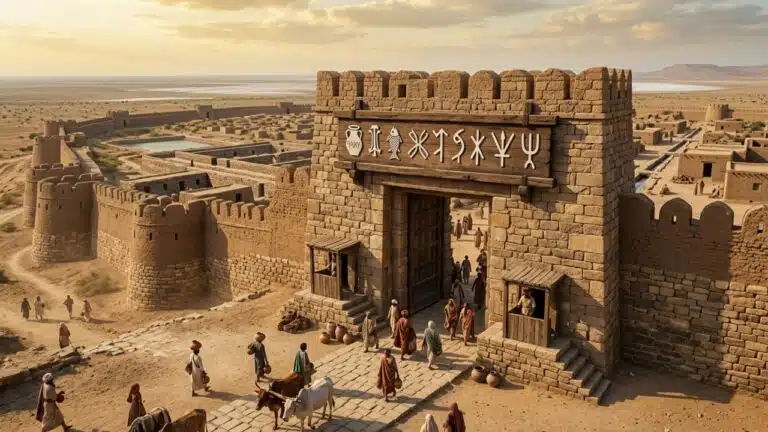
Genesis describes five cities on a fertile plain near the Dead Sea: Sodom, Gomorrah, Admah, Zeboiim, and Zoar, collectively referred to as the Cities of the Plain. Genesis 13:10 describes Lot looking out at the Jordan River valley before the destruction as “well watered everywhere, like the garden of the Lord.” These cities were fortified, prosperous, and densely settled enough to field armies in the regional power struggles described in Genesis 14.
Then, in Genesis 19, the destruction comes. Fire and burning sulfur fall from the sky. Every inhabitant and every living thing in the plain is killed. The cities themselves are turned to ash. Lot and his two daughters escape. Lot’s wife, looking back, becomes a pillar of salt.
What makes Sodom and Gomorrah history so compelling to archaeologists is the specificity of the biblical geography. The text places the cities northeast of the modern Negev, south or east of ancient Canaan, within a day’s walk of Zoar, and in a plain visible from the highlands of Bethel. These are not vague mythological coordinates. They are navigable. And they have been navigated, by researchers carrying trowels and ground-penetrating radar, for decades.
The Southern Candidate: Bab edh-Dhra and Numeira
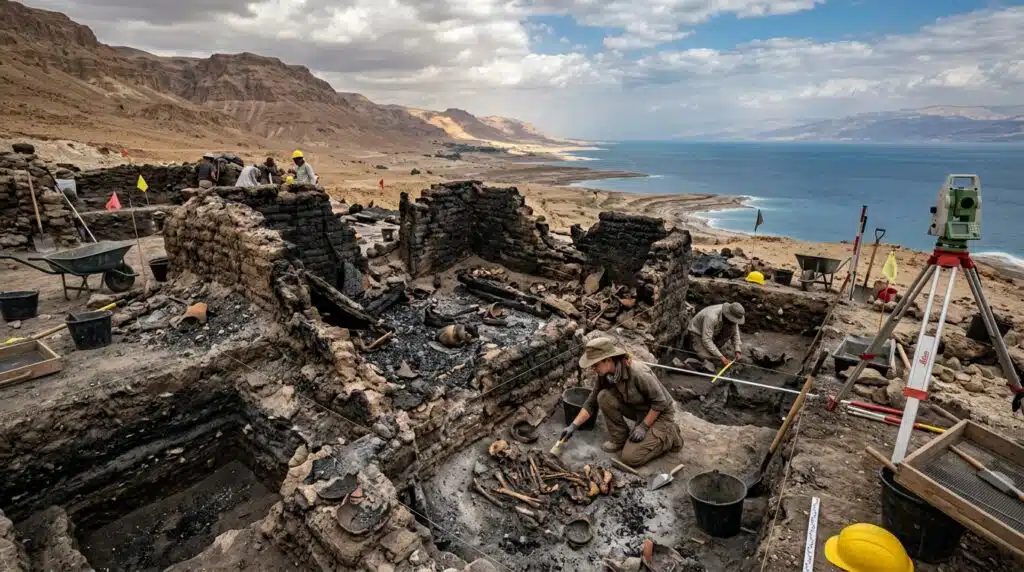
The first serious modern evidence connected to Sodom and Gomorrah history emerged in 1973, when archaeologists excavating on the southeastern shore of the Dead Sea encountered something unexpected.
At Bab edh-Dhra, the largest known settlement in the region during the Early Bronze Age, they found a cemetery. Not an ordinary cemetery. A vast burial complex containing an estimated half million remains, interred in charnel houses built above ground across the landscape. And when they examined those charnel houses, they found something that has never been adequately explained through conventional means.
Every structure had been burned from the roof down. Fire had started at the top of each building and burned inward and downward, consuming the interiors. The destruction was total, consistent, and uniform across the entire site.
As archaeologist Dr. Titus Kennedy noted in research presented through the Discovery Institute in 2025, this pattern hints that the destruction came from above and was not deliberately set from within the tombs. The only explanation that accounts for fire consistently starting on the roofs of widely separated structures across an entire site is that burning material fell from the sky.
The destruction layer at Bab edh-Dhra is roughly three feet thick. The site was occupied continuously through the Early Bronze Age and then abandoned entirely. It was never rebuilt.
Approximately 20 kilometers south, the site of Numeira presents a companion narrative. Numeira contained large storage pits that were found empty, suggesting residents grabbed food and fled before the disaster struck. Human skeletons were found lying exposed beneath a collapsed tower, not interred but simply present, killed where they stood. Like Bab edh-Dhra, Numeira was destroyed by fire and never reoccupied.
The linguistic resemblance between the name Numeira and the name Gomorrah has not been lost on researchers, though name connections in ancient Semitic languages require careful handling before they can be treated as evidence.
There is, however, a significant problem with the Bab edh-Dhra identification in Sodom and Gomorrah history. The destruction of Bab edh-Dhra is typically dated to approximately 2300 BC. The biblical chronology places the destruction of Sodom and Gomorrah later, closer to the Middle Bronze Age period. That gap of roughly two hundred years is not a minor discrepancy. The excavators of Bab edh-Dhra themselves recognized this, proposing the site as the basis for an origin of the Sodom and Gomorrah story rather than as direct evidence of the events described in Genesis.
The Northern Candidate: Tall el-Hammam
The second major candidate in Sodom and Gomorrah history has generated significantly more controversy, and as of 2025, significantly more scientific drama.
Tall el-Hammam sits in the southern Jordan Valley, northeast of the Dead Sea. It is one of the largest Bronze Age sites in the entire southern Levant, with an enormous lower city covering roughly 36 hectares and an upper city containing a substantial palace complex. Its size alone has made it a compelling candidate for the most prominent of the Cities of the Plain.
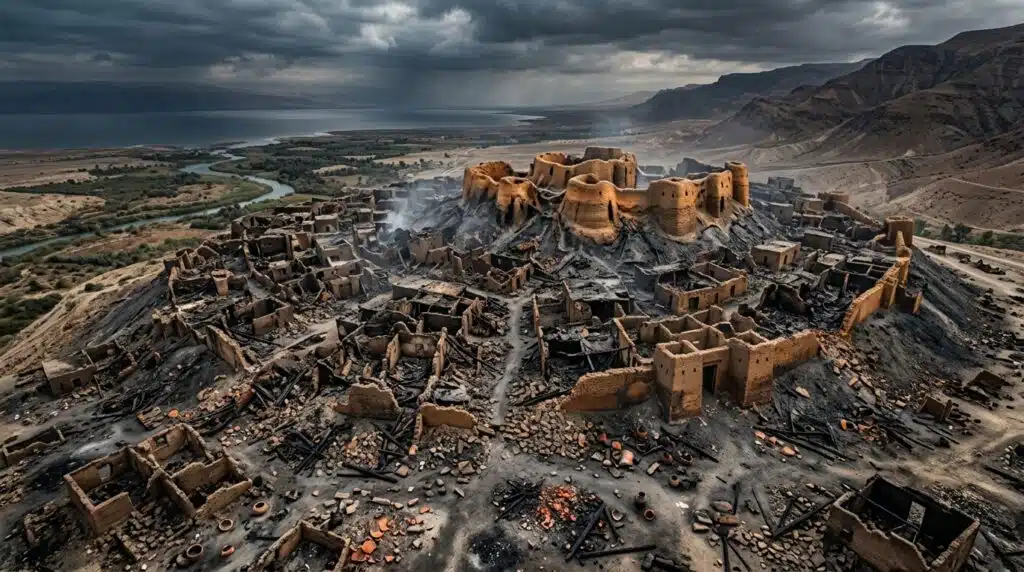
Excavations led by Dr. Steven Collins of Trinity Southwest University, beginning in 2005, uncovered something in the Middle Bronze Age destruction layer that stopped the team in its tracks. Pottery with surfaces that had been melted at extraordinarily high temperatures. Mudbrick fragments fused into glass. A destruction layer a meter and a half thick, running across the entire site, containing ash, carbon, melted building materials, and micro-spherules consistent with extreme heat events.
In September 2021, a research team led by Ted Bunch published a paper in Scientific Reports claiming that this destruction was caused by a cosmic airburst, a meteor or comet fragment that exploded in the atmosphere above the city around 1650 BCE, releasing energy estimated to be greater than the 1908 Tunguska event in Siberia. The paper reported temperatures exceeding 2000 degrees Celsius at the site, the presence of shocked quartz, diamond-like carbon, and melted platinum, iridium, and gold, materials that cannot be produced by ordinary fires or warfare.
The paper made global headlines. Sodom and Gomorrah history suddenly had what appeared to be a scientific mechanism. A fireball from the sky, devastating everything below it in an instant, salt deposits covering the plain, a city abandoned for six hundred years. The biblical narrative and the physics seemed, for a moment, to align.
That moment ended in April 2025.
The Retraction That Changed Everything
On April 24, 2025, Scientific Reports published a formal retraction of the Tall el-Hammam airburst paper.
The retraction note stated plainly that the claims about an airburst event destroying the Middle Bronze Age city of Tall el-Hammam appear not to be sufficiently supported by the data in the Article, and that the Editors no longer have confidence that the conclusions presented are reliable.
The specific challenge came from the impact cratering community, which holds that mineralogical and geochemical evidence are the only kinds of evidence that can provide uniquely diagnostic confirmation of an extraterrestrial impact or airburst event. A 2022 counter-study published in the same journal by S.J. Jaret and R. Scott Harris found no mineralogical or geochemical evidence of impact at Tall el-Hammam, directly challenging the Bunch team’s interpretation of the shocked quartz and other materials.
This is how science is supposed to work. A claim is made, challenged, examined, and either confirmed or withdrawn. In the case of Sodom and Gomorrah history, the 2021 study was withdrawn.
What remains at Tall el-Hammam is still remarkable. A genuine catastrophic destruction event occurred there around 1650 BCE. The city was destroyed suddenly and violently. All 16 major settled sites in the southern Jordan Valley appear to have been abandoned at approximately the same time. Jericho was not resettled until roughly 300 years later. Tall el-Hammam itself was not reoccupied for approximately 600 years.
The cause of that destruction is now, once again, an open question within Sodom and Gomorrah history. Earthquake, warfare, conventional fire, geological activity in a region known for bitumen and sulfur deposits, and the lingering possibility of some extraterrestrial event that left less detectable evidence than the retracted study claimed are all still on the table.
The Geography Problem That Nobody Agrees On
Even setting aside the destruction evidence, Sodom and Gomorrah history faces a fundamental disagreement about location that the physical evidence has not resolved.
The biblical text of Genesis 13 describes Lot looking east from the highlands near Bethel and choosing the well-watered plain of Jordan for himself. This places his gaze toward the northern Dead Sea region, which would position the Cities of the Plain in the Jordan Valley northeast of the Dead Sea, consistent with Tall el-Hammam’s location.
But Ezekiel 16:46 describes Sodom as lying to the south of Jerusalem. Genesis 10:19 traces Canaan’s border moving south toward Gerar and Gaza before reaching Sodom. And ancient sources from the first-century historian Josephus through Byzantine pilgrims consistently place the city of Zoar, which Lot fled to for safety, on the southeastern shore of the Dead Sea near the modern Safi area, positioning the other cities in the southern region around Bab edh-Dhra and Numeira.
The Madaba Map, a sixth-century Byzantine mosaic floor in Jordan, shows Zoar on the southeastern Dead Sea shore. Multiple ancient sources corroborate this placement. If Zoar was in the south, and Sodom was within a night’s walk of Zoar, then Sodom was also in the south.
Neither theory accounts for all the biblical geographic clues simultaneously. Tall el-Hammam fits the Genesis 13 viewing direction and the Middle Bronze Age timeline but conflicts with the Zoar evidence. Bab edh-Dhra fits the Zoar evidence and the southern geography but conflicts with the timeline. Sodom and Gomorrah history, as an archaeological puzzle, remains genuinely and stubbornly unsolved.
What the Sulfur Actually Tells Us
One detail in Sodom and Gomorrah history that archaeology consistently confirms is that the Dead Sea region was, and remains, an environment associated with natural sulfur and bitumen deposits in ways that the ancient world would have found both remarkable and terrifying.
Genesis 14:10 describes the vale of Siddim as full of slime pits, a term scholars translate as bitumen or tar, a sulfur-rich natural product that occurs in the geological formation of the Dead Sea basin. The region sits on active fault lines. Natural sulfur balls have been found embedded in ash layers near the Dead Sea shores. The landscape has been producing brimstone from its own geology for thousands of years.
What this tells researchers studying Sodom and Gomorrah history is that whatever catastrophe struck the Cities of the Plain, it occurred in an environment where the raw materials for fire from the sky already existed in abundance. An earthquake could rupture bitumen deposits. Burning debris could ignite sulfur fields. The line between natural geological catastrophe and the biblical description of divine fire is, in the Dead Sea basin specifically, genuinely thin.
What Has Never Been Found
In Sodom and Gomorrah history, the absence of evidence is itself a form of evidence.
Neither Bab edh-Dhra, nor Numeira, nor Tall el-Hammam has been conclusively identified through inscriptions, seals, or direct naming in ancient texts as the biblical Sodom or Gomorrah. No artifact bearing those names has been recovered from any of the candidate sites. The identification of each site rests entirely on circumstantial archaeological correlations, geographical reasoning, and the interpretation of destruction evidence.
This is not unusual in ancient Near Eastern archaeology. Direct naming evidence is extremely rare. The absence of an inscription does not disprove a site’s identity. But it does mean that Sodom and Gomorrah’s history remains, for now, a case built on inference rather than confirmed identification.
The cities that burned are real. The destruction events are documented. The timing, the geography, and the nature of the fires at multiple Dead Sea sites carry remarkable resemblances to the elements of the Genesis account.
Whether those resemblances constitute evidence, memory, or coincidence is a question that no trowel has yet answered.
Conclusion: A Fire That Science Is Still Trying to Name
Sodom and Gomorrah history sits at the intersection of two things that rarely coexist comfortably: faith and geology. One side brings ancient texts and theological tradition. The other brings carbon dating, mineralogical analysis, and a peer review process that, in April 2025, demonstrated its willingness to retract even a widely celebrated headline discovery when the evidence did not hold.
What the archaeology does confirm is this: in the Bronze Age, along the shores of the Dead Sea, something catastrophic happened. Multiple cities were destroyed simultaneously. Fire started from above. Communities that had been continuously inhabited for centuries were abandoned and never rebuilt. The plain itself changed.
Whether that was a cosmic airburst, a seismic cascade that ignited natural bitumen, a conventional military catastrophe, or something else entirely is still being argued in peer-reviewed journals and excavation tents across Jordan.
The fire of Sodom and Gomorrah history has been burning for three thousand years. Science is still trying to name what lit it.
Discover a Hidden Maya City
Deep in Mexico’s jungle, LiDAR has revealed a massive lost city of 30,000 people—reshaping everything we know about Maya civilisation.
In 2024, a team of archaeologists made a discovery that could change everything: they found a lost city beneath the pyramids.
Click below to watch the full story:
https://www.youtube.com/@EchoesofAntiquity-egypt/videos
Sources
- Scientific Reports (Retraction, April 24, 2025) — Retraction Note: “A Tunguska-sized airburst destroyed Tall el-Hammam, a Middle Bronze Age city in the Jordan Valley near the Dead Sea.” DOI: 10.1038/s41598-025-99265-5 — nature.com
- Scientific Reports (Original Study, September 2021) — Bunch, T.E. et al., “A Tunguska-sized airburst destroyed Tall el-Hammam, a Middle Bronze Age city in the Jordan Valley near the Dead Sea.” DOI: 10.1038/s41598-021-97778-3 — nature.com
- Scientific Reports (Counter-Study, March 2022) — Jaret, S.J. and Scott Harris, R., “No mineralogic or geochemical evidence of impact at Tall el-Hammam, a Middle Bronze Age city in the Jordan Valley near the Dead Sea.” DOI: 10.1038/s41598-022-08216-x — nature.com
- Discovery Institute — “New Research on Sodom and Gomorrah with the Zoar Excavations” featuring Dr. Titus Kennedy (May 7, 2026) — discovery.org
- Israel365 News — “New Archaeological Evidence Points to Sodom and Gomorrah’s Location Near the Dead Sea” (November 7, 2025) — israel365news.com
- Associates for Biblical Research — “The Discovery of the Sin Cities of Sodom and Gomorrah” — biblearchaeology.org
- Associates for Biblical Research — “Sodom and Gomorrah: Is There Evidence for Their Destruction?” — biblearchaeology.org
- Armstrong Institute of Biblical Archaeology — “Uncovering the Biblical City of Sodom” — armstronginstitute.org
- BiblePlaces.com — “Bab edh-Dhra” (Updated October 2024) — bibleplaces.com
- Patterns of Evidence — “Finding Sodom and Gomorrah with Archaeologist Dr. Titus Kennedy” (June 27, 2025) — patternsofevidence.com
- Friendship Tours — “The Destruction of Sodom: Archaeological Evidence Behind the Biblical Catastrophe” (November 8, 2024) — friendshiptours.com
- PubMed / NCBI — Retraction notice for Bunch et al. 2021, published April 24, 2025. PMID: 40275027 — pubmed.ncbi.nlm.nih.gov