Sacsayhuaman Engineering: How the Inca Built the Impossible Walls
The Walls That Defeated the Spanish Twice
In 1536, Francisco Pizarro’s conquest of the Inca Empire was already two years old when Manco Inca, the puppet emperor the Spanish had installed, decided he had been patient enough. He gathered an army estimated at somewhere between 100,000 and 200,000 warriors and laid siege to Cusco. The Spanish garrison inside the city numbered fewer than 200 men.
The battle for Sacsayhuaman, the massive ceremonial complex overlooking Cusco from its northern ridge, became the turning point of the entire siege. The Inca warriors held the great walls for weeks. Juan Pizarro, brother of the conquistador, was killed in the assault. The last Inca defender, a general named Cahuide, held the Muyucmarca tower with a captured Spanish sword until there was nothing left to defend, then threw himself from the walls rather than be taken prisoner.
The Spanish won. And then they did something that tells you everything about what Sacsayhuaman engineering had built.
They could not tear it down.
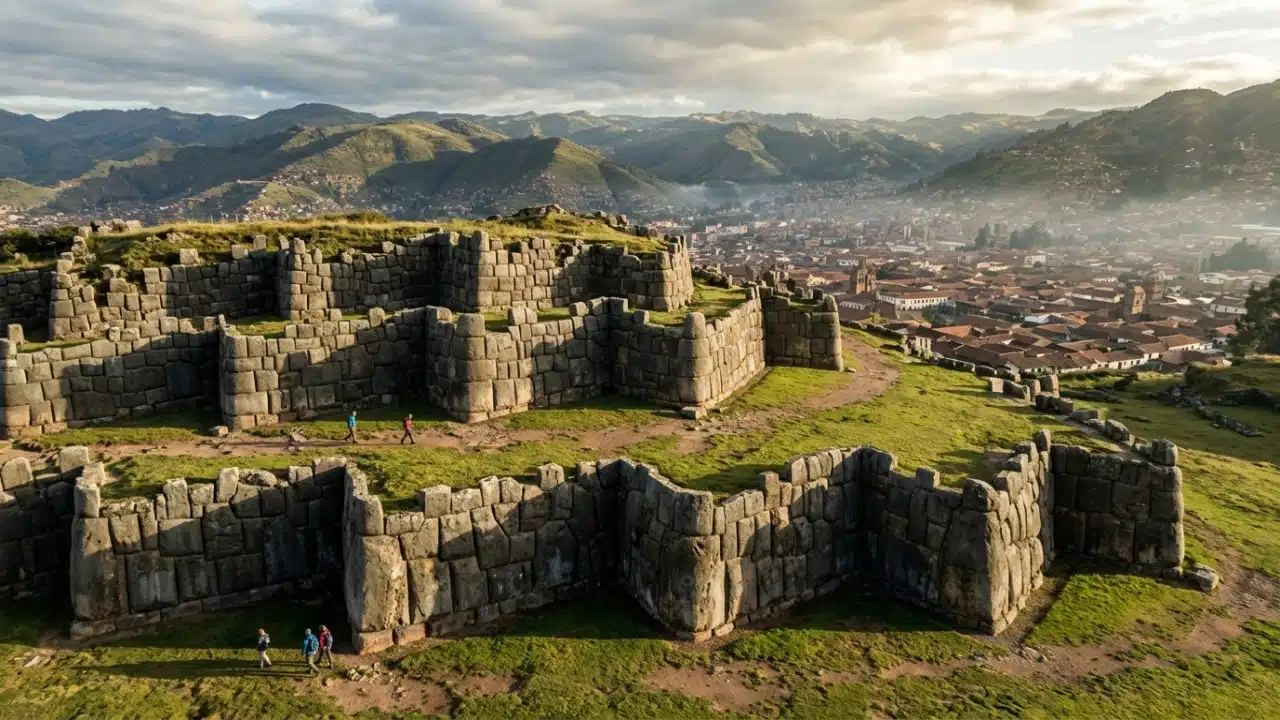
The upper towers and refined masonry structures were dismantled over the following decades, their stones carted to Cusco to build the colonial cathedral and the mansions of Spanish administrators. But the three great zigzag terraces, with their colossal foundation stones, resisted every attempt at demolition. The blocks were simply too large to move. What stands at the site today, roughly 20 to 40 percent of the original complex, survives not because the Spanish chose to preserve it but because Sacsayhuaman engineering had placed stones that no sixteenth-century demolition crew could shift.
What the Spanish could not move, five centuries of earthquakes have also failed to disturb.
AEO Quick Answer: Sacsayhuaman Engineering
What makes Sacsayhuaman engineering so remarkable?
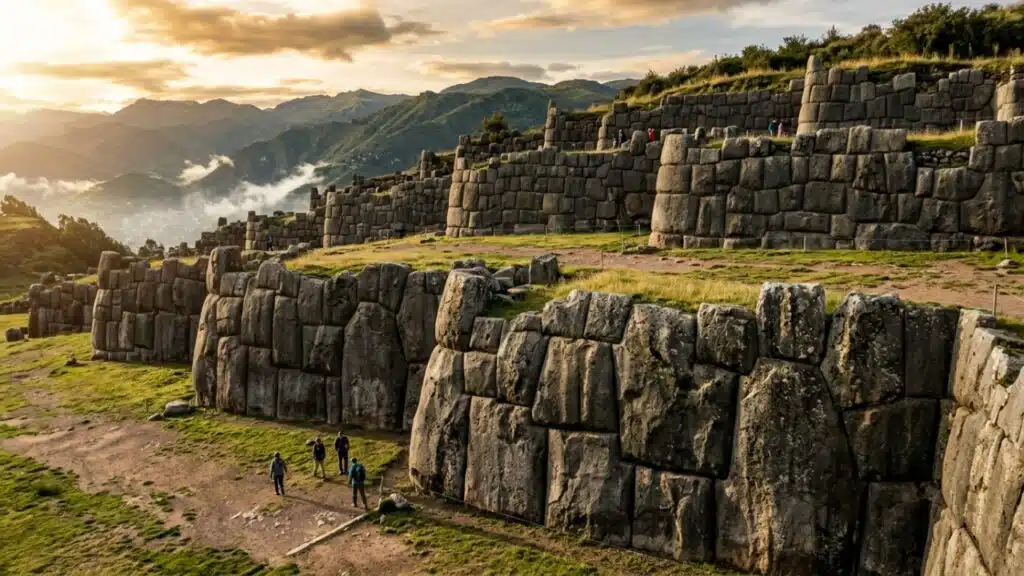
Sacsayhuaman engineering is remarkable for three interconnected reasons. The walls were built entirely without mortar, yet the joint precision between individual stones is so exact that a sheet of paper cannot be inserted between them. The stones are polygonal rather than rectangular, each custom-shaped to interlock with its neighbors through a technique called cyclopean polygonal masonry. And the structure is inherently earthquake-resistant by design; the irregular interlocking geometry allows stones to shift slightly during seismic events and settle back into their exact original positions when the shaking stops.
How did the Inca cut and fit the stones at Sacsayhuaman?
Sacsayhuaman engineering used a method called scribing and coping. A new stone was suspended by ropes alongside the stones already set in the wall. Workers identified points of contact between the surfaces, then removed the suspended stone and used hiwaya hammer stones, dense orbs of olivine basalt or hematite significantly harder than limestone, to pound away the high points. The stone was lowered back to check the fit, raised and adjusted repeatedly until the surfaces met with precision across the entire contact area. Researcher Jean-Pierre Protzen of UC Berkeley replicated this technique using only river cobbles and confirmed it could produce the precision visible at Sacsayhuaman.
How were the massive stones transported to Sacsayhuaman?
Stones for Sacsayhuaman engineering were quarried from sites up to 32 kilometers away. Spanish chronicler Pedro Cieza de León, writing shortly after the conquest, described thousands of workers hauling stones with ropes across mountain terrain. The primary transport method used log rollers placed under the stones to reduce friction, woven ropes braided from ichu grass, llama hide pulled by coordinated teams, earthen ramps to manage elevation changes, and levers to steer direction. The workforce, organized through the mita system of state labor taxation, reached an estimated 20,000 to 30,000 workers at peak construction.
When was Sacsayhuaman built and who built it?
Construction of Sacsayhuaman was commissioned by Sapa Inca Pachacuti around 1438 to 1450 CE and continued under his successors Tupac Inca Yupanqui and Huayna Capac over approximately 50 to 90 years. The site sits on ground previously occupied by the earlier Killke culture, and some researchers believe earlier pre-Inca structures may have been incorporated into the Inca construction. The complex was designated a UNESCO World Heritage Site as part of the historic city of Cusco in 1983.
The Scale That Numbers Cannot Fully Carry
Sacsayhuaman engineering begins with numbers, and the numbers are staggering.
The largest single stone in the walls stands approximately 8.2 meters tall and weighs an estimated 200 tonnes. Other blocks range from 100 tonnes to 120 tonnes, with the smallest visible foundation components still weighing dozens of tonnes each. Some stones have been measured to have up to twelve distinct angular faces, each shaped to interlock precisely with the stones on every touching surface around it.
The three main terraces of zigzag walls extend for approximately 400 meters along the northern ridge above Cusco. Each terrace steps back from the one in front of it, creating a tiered effect when viewed from below that the Spanish chronicler who described it compared to the teeth of a fortress. Above the three terraces, in the structure’s original form, rose three towers, the largest of which, the Muyucmarca, was circular and reportedly five stories tall.
None of that upper structure survives. Sacsayhuaman engineering produced two essentially different parts of the complex. The massive polygonal wall terraces at the base, too heavy for the Spanish to demolish, survive. The refined upper structures, lighter and more accessible, were dismantled stone by stone and their material reused across Cusco for three centuries of colonial construction.
What makes Sacsayhuaman engineering exceptional is visible in the surviving walls, and it is not primarily the size of the stones. It is the relationship between them.
The Secret of the Hiwaya
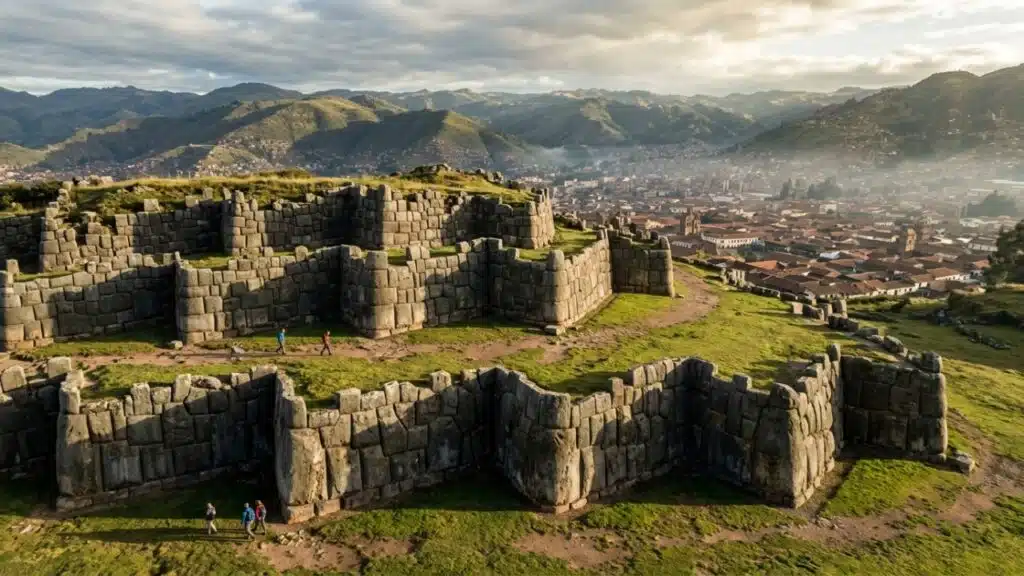
The central technical mystery of Sacsayhuaman engineering is how the Inca produced mortar-free joints of such precision between stones of irregular polygonal shape, each weighing upward of 100 tonnes, at a construction site 3,400 meters above sea level, without iron tools, without wheels, and without any written engineering manual.
The answer begins with a tool that looks nothing like what you might expect.
The hiwaya is a dense, heavy sphere of olivine basalt or hematite, typically about the size of a large cantaloupe, sourced from riverbeds where repeated tumbling over centuries has produced the rounded, compact shape. Olivine basalt and hematite are significantly harder than the limestone the Inca were shaping. When you strike limestone repeatedly with a harder stone, the limestone yields. With enough precision in the striking, with enough patience in the working, you can shape limestone to almost any surface geometry you intend.
Sacsayhuaman engineering relied on this tool for what researchers call the scribing and coping technique. When a new block was ready to be fitted into the wall, it was not cut to a predetermined template in the quarry and then placed. Instead, it was brought to the wall, suspended in position alongside the stones already set, and carefully examined at every point where it would touch its neighbors. The mason identified the areas where the surfaces made contact and where gaps existed. The stone was then removed, the protruding high points were pounded away with the hiwaya, and the stone was returned to check the fit again.
This process was repeated, potentially dozens of times for a single stone, until the surfaces matched across the entire contact area. Jean-Pierre Protzen, a researcher at the University of California, Berkeley, traveled to the quarry sites near Sacsayhuaman and attempted to replicate this process using only the tools the Inca had available. He was able to produce fits of the precision visible in the existing walls using nothing but river cobbles as hammer stones.
The technique is not magic, and it is not lost technology. It is patience applied systematically at a scale that modern construction economics would never permit. Each Sacsayhuaman engineering adjustment required lifting and re-suspending stones that weighed over 100 tonnes. Each check required positioning accuracy to identify contact points across irregular surfaces. The workforce that made this possible was not motivated by wages. It was organized by a labor obligation system that mobilized the entire productive capacity of the largest empire in pre-Columbian American history.
Why the Stones Are Irregular: Seismic Intelligence
One of the most frequently misunderstood aspects of Sacsayhuaman engineering is the choice to use irregular polygonal shapes rather than the rectangular blocks that most other ancient civilizations preferred.
Rectangular blocks are easier to cut. They stack in predictable patterns. They make it straightforward to calculate course heights and alignment. Every major stone construction tradition from ancient Egypt to Rome to medieval Europe preferred rectangular blocks for exactly these practical reasons.
The Inca chose irregular polygons, and that choice was not aesthetic. It was structural.
Cusco sits in one of the most seismically active regions on earth, in the Andean highlands where tectonic plates interact regularly enough that the question is not whether an earthquake will come but when. A wall built with rectangular blocks and mortar responds to seismic stress by cracking at the mortar joints, which are structurally weaker than the stone itself. When the ground moves, the rigid rectangular grid breaks along its weakest lines, producing structural failure.
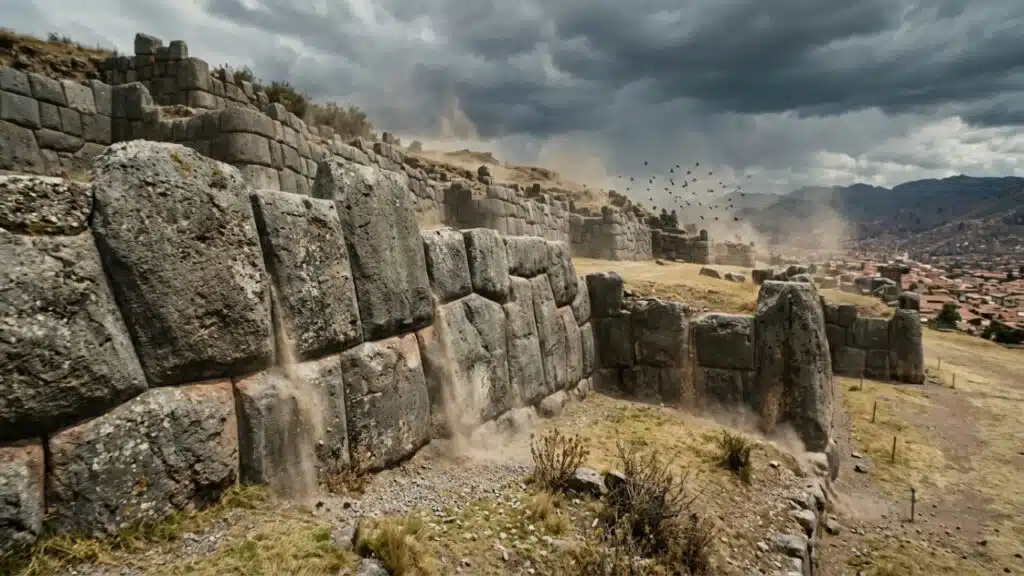
A mortar-free polygonal wall responds to seismic stress differently. When the ground shakes, the irregular interlocking stones shift slightly in the direction of the force. Because there is no mortar to crack, no rigid bond to fracture, the stones can move without destroying the wall’s integrity. And because the polygonal geometry means each stone is locked by the specific three-dimensional shape of its neighbors, the stones naturally return to their original positions as the shaking subsides. UNESCO documentation of Sacsayhuaman engineering describes this behavior as the stones settling back into their exact original configuration after seismic events.
Spanish colonial builders constructed rectangular mortar-bonded churches and administrative buildings directly on top of or alongside Inca foundation walls throughout Cusco. When major earthquakes struck the region, the colonial structures collapsed repeatedly. The Inca foundations beneath them survived intact, and in several documented cases after the 1950 Cusco earthquake, Inca walls that had stood for five centuries remained standing while the colonial structures built on them fell to rubble.
Sacsayhuaman engineering built the seismic intelligence into the geometry itself.
The Labor System That Made It Possible
Sacsayhuaman engineering at this scale required one resource that no amount of technical sophistication can substitute: an enormous, organized, sustained workforce.
The Inca Empire had a solution for this problem that was unique in the ancient world. The mita system was a form of labor taxation in which every able-bodied adult in the empire owed a portion of their labor time to the state each year. This was not slavery, and it was not wage labor. It was a civic obligation, reciprocated by the state providing food, shelter, and tools for the duration of the work period. Communities across the four quarters of Tahuantinsuyo, the Inca name for the empire meaning “the four regions,” rotated through labor assignments that could include agriculture, road building, military service, or construction.
At Sacsayhuaman, the mita system was deployed at its most ambitious scale. Garcilaso de la Vega, an Inca descendant writing in the early seventeenth century and drawing on oral tradition passed down through his Inca lineage, estimated that twenty thousand workers labored on the complex at its peak. More recent analysis suggests the peak workforce may have reached twenty to thirty thousand workers, organized in rotational teams that meant the site was never understaffed and no single community was permanently burdened.
Pachacuti, who commissioned the project around 1438, was the same Sapa Inca who redesigned the entire city of Cusco in the shape of a puma, with Sacsayhuaman forming the puma’s head and its zigzag walls representing the animal’s teeth. The construction was not completed in his lifetime. His son Tupac Inca Yupanqui and his grandson Huayna Capac continued the work for decades after Pachacuti’s death, suggesting that the project was understood as a generational commitment rather than a short-term construction goal.
This multi-generational organizational structure was possible only because the mita system created a labor supply that was institutionally guaranteed across successive rulers. Sacsayhuaman engineering required not just technical knowledge but a state infrastructure that could sustain a 20,000-person workforce for sixty to ninety consecutive years.
Moving Stones Across the Andes
The technical challenge of fitting the stones at Sacsayhuaman is matched by the logistical challenge of getting them to the site in the first place.
The limestone used in the largest Sacsayhuaman engineering foundations came from quarries at Waqoto and Rumiqolqa, with the nearest quarries approximately three to four kilometers from the construction site and others up to 32 kilometers away. This was not flat terrain. The Andes present constant elevation changes, unstable ground, and gradients that make even light cargo movement demanding.
The Inca moved the stones using a system that has been partially documented in Spanish chronicles and partially reconstructed through experimental archaeology. Log rollers placed under the stones reduced the friction of movement across prepared earthen surfaces. Woven ropes braided from ichu grass, a native Andean grass with exceptional tensile strength, and llama hide were used by teams of workers pulling in coordinated rhythm. Earthen ramps were constructed at grade transitions to manage the movement of stones over elevation changes. Levers provided the rotational force to steer direction.
The quarry at Rumiqolqa still shows the marks of abandoned stones, blocks that were partially cut and left when cracks or defects appeared in the material, demonstrating the careful quality control the Inca applied before a stone was considered worth the enormous effort of transport. The selection process began at the quarry, where experienced stone workers evaluated each potential block for structural integrity before committing to the extraction and transport process.
The Fortress That Was Not Just a Fortress
Popular accounts of Sacsayhuaman typically describe it as a fortress, and the 1536 battle confirms it served a defensive function. But Sacsayhuaman engineering served a purpose that was simultaneously military, ceremonial, astronomical, and cosmological.
The site’s alignment with key solstice and equinox positions confirms that Sacsayhuaman was designed with astronomical precision built into its orientation. The great open plaza in front of the zigzag terraces served as the stage for the Inti Raymi festival, the Inca celebration of the winter solstice that was the most important ceremonial event in the Inca calendar. The three towers above the terraces, now destroyed, housed the sacred objects of Inca religious practice and the personnel responsible for maintaining them.
Pachacuti’s redesign of Cusco in the shape of a puma placed Sacsayhuaman as the animal’s head, giving the entire city a sacred geography that mapped the empire’s power onto the landscape in a form visible to anyone who understood the symbolic language. Sacsayhuaman engineering was the physical materialization of that symbolic language, a declaration in stone that the Inca state was as permanent as the mountains surrounding it.
The Killke culture that preceded the Inca at this site, identified by radiocarbon dating of ceramic materials beneath the Inca construction layers, suggests that the ridgeline above Cusco held ceremonial significance before Pachacuti chose it as the location for his great project. The Inca did not impose Sacsayhuaman on an empty landscape. They built it on ground that already had sacred history, amplifying something that was already there rather than creating it from nothing.
What Only 20 Percent Reveals
The most significant context for understanding Sacsayhuaman engineering today is the recognition that what survives is only a fraction of what was built.
Between 20 and 40 percent of the original complex remains visible. The Spanish dismantled the towers, the upper temple structures, the refined interior masonry, and the majority of the dressed facing stones from the terraces themselves, leaving only what was too heavy to move. Three centuries of stone-stripping for colonial construction in Cusco below removed everything that Sacsayhuaman engineering had produced above the level of the largest foundation blocks.
What the surviving walls demonstrate about Sacsayhuaman engineering is therefore a conservative view. The surviving sections are the heaviest, the most massive, the structurally indestructible remnants of a complex that in its complete form would have been considerably more impressive. The five centuries since the Spanish conquest have given the world only the bottom of something that once extended much higher into the Andean sky.
And even in this diminished form, those walls stopped the Spanish army, survived hundreds of earthquakes, and continue to resist every engineering explanation that tries to reduce them to something simpler than what they are.
Conclusion: The Intelligence the Stones Record
Sacsayhuaman engineering is not mysterious in the sense of being inexplicable. Every technique involved has been identified, tested, and in many cases replicated by experimental archaeologists. The hiwaya and the scribe-and-fit method produce precision that modern researchers can demonstrate. The mita labor system explains the workforce. The quarry evidence confirms the transport methods.
What Sacsayhuaman engineering is mysterious about is its scale of ambition. The Inca did not build these walls because they had no other option. They could have cut rectangular blocks. They could have used mortar. Every other major civilization on earth chose simpler approaches for good practical reasons.
The Inca chose complexity because complexity in this case produced something that nothing simpler could achieve: walls that survive earthquakes by moving with them, joints so precise they appear machined, and foundation stones so heavy that a colonial empire with European tools could not demolish them five centuries after they were placed.
The intelligence encoded in Sacsayhuaman engineering is the intelligence of a civilization that understood its environment so completely that it designed its most important structures to last longer than any threat it could imagine.
The Spanish came and could not break it. Five centuries of earthquakes came and could not move it. It is still there.
Sacsayhuaman engineering built something that outlasted everything that tried to end it.
Discover a Hidden Maya City
Deep in Mexico’s jungle, LiDAR has revealed a massive lost city of 30,000 people—reshaping everything we know about Maya civilisation.
In 2024, a team of archaeologists made a discovery that could change everything: they found a lost city beneath the pyramids.
Click below to watch the full story:
https://www.youtube.com/@EchoesofAntiquity-egypt/videos
Sources
- The Galactic Mind — “Sacsayhuamán and the Stone Intelligence of the Inca World” (October 14, 2025) — thegalacticmind.com
- The Archaeologist — “Sacsayhuamán: Inca Walls Cut with Laser Precision?” (hiwaya hammer stones, scribe-and-coping technique, UNESCO seismic documentation) — thearchaeologist.org
- Missed History — “Cusco’s Megalithic Walls Still Puzzle Engineers Today” (Pedro Cieza de León chronicles, Jean-Pierre Protzen replication) — missedhistory.com
- Ancient Travel — “Sacsayhuaman Peru Guide 2026: Cyclopean Walls and Inca Ceremonial Fortress” — ancienttravel.org
- Megalithic Builders — “Sacsayhuamán: Cusco, Peru ancient ruins” (mita system, radiocarbon dating, 90-year construction, Killke culture) — megalithicbuilders.com
- Discover Wild Science — “Who Built the Walls of Sacsayhuamán? Peru’s Puzzle of Precision Stonework” — discoverwildscience.com
- Peru Jungle Trips — “The Inca Mastery Behind Sacsayhuaman: Unraveling the Secrets of Its Construction” — perujungletrips.com
- Legacy Trove — “Sacsayhuaman Walls: How Inca Cut 200-Ton Stones Perfectly” (Jean-Pierre Protzen UC Berkeley replication) — thelegacytrove.com
- Machu Picchu Amazon Peru — “Guide to Visiting Sacsayhuamán in Cusco Peru” (woven rope materials, ichu grass, log roller method) — machupicchuamazonperu.com
- SAM Travel Peru — “Sacsayhuaman: The Wonderful Fortress of the Incas” (puma city design, 90-year construction, Spanish dismantling) — samtravelperu.com
- Cusco Peru — “Sacsayhuaman, Capital of the Inca Empire” (Killke culture preceding the Inca) — cuscoperu.com
- Wikipedia — “Sacsayhuamán” (construction period, towers, battle of 1536) — en.wikipedia.org
- Machu Picchu org — “Explore the Ancient Fortress of Sacsayhuaman in Peru” (mita labor system, 20,000 to 30,000 workers) — machupicchu.org
- Peruanos.nl — “Sacsayhuamán: The Stone Enigma that Guards the Secrets of the Inca Empire” (astronomical alignment, seismic precision) — peruanos.nl