
9 Shocking Troy Sling Stones That May Prove the Iliad
One of the most compelling archaeological hints that the fabled Trojan War may not have been pure mythology after all is the discovery of the Troy Sling Stones. Many historians regarded Homer’s Iliad for centuries as a lyrical fantasy, a dramatic tale of gods, heroes, and inconceivable conflicts.
However, beneath the Troy remains, investigators have discovered something hard to overlook:
Thousands of expertly crafted sling stones were gathered around layers of devastation associated with violent conflict.
The peculiar aspect is this….
These Troy Sling Stones’ distribution resembles evidence from a real battlefield rather than haphazard rubble.
The Discovery That Changed Troy Forever
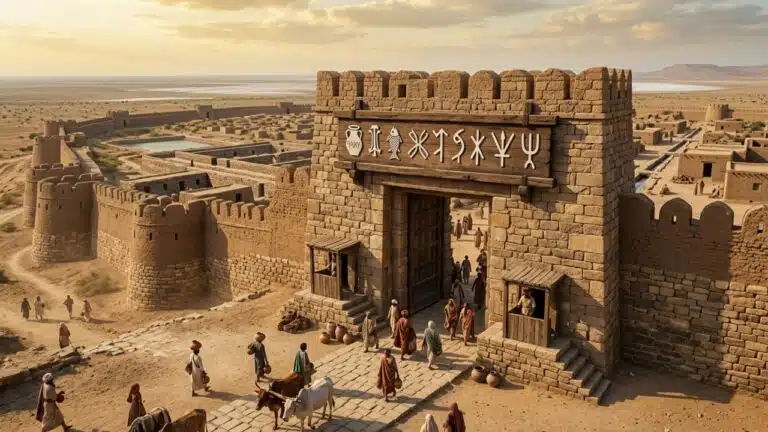
For much of history, many scholars doubted that Troy itself even existed. That changed in the 19th century when excavations at Hisarlik in modern-day Turkey revealed the remains of multiple ancient cities stacked atop one another.
Since then, archaeologists have spent decades trying to determine which layer—if any—matches the Troy described by Homer.
One layer in particular, known as Troy VI and VIIa, has drawn enormous attention because it shows signs of sudden destruction around the late Bronze Age, roughly the same period traditionally associated with the Trojan War.
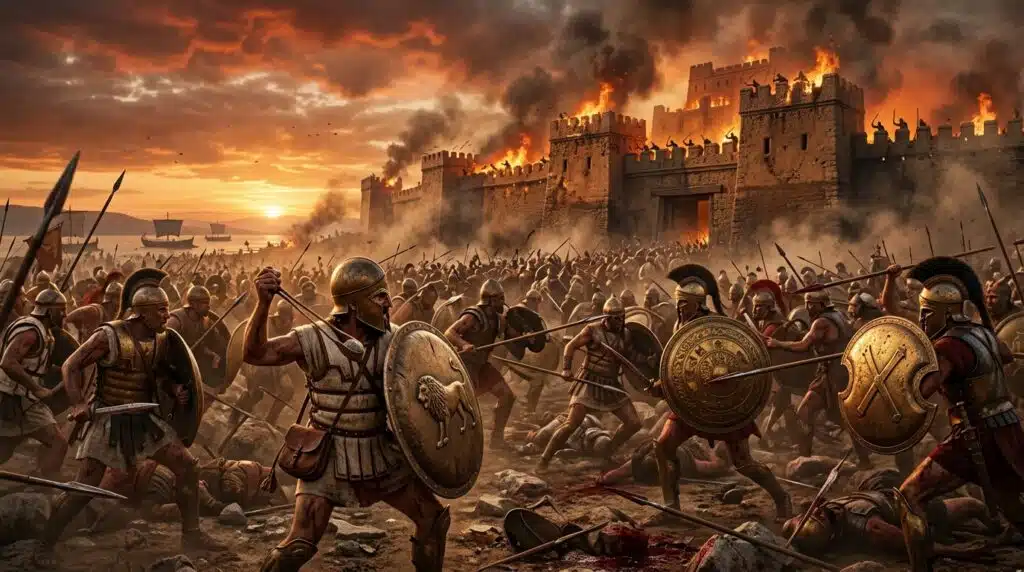
And scattered throughout these destruction zones were massive concentrations of Troy Sling Stones.
The Significance of Sling Stones
Sling stones may seem unimportant at first.
These tiny, rounded stones are used as ammo for slings, which are straightforward yet lethal ancient weapons that can quickly pierce armour or break skulls.
However, focus is important in archaeology.
It doesn’t mean much to find a few sling stones.
Organised warfare is suggested when hundreds or even thousands of people are gathered around defensive fortifications and layers of damage.
At Troy, researchers discovered precisely that.
The sheer number of Troy Sling Stones found close to fortifications clearly points to prolonged fighting as opposed to individual incidents.
The Battlefield Hidden Beneath the City
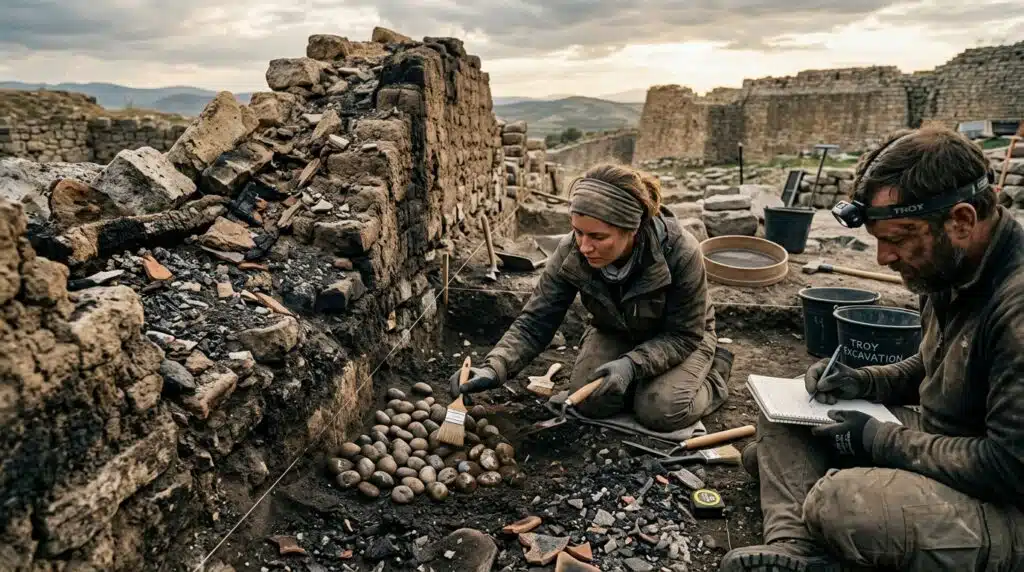
Archaeologists studying the site noticed something important:
The Troy Sling Stones were not randomly scattered across the settlement.
Instead, many appeared concentrated near:
- Defensive walls
- Gateways
- Burn layers
- Collapsed structures
- Areas showing signs of panic and destruction
This pattern resembles what archaeologists find at confirmed ancient battle sites.
Combined with evidence of fire damage, emergency food storage, and hurried rebuilding attempts, the picture becomes increasingly difficult to dismiss.
Something violent happened at Troy.
And it may have happened on a large scale.
It’s Possible That Homer Retained a True Memory
Traditionally credited to Homer, the Iliad was composed centuries after the alleged Trojan War.
For a long time, many historians believed the story was wholly made up due to this time lapse.
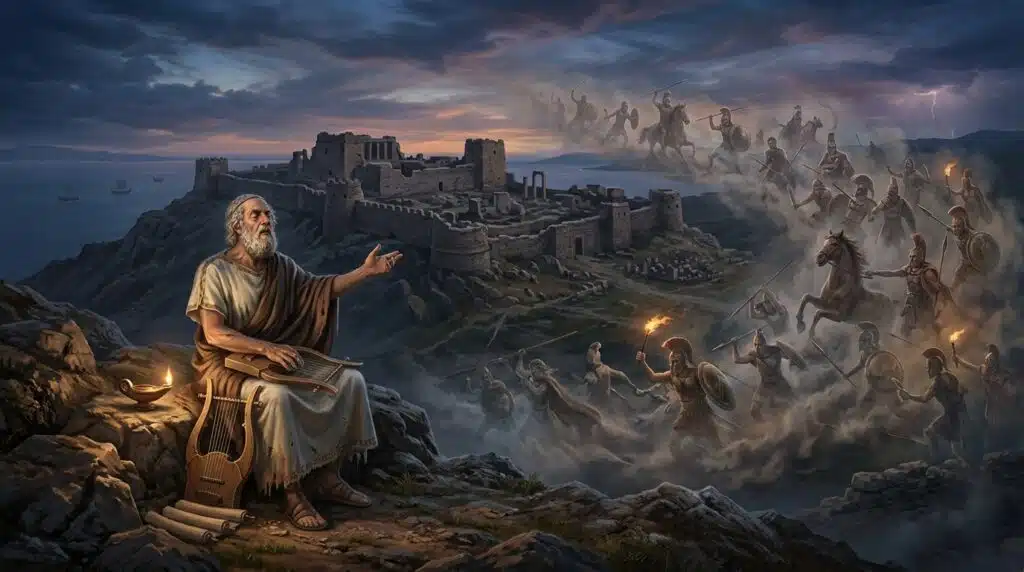
However, oral traditions are surprisingly good at preserving bits of actual events.
According to contemporary scholars, the Iliad might be a combination of:
- Actual conflict in the late Bronze Age
- Exaggerated tales of heroism
- Generational expansions to mythology
The idea that Homer’s epic was inspired by a real conflict that people have remembered for generations is strengthened by the discovery of concentrated Troy Sling Stones.
Not entirely conserved.
However, it wasn’t created out of nothing either.
A War Bigger Than One City
The late Bronze Age Mediterranean world was deeply interconnected through trade, alliances, and rivalries.
Troy occupied a strategically critical location near the Dardanelles, controlling access between the Aegean and Black Seas.
That made the city economically valuable.
And valuable cities attract enemies.
Some historians believe the conflict behind the Trojan War may not have been about Helen of Sparta at all.
Instead, it may have involved:
- Trade competition
- Control of maritime routes
- Regional political power struggles
If true, the Troy Sling Stones may represent physical evidence of one of the ancient world’s most important geopolitical conflicts.
Ancient Warfare Was Brutal and Chaotic
The discovery of the Troy Sling Stones is significant because slings were used extensively in actual Bronze Age warfare. Unlike the sword fights in movies that are frequently linked to the Trojan War, actual combat probably involved: projectile weapons, siege pressure, fire attacks, defensive barricades, and urban destruction. Since a skilled slinger could launch projectiles at speeds of over 100 kilometres per hour, the thousands of Troy Sling Stones discovered at the site were ammunition from organised violence.
Slings were utilised extensively in actual Bronze Age combat, which is one reason the finding of the Troy Sling Stones is significant.
In contrast to the sword fights in movies that are frequently connected to the Trojan War, real fighting probably involved:
Weapons with projectiles
Pressure during a siege
Attacks by fire
Protective barriers
Destroying cities
Sling stones were inexpensive, powerful, and destructive.
Projectiles might be launched at speeds of more than 100 km/h by a skilled slinger.
This indicates that the thousands of Troy Sling Stones discovered at the location were not innocuous items.
They were weapons used in organised crime.
The Collapse of the Bronze Age World
The possible timing of Troy’s destruction makes the story even more fascinating.
Around 1200 BCE, much of the eastern Mediterranean world collapsed suddenly:
- Kingdoms disappeared
- Trade networks broke apart
- Major cities burned
- Populations migrated
This period, known as the Late Bronze Age Collapse, remains one of history’s greatest mysteries.
Troy appears to have suffered during this wider regional instability.
Which means the conflict remembered in the Iliad may have been part of something much larger than a single war.
The Troy Sling Stones may represent one battlefield inside a collapsing world.
Myth and Archaeology Are Finally Collapsing
Discoveries at Troy continue to blur the boundaries between mythology and archaeology. While no archaeologist disputes that Homer accurately depicted events—there is no proof that Achilles engaged in combat with Hector exactly as described—archaeology also refutes the notion that the Trojan War was wholly fictional. The concentration of Troy Sling Stones, along with layers of destruction and defensive structures, points to an actual conflict that is remembered through legend.
Scholars kept mythology and archaeology apart for generations.
However, new findings at Troy continue to obfuscate that distinction.
No archaeologist asserts that Homer gave an accurate account of the events.
There is no proof that Achilles and Hector engaged in combat as described.
However, the notion that the Trojan War was wholly made up is no longer supported by archeology.
The concentration of Troy Sling Stones, along with defensive buildings and layers of ruin, suggests actual warfare that is recorded in legend.
And everything is altered by that.
Why the Troy Sling Stones Matter Today
The most fascinating part of the Troy Sling Stones discovery is not simply whether the Trojan War happened.
It’s what the discovery reveals about human memory itself.
Stories survive because something powerful sits beneath them.
Across 3,000 years, the Iliad carried echoes of fear, violence, siege warfare, and the collapse of cities.
Now archaeology is beginning to uncover physical traces of those echoes.
Small stones.
Scattered in ruined walls.
Waiting thousands of years for someone to ask whether the legend was real.
And increasingly, history’s answer seems to be:
At least partly… yes.
Discover a Hidden Maya City
Deep in Mexico’s jungle, LiDAR has revealed a massive lost city of 30,000 people—reshaping everything we know about Maya civilization.
In 2024, a team of archaeologists made a discovery that could change everything: they found a lost city beneath the pyramids.