Cleopatra Sunken Port Secrets Found at Taposiris Magna
Cleopatra Sunken Port: The Underwater Secrets of Taposiris Magna
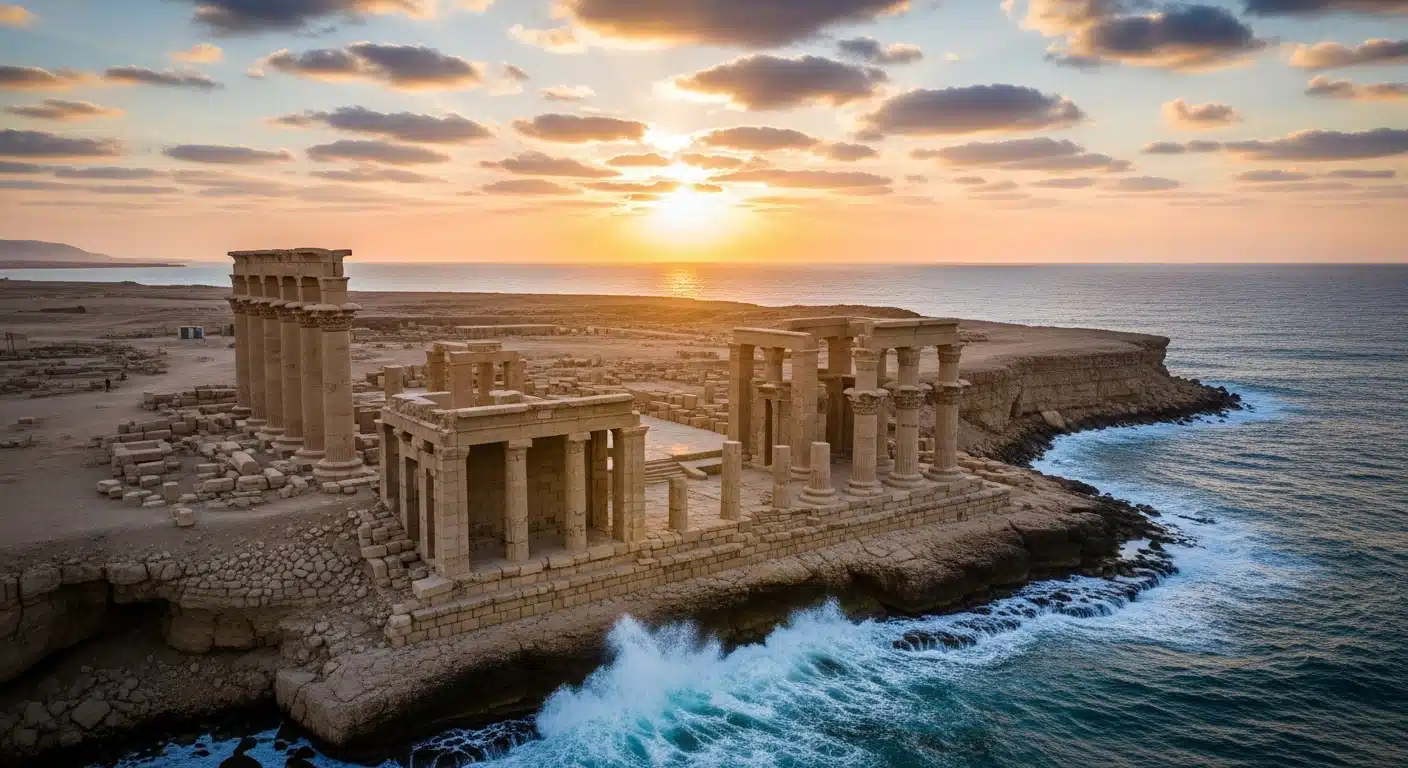
Cleopatra Sunken Port isn’t just another archaeological headline—it feels like a scene pulled straight out of a lost epic. Along Egypt’s Mediterranean coast, near the ancient site of Taposiris Magna, archaeologists have been chasing a mystery that refuses to stay buried. Or in this case… submerged.
Because beneath the waves and shifting sands, something unusual has been taking shape: collapsed structures, hidden tunnels, and evidence of a once-active coastal hub tied to one of history’s most iconic figures—Cleopatra VII.
But here’s where it gets interesting…
This isn’t just about Cleopatra. It’s about a lost connection between land, sea, and power.
The Shoreline That Engulfed a City
At first glance, nothing looks out of the ordinary when you stand today west of Alexandria, close to the ruins of Taposiris Magna. dry terrain. columns that are broken. Quiet.
However, this coastline was quite different thousands of years ago.
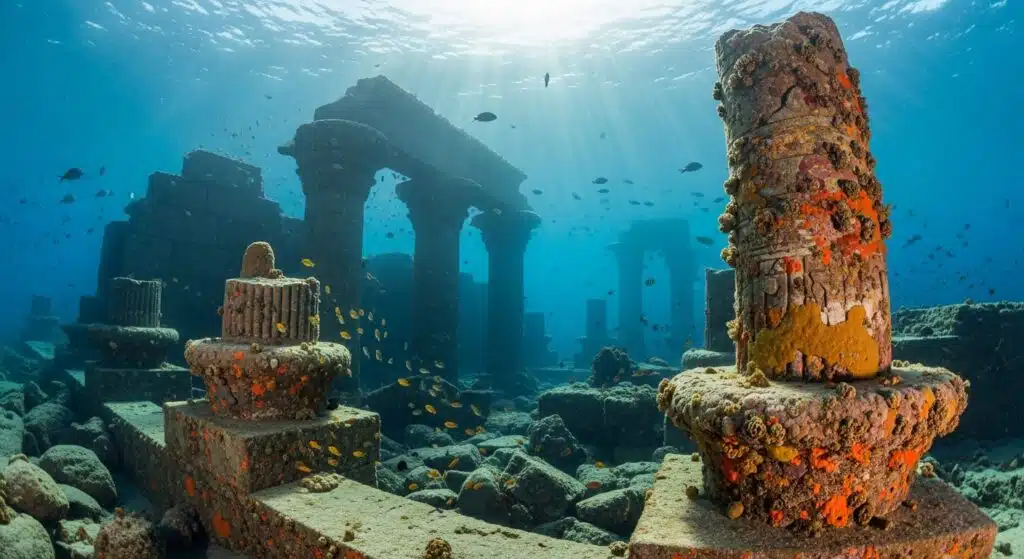
The area was gradually altered by coastal subsidence, rising sea levels, and earthquakes. Layer by layer, remnants of old towns vanished into the Mediterranean. Roads, ports, and temples that were formerly above ground are now underwater.
That’s where the concept of a Cleopatra Sunken Port originates.
This is a geological result rather than a myth.
Why Taposiris Magna Matters
Taposiris Magna wasn’t just a random temple site. It was strategically positioned between the Mediterranean Sea and Lake Mariout, making it a key point in trade and religious activity during the Ptolemaic period.
The temple itself was dedicated to Osiris, god of the afterlife,A detail that becomes important later.
Archaeologists believe this site may have served as more than a religious center. Its location suggests it could have functioned as a secondary port or ceremonial gateway, especially during Cleopatra’s reign.
And recent discoveries are starting to support that idea.
What’s Underneath the Water
Underwater excavations close to Taposiris Magna have uncovered an unexpected discovery in recent years.
Archaeologists and divers have recorded:
- Blocks of submerged stone and structural remnants
- Walls that have crumbled and stretch into the sea
- Potential forms beneath silt that resemble harbors
- Coins depicting Cleopatra are among the artifacts.
According to these results, a portion of the ancient complex may have originally stretched closer to the coast or possibly straight into it.
The Cleopatra Sunken Port may have been a useful coastal extension of the temple complex rather than a single, well-defined harbor like Alexandria’s main port.
a location for ships to dock.
where products were transported.
Where the sea and ceremonies meet.
The Tunnel That Changed Everything
One of the most dramatic discoveries at Taposiris Magna didn’t come from underwater—but from beneath the earth.
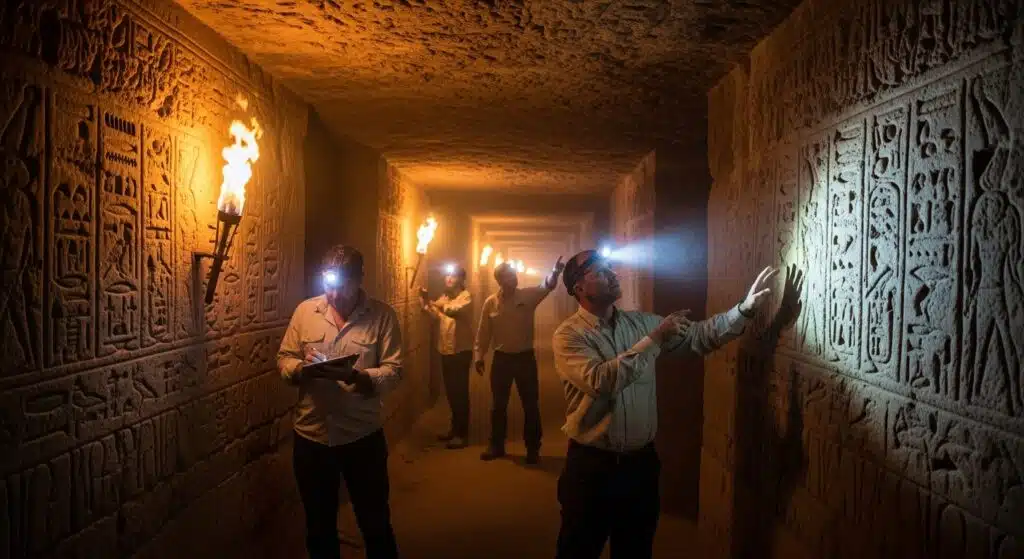
Archaeologists uncovered a 1,300-meter-long tunnel carved through solid rock, located about 13 meters below ground level.
Perfectly engineered, the tunnel runs beneath the temple complex and stretches toward the Mediterranean.
Its purpose?
Still debated.
But here’s the theory that’s gaining attention:
This tunnel may have connected the temple to a hidden coastal or port structure—possibly part of the same system now found underwater.
If true, this transforms the entire site from a simple temple into a multi-layered complex combining religion, engineering, and maritime activity.
Cleopatra Sunken Port Final Chapter?
Let’s address the question everyone is thinking.
Was this connected to Cleopatra Sunken Port burial?
Some archaeologists, including Dominican researcher Kathleen Martinez, believe that Taposiris Magna could be the burial site of Cleopatra and Mark Antony.
The reasoning is bold:
- Cleopatra associated herself with the goddess Isis
- The temple is dedicated to Osiris (Isis’s counterpart)
- The underground tunnels resemble ritual pathways linked to the afterlife
If Cleopatra wanted to be remembered not just as a queen, but as a divine figure, this location would make symbolic sense.
But there isn’t yet a verified tomb.
And that’s crucial.
The Cleopatra Sunken Port idea indicates that this area was significantly more significant than previously thought, but it does not confirm where she was buried.
An Alternative Form of Power
The potential for a lost port is not the only thing that sets this narrative apart.
It’s what it makes clear about the world of Cleopatra.
In ancient Egypt, power was more than just political.
It was geographical, symbolic, and even spiritual.
A port close to a holy temple served as a doorway between worlds in addition to being a place for trade:
- Land and sea
- Life and afterlife
- Human and divine
The combination of underwater ruins and underground tunnels suggests that Taposiris Magna may have been designed as a controlled environment of movement and meaning.
Nothing random.
Everything intentional.
The Sea Still Has the Final Word
Despite all these discoveries, much of the story remains hidden.
The Mediterranean is unpredictable. Sediment shifts. Visibility drops. Entire structures can remain buried just meters below the surface.
Which means the Cleopatra Sunken Port is only partially revealed.
There could be:
- More harbor structures further offshore
- Ship remains buried under layers of sand
- Additional tunnels connecting unseen sections
Or even something bigger.
The Significance of This Discovery
The tale of Cleopatra Sunken Port serves as a crucial reminder:
History doesn’t always vanish.
It sinks occasionally.
When it does, it waits.
Not for explorers, but for the appropriate questions, the appropriate time, and the appropriate technology.
Taposiris Magna is no longer merely a ruin of a temple.
The intersection of geology, mythology, and archaeology is a living conundrum.
And Cleopatra’s universe is still attempting to tell its tale somewhere between the sea and the tunnels.
Discover a Hidden Maya City
Deep in Mexico’s jungle, LiDAR has revealed a massive lost city of 30,000 people—reshaping everything we know about Maya civilization.
In 2024, a team of archaeologists made a discovery that could change everything: they found a lost city beneath the pyramids.
Click Below To Watch Full Story
https://www.youtube.com/@EchoesofAntiquity-egypt/videos