
8 Terracotta Army Mysteries Science Still Can’t Explain
An Emperor Who Refused to Die
He was thirteen years old when the work began. An age when most children are learning arithmetic and managing their first politics with friends. Ying Zheng, prince of the Qin state, was managing something considerably more ambitious: the construction of an underground city that would protect him not in life, but in death.
By the time he was done, he had become Qin Shi Huang, the First Emperor of China, the man who ended four centuries of warring states and hammered six rival kingdoms into a single unified empire. He standardized the currency, the writing system, the weights and measures. He built the first version of the Great Wall. He created the first centralized Chinese state from sheer, relentless will.
And then he spent the rest of his life trying to avoid dying.
He consumed mercury elixirs because court alchemists told him they would grant immortality. He sent expeditions to find islands where magical herbs grew. He refused to speak the word for death. And beneath a mound of earth in Shaanxi Province that still stands 76 meters tall today, he commissioned the most elaborate burial complex in human history, one that is still only partially understood and almost entirely unexcavated more than two thousand years after the day his body was sealed inside it.
The terracotta army mysteries do not begin and end with 8,000 clay soldiers. They begin where the clay soldiers stop, at the edge of a tomb that no living person has entered since 210 BCE.
Quick Answer: Terracotta Army Mysteries
What are the biggest terracotta army mysteries?
The most significant terracotta army mysteries include: the main tomb of Emperor Qin Shi Huang has never been opened; scientific analysis has confirmed abnormally high mercury levels in the soil above the burial mound, consistent with ancient descriptions of mercury rivers inside; a 2026 study published in Scientific Reports detected mercury vapor actually leaking from the sealed tomb to the surface; each of the 8,000 terracotta warriors has a unique face, possibly modeled on real soldiers; and European mitochondrial DNA found near the site suggests ancient Greek sculptors may have been present, predating the Silk Road by centuries.
Why has the terracotta army tomb never been opened?
Chinese authorities have deliberately chosen not to excavate the main burial chamber of Qin Shi Huang for several reasons. When terracotta warriors were first unearthed in 1974, their paint began fading and flaking within minutes of exposure to air. The technology to preserve what is inside does not yet exist at the required scale. Ancient records also describe mechanical crossbow traps set to fire automatically at intruders. And a 2026 Scientific Reports study confirmed mercury vapor is leaking from the sealed chamber, meaning toxic gas is a real concern for any excavation team.
How many terracotta warriors are there?
Estimates based on ongoing excavations suggest the mausoleum of Qin Shi Huang contains over 8,000 terracotta soldiers, 130 chariots, approximately 670 horses, and additional figures including officials, acrobats, and musicians. Pit One alone, the largest, is estimated to hold over 6,000 figures. Excavations have been ongoing since 1974 but have covered only a fraction of the total site, which spans 22 square miles.
Did ancient Greeks help create the terracotta army?
This is one of the most debated terracotta army mysteries. Senior archaeologist Li Xiuzhen of the Emperor Qin Shi Huang Mausoleum Site Museum has stated that European mitochondrial DNA found at Xinjiang province sites near the mausoleum suggests contact between China and the West before the Silk Road formally opened. Professor Lukas Nickel of the University of Vienna proposed that Greek sculptors, following Alexander the Great’s campaign to India in 326 BCE, may have traveled to China and trained local craftsmen in life-sized sculpture. Prior to the terracotta army, no tradition of life-sized human statuary existed in China.
Mystery 1: The Tomb That Has Never Been Opened
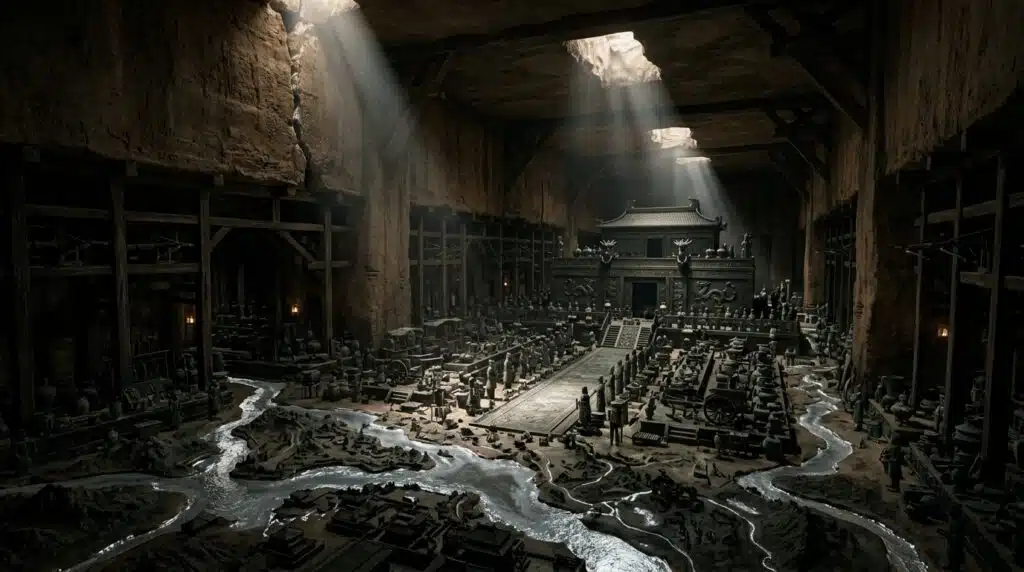
At the center of every terracotta army mystery is a single undeniable fact. The tomb of Qin Shi Huang, the most elaborate burial chamber ever constructed in human history, has never been opened.
The burial mound rises 76 meters above the Shaanxi plain. Its base covers roughly 380 by 330 meters. Geo-radar and gravimeter investigations have established that the underground palace beneath it measures approximately 140 by 110 by 30 meters, with the central coffin chamber sitting about 30 meters below the present ground level. The complex as a whole spans 22 square miles of landscape and includes not just the warrior pits but stables, administrative buildings, an underground palace modeled on the capital city of Xianyang, and dozens of satellite burial sites still only partially explored.
The scale is beyond comparison. And not a single archaeologist has set foot inside the burial chamber itself since the day it was sealed.
This is a deliberate choice, not a failure of ambition. When farmers first struck terracotta fragments while digging a well in March 1974, the discovery was immediately recognized as extraordinary. But as excavation began and the first warriors were lifted from the earth, a problem emerged immediately. The painted surfaces, vivid with original color after more than two thousand years in sealed darkness, began to crack, bubble, and fade within minutes of exposure to open air. Some painted surfaces started to flake and fade as soon as they were excavated. An irreplaceable coat of paint, two millennia old, destroyed in the time it takes to walk across a room.
If this is what happened to the outer pits, what would happen to whatever is inside the central tomb when it meets the modern atmosphere? The technology to answer that question safely does not yet exist. And so the tomb waits.
Mystery 2: Mercury Is Leaking From the Sealed Chamber
The ancient historian Sima Qian, writing roughly a century after Qin Shi Huang’s death, described the interior of the burial chamber in language that for most of recorded history was dismissed as literary exaggeration. He wrote of an underground palace containing rivers and seas made of flowing mercury, arranged across a vast map of the Chinese empire. The roof was embedded with pearls representing the stars. Jewels lit the ceiling like the sun and moon.
Mercury rivers. In a sealed underground palace. Two thousand years ago.
It sounds impossible. The science says otherwise.
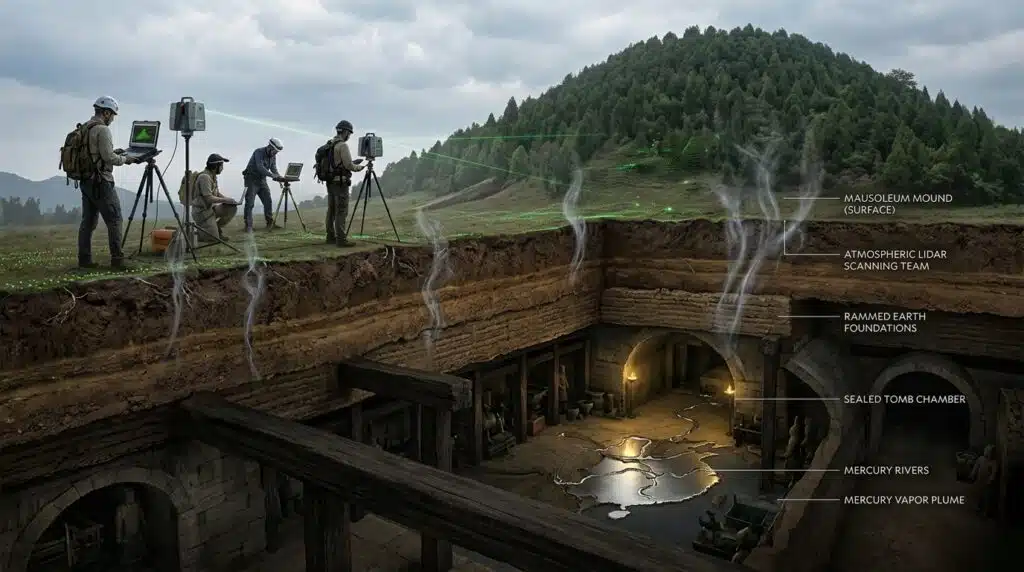
In 1980, Chinese researchers used soil sampling around the tomb mound and found abnormally elevated levels of mercury in the surrounding earth, far above any natural background level. Those findings confirmed that mercury was present in significant quantities beneath the mound, consistent with Sima Qian’s description.
Then, in a study published in Scientific Reports just weeks before this article was written, a team led by physicist Sune Svanberg of Lund University and South China Normal University went further. Using differential absorption lidar technology, a form of laser radar that detects mercury at the molecular level from above ground, they detected localized mercury vapor actually rising from the sealed tomb and escaping to the surface atmosphere.
This is not a historical footnote. It is active physical evidence. Mercury sealed inside a burial chamber over two thousand years ago is still present in sufficient quantities to leak through meters of compacted earth and be detected by atmospheric scanning technology in 2026.
What Sima Qian described as rivers of mercury in a miniature empire was not myth. Something is in that chamber. And it is still moving.
Mystery 3: 8,000 Faces, Not One the Same
Every account of the terracotta army mentions the warriors’ numbers. Fewer accounts engage properly with what is perhaps the strangest detail of all: every single face is different.
Eight thousand soldiers. Eight thousand unique physiognomies. Different bone structures, different ear shapes, different expressions, different ages, different emotional states. One figure appears calm. Another has a slight frown. A third looks directly ahead with an expression that reads, unmistakably, like controlled tension before a battle.
This is not a matter of artistic variation within a standard template. The differentiation is systematic and specific. Bodies were manufactured from standardized modular parts produced in workshops across the region, with heads, arms, and torsos assembled from interchangeable components. But the heads were then individually detailed by hand, with distinct faces applied to each figure before firing.
The question that has occupied researchers for decades is whether these faces were modeled on real people. The leading theory within archaeology is that they were. That the army of Qin Shi Huang was not an abstract symbolic force but an attempt to recreate, in terracotta, the actual men who had fought for him in life.
If this is correct, then what stands in those underground pits is not a generic army. It is a portrait gallery of real individuals, of soldiers and commanders who lived and breathed in the third century BCE, whose names and histories have been entirely lost but whose faces are still recognizable twenty-two centuries later.
That possibility transforms the terracotta army mysteries from an archaeological puzzle into something considerably more intimate.
Mystery 4: The Greek Question
The terracotta army has no predecessor in Chinese artistic history. That is not a casual observation. It is the central mystery behind one of the most provocative theories in the field.
Before Qin Shi Huang’s tomb complex was built, Chinese funerary art used small figurines, typically under 20 centimeters in height, rigid in posture and generalized in detail. The tradition of carving life-sized, anatomically individualized human figures simply did not exist in China.
Then, suddenly, 8,000 of them appeared.
Senior archaeologist Li Xiuzhen of the Emperor Qin Shi Huang Mausoleum Site Museum stated directly that prior to the construction of the terracotta army, there had been no tradition of building life-sized human statues in China, and that only outside influence could explain such a significant change in style and skill. She and her colleagues concluded that the terracotta army, the acrobats, and the bronze sculptures found on site have been inspired by ancient Greek sculptures and art.
Professor Lukas Nickel, chair of Asian Art History at the University of Vienna, proposed the mechanism. Alexander the Great’s military campaign reached India in 326 BCE, roughly a century before the terracotta army was commissioned. That campaign left in its wake a tradition of Greco-Buddhist art that blended Greek sculptural technique with Asian iconography across Central Asia. Nickel argued that Greek statues had made their way eastward along proto-Silk Road trade networks, and that Greek sculptors, or craftsmen trained by them, eventually reached China and taught local artisans the techniques of life-sized naturalistic sculpture.
The supporting evidence came from European mitochondrial DNA found in human remains at sites in Xinjiang province, the westernmost region of China, dating to the period of the First Emperor. These findings suggest that Westerners had settled, lived, and died in the region before the Silk Road was formally established in the second century BCE.
The terracotta army mysteries connected to Greek influence remain contested. Chinese archaeologists point out that ceramic figures had been produced in earlier dynasties, that the lost-wax casting technique used in bronze figures may have developed independently, and that the scale and collective character of the army is profoundly unlike anything in Greek artistic tradition. The Greeks carved the individual. The terracotta army is the opposite of individualism at the collective level, even as each face within it is individually distinct.
The debate has not been settled. The DNA evidence is real. The artistic precedent question remains genuinely open.
Mystery 5: The Automatic Crossbows
Sima Qian’s account of the burial chamber includes a detail that has always been taken either as legend or as an engineering impossibility: the tomb was fitted with automatic crossbows designed to fire at any intruder who managed to enter.
Mechanical crossbow triggers from the Qin dynasty have been found in the outer necropolis areas. The engineering capacity to create a hair-trigger release mechanism existed in the third century BCE in China. The terracotta army mysteries surrounding the interior traps cannot be dismissed on technological grounds alone.
What cannot be confirmed is whether these mechanisms, if they exist inside the burial chamber, remain functional after more than two thousand years underground. Wood rots. Metal corrodes. Silk strings decay. But in a sealed chamber where mercury is apparently still present in liquid or near-liquid form after twenty-two centuries, the preservation conditions are clearly extraordinary.
No archaeologist will know what the crossbows look like until the tomb is opened. And the crossbow question is one more reason why opening it requires considerably more planning than enthusiasm.
Mystery 6: The Underground Palace Was Modeled on a City
The terracotta army mysteries extend well beyond the warrior pits into the structure of the entire mausoleum complex, which was not designed as a tomb in any conventional sense. It was designed as a functioning city for the afterlife.
A 2010 excavation focused on the tomb’s foundations and uncovered a massive underground palace with 18 courtyard-style homes arranged around a central building. This structure is a quarter the size of Beijing’s Forbidden City and is regarded by some architectural historians as its conceptual predecessor, though it was built for an emperor to inhabit after death rather than during life.
The mausoleum takes its layout from Xianyang, the actual Qin capital. Streets, administrative buildings, residential quarters, stables with bronze horses and chariots, a garden with bronze trees. The workers who built Qin Shi Huang’s tomb did not simply dig a hole and furnish it. They constructed an entire subterranean civilization.
Sima Qian also recorded that workers who built the inner burial chamber were sealed inside when the outer doors were closed. Whether this claim is accurate remains one of the terracotta army mysteries that archaeology cannot confirm or deny without entering the chamber itself. But the skeletal remains of workers have been found in outer areas of the complex, suggesting that the practice of sealing people inside the construction was not entirely confined to legend.
Mystery 7: The Paint That Vanished
The terracotta warriors were not gray. That is perhaps the single most important fact about them that the popular image gets wrong.
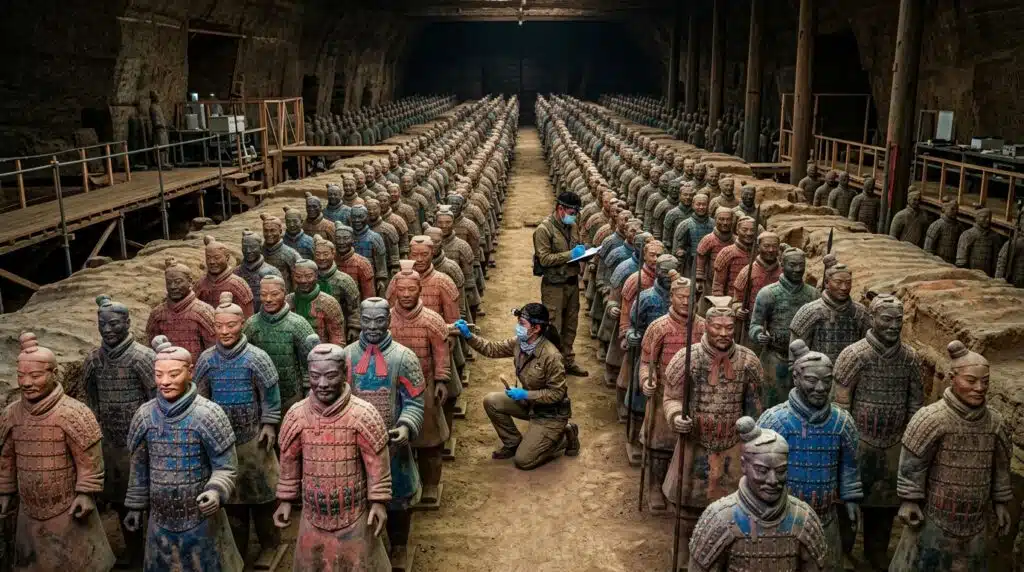
Every warrior was painted in vivid colors. Black armor, red robes, pink skin, blue sashes, green detailing on weapons. The figures were decorated with mineral and organic pigments applied over a layer of lacquer that itself bonded to the clay surface. The result was an army that would have looked, when first sealed, shockingly lifelike in both form and color.
Two thousand years of sealed darkness preserved the lacquer base but left the pigments fragile beyond any modern conservation technique’s ability to prevent their loss. When the first warriors were excavated in 1974, those pigments lasted approximately four minutes in open air before beginning to flake irreversibly.
That four-minute window defines the entire cautious approach to the terracotta army site. If the outer warriors, those furthest from the central chamber and exposed to more varied archaeological conditions, lose their paint in under five minutes, what is the state of the innermost figures closest to the emperor’s coffin? What colors survive in total darkness, in a mercury-saturated, sealed atmosphere that has not changed since 210 BCE?
The terracotta army mysteries embedded in that question are not academic. They determine the entire future of the excavation. Until a preservation method exists that can stabilize ancient lacquer on contact, the most important visual information in the tomb cannot be saved. And so it waits, in the dark, for technology that does not yet exist.
Mystery 8: The Emperor’s Obsession With His Own Death
The final and perhaps most human of the terracotta army mysteries is not a question of chemistry or archaeology. It is a question of psychology.
Qin Shi Huang was terrified of dying. He banned the word for death from his court. He sent ships to sea to find islands of immortality. He consumed mercury-based elixirs that his alchemists assured him would extend his life, and that almost certainly contributed to the mercury poisoning that killed him at 49. His own pursuit of immortality was what ended it.
And yet, simultaneously, he spent 38 years building the most elaborate death-preparation structure in human history. He began the mausoleum at 13, expanded it after unifying China, and continued refining it until the last year of his life. He prepared for his own death with a thoroughness that borders on obsession while refusing to acknowledge that death was coming.
The terracotta army exists in that contradiction. It is the product of a man who could not accept mortality and who therefore decided, with the full resources of a unified empire at his disposal, to defeat it not in life but in the afterlife. If he could not live forever, he would at least live in death in the most magnificent way any human being had ever arranged.
He took 700,000 workers. He took 38 years. He took rivers of mercury and thousands of clay soldiers and an underground city modeled on his capital.
And then he died anyway, at 49, probably of the poison he was drinking to avoid it.
Conclusion: The Greatest Archaeological Site Not Yet Excavated
The terracotta army mysteries are not the property of the past. They are active, ongoing, and in some cases, literally rising to the surface.
Mercury vapor is leaking from a sealed tomb that has not been touched in over two thousand years. Eight thousand individual human faces stand in underground pits waiting for the conservation technology that will allow them to be seen in their original color for the first time since they were painted. A burial chamber larger than a football field, containing what may be rivers of liquid metal, a map of an empire, jewels representing the sky, and possibly functional crossbow traps, sits sealed under 76 meters of packed earth in Shaanxi Province.
The terracotta army mysteries will not be resolved in a single excavation season. They may not be fully resolved within this generation of archaeology. The tools required to open the tomb without destroying what is inside do not yet exist at the necessary scale, and Chinese authorities have consistently and correctly prioritized preservation over speed.
But the knowledge that it is there, sealed, intact, leaking mercury into the air above it like a message from the third century BCE, is itself one of the most extraordinary facts in the entire history of human civilization.
The emperor who refused to accept death built something that has now outlasted every empire that came after him, and it is still keeping his secrets.
Sources
- Scientific Reports / Daily Galaxy (July 2026) — Sune Svanberg et al., “Mercury Vapor Is Rising From Qin Shi Huang’s Sealed Tomb” (Lund University and South China Normal University study) — dailygalaxy.com
- PMC / Scientific Reports (2020) — “Mercury as a Geophysical Tracer Gas: Emissions from the Emperor Qin Tomb in Xi’an Studied by Laser Radar” — ncbi.nlm.nih.gov
- Smithsonian Magazine — “What You Need to Know About China’s Terra-Cotta Warriors and the First Qin Emperor” (Updated April 19, 2024) — smithsonianmag.com
- Smithsonian Magazine — “Did the Greeks Help Sculpt China’s Terra Cotta Warriors?” — smithsonianmag.com
- ScienceAlert — “New Evidence Could Rewrite The History of China’s Terracotta Warriors” (October 2016) — sciencealert.com
- History.com — “Greeks May Have Influenced China’s Terra Cotta Army” (Updated March 6, 2025) — history.com
- Ancient Origins — “Controversial New Theory Suggests Ancient Greeks Helped Build Terracotta Army in China” — ancient-origins.net
- Arkeonews — “A Treasure-Laden Burial Chamber Found Hidden Among Terracotta Army” (June 7, 2024) — arkeonews.net
- Futura Sciences — “Why archaeologists still refuse to open China’s 2,200-year-old emperor’s tomb” (March 11, 2026) — futura-sciences.com
- China Underground — “The Unexplored Tomb of China’s First Emperor” (April 9, 2024) — china-underground.com
- Travel China Guide — “Underground Palace of Qin Shi Huang Mausoleum” — travelchinaguide.com
- LadbBible — “Archaeologists uncover major new find studying China’s mysterious 2,000 year old Terracotta Army” (January 27, 2025) — ladbible.com
- arXiv / Cambridge University — “Royal mausoleums of the Western-Han and of the Song Chinese dynasties: a contextual approach” — arxiv.org
Discover a Hidden Maya City
Deep in Mexico’s jungle, LiDAR has revealed a massive lost city of 30,000 people—reshaping everything we know about Maya civilisation.
In 2024, a team of archaeologists made a discovery that could change everything: they found a lost city beneath the pyramids.